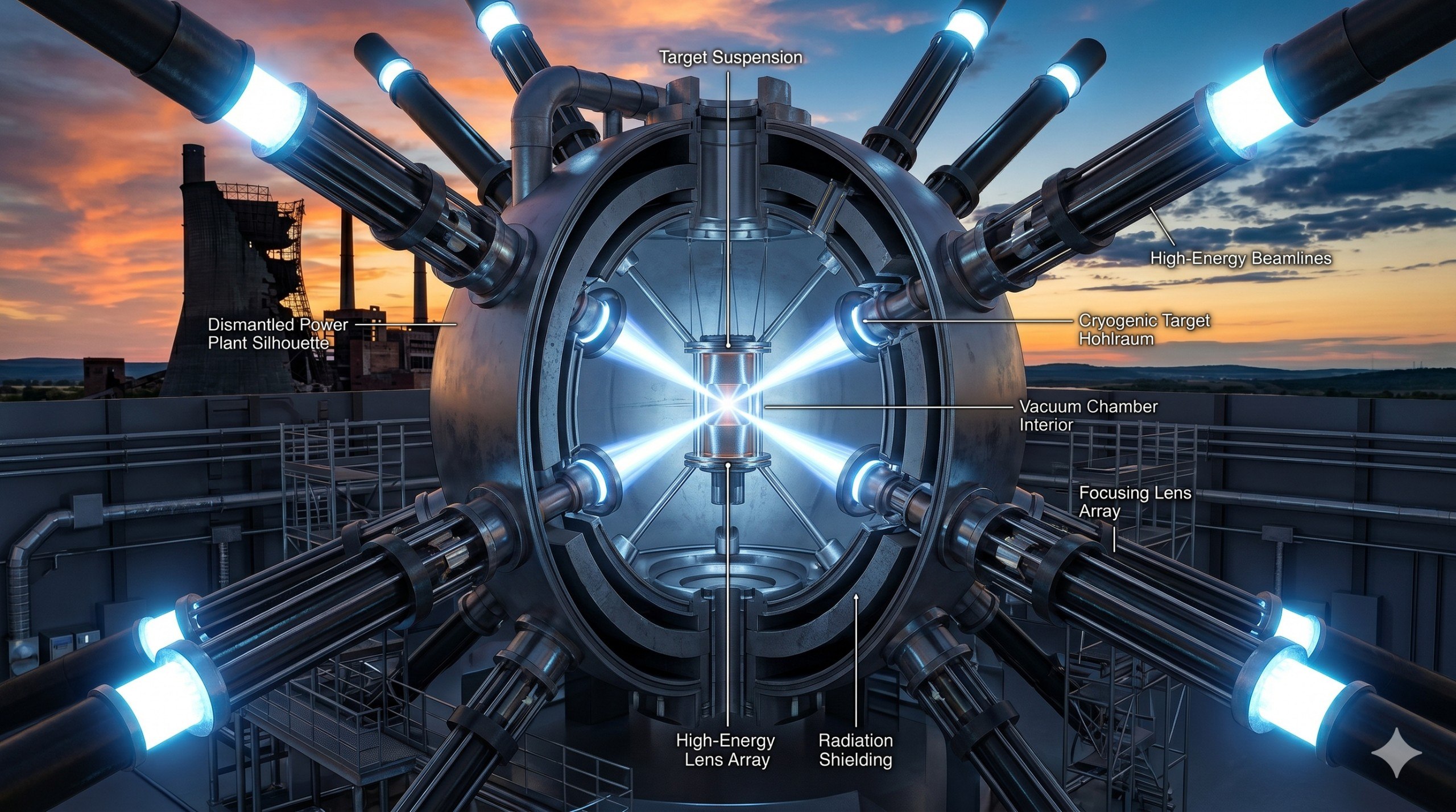
On June 10, 2026, the U.S. Department of Energy (DOE) formally approved XCimer Energy's Athena fusion power plant preconceptual technical design. The 724-page submission provided a detailed assessment of plant performance targets, economics, system-level engineering requirements, safety and environmental analyses, and technology development pathways required to achieve commercial fusion power. The milestone for the Denver-based startup marks official recognition that laser inertial confinement fusion — long confined to national laboratory experiments — is being taken seriously as a pathway to commercial power generation.
Athena: Designed for Industrial Scale from Day One
XCimer Energy's Athena plant architecture differs fundamentally from the mainstream tokamak and stellarator approaches. Athena integrates the company's proprietary excimer laser platform with target delivery systems, a fusion chamber, tritium breeding, and power generation systems engineered from the outset for continuous industrial-scale operation.
Alexander Valys, XCimer's co-founder and president, told ANS Nuclear Newswire: "NIF proved laser fusion physics works. Our thesis is that commercial laser fusion becomes possible only if the laser system itself becomes dramatically simpler, cheaper, and more manufacturable." XCimer's electron-beam-pumped gas laser design "targets laser cost reductions by two orders of magnitude."
Key Athena design parameters include a repetition rate of up to 1 Hz (one fusion ignition per second) and a liquid wall fusion chamber — a stark contrast to the National Ignition Facility's solid-state glass lasers with 192 beamlines operating as a scientific experiment. XCimer's system uses just two beamlines, achieving efficient energy conversion through excimer laser technology.
The Liquid Wall Chamber: XCimer's Core Technology Moat
Athena's most critical innovation is its liquid wall chamber design. Susana Reyes, Ph.D., Vice President for Chamber and Plant Design at XCimer Energy, explained: "A commercially attractive power plant looks very different from a scientific breakthrough facility. We are designing Athena to run continuously at a repetition rate of up to 1 Hz, and the use of a liquid wall chamber maximizes availability by protecting solid structures from the fusion reaction emissions over the entire plant lifetime."
She further noted: "One reason other fusion chamber designs face a durability problem is that they put solid material where the fusion neutrons go. We don't. The molten salt curtain absorbs and moderates the flux, breeds fuel, and carries the heat — and it flows, so it renews itself continuously. We designed Athena around that property from day one, and it shapes everything: the materials choices, the thermal management, the maintenance philosophy, the economics."
This liquid wall design addresses a core long-standing engineering challenge: 14 MeV high-energy neutron radiation damage to structural materials. In conventional solid-wall designs, cumulative neutron flux causes material embrittlement and failure over time, limiting plant lifespan and availability. XCimer's liquid wall uses a continuously flowing molten salt curtain to absorb and moderate the neutron flux, isolating structural materials from the neutron source and dramatically extending critical component lifetimes.
From NIF to Commercialization: The Gap and the Path
In December 2022, Lawrence Livermore National Laboratory's National Ignition Facility achieved the first inertial confinement fusion net energy gain (Q>1), proving laser fusion physics works. However, NIF is a multi-billion dollar research facility using 192 solid-state glass laser beamlines, capable of only a few ignition experiments per day — a vast gulf from commercial power generation requirements.
XCimer's commercialization thesis rests on three key differentiators:
First, laser efficiency and cost. NIF's solid-state glass laser system achieves approximately 0.5-1% efficiency with extremely high cost per joule of laser energy. XCimer's electron-beam-pumped excimer laser has a theoretical efficiency of 5-10%, and because it uses a gaseous medium, manufacturing costs are far lower than solid-state systems. The company targets laser costs below 1% of NIF's system.
Second, ignition repetition rate. NIF manages only a few shots per day, while Athena targets 1 Hz — 86,400 ignitions per day, the parameter regime required for commercial power generation.
Third, chamber durability. NIF's chamber requires hours of cooling and maintenance after each shot. Athena's liquid wall chamber is designed for continuous operation, with the molten salt curtain automatically renewing after each ignition without shutdown.
The Resurgence of Inertial Confinement Fusion
XCimer's milestone arrives amid a broader revival of inertial confinement fusion (ICF) commercialization efforts. Several other companies are pursuing distinct ICF pathways:
First Light Fusion (UK) takes a projectile fusion approach, using gas guns to accelerate projectiles striking deuterium-tritium fuel targets to create shock compression for ignition. The company achieved a scientific breakthrough in 2024 and is developing a demonstration plant.
Marvel Fusion (Germany) pursues ultra-short-pulse laser fusion, focusing on aneutronic fuel cycles (hydrogen-boron-11) to avoid neutron irradiation issues. The company has established a joint research laboratory with the Colorado School of Mines.
Longview Fusion Energy Systems follows a direct-drive laser approach similar to NIF's architecture but targets cost reduction through engineering simplification to commercially viable levels.
Compared to magnetic confinement fusion (MCF) approaches (CFS, Helion, TAE), ICF's advantages include no need for superconducting magnets, less demanding plasma stability requirements, and higher modularity. However, ICF faces unique challenges: target manufacturing cost and precision, laser repetition rate and lifespan, and ignition energy gain reliability.
DOE's Fusion Strategy and XCimer's Next Steps
DOE's approval of the Athena design marks completion of XCimer's first 18-month budget period under the milestone program. The company says its next phases include full-scale subsystem testing, engineering validation, and preparation for an integrated plant demonstration.
Conner Galloway, XCimer's CEO and Chief Science Officer, stated: "The question facing laser fusion is no longer whether the physics works. The question is how fast we can industrialize it. DOE's acceptance of Athena reflects both the strength of our technical approach and our ability to execute against an ambitious commercialization roadmap."
DOE's fusion strategy is undergoing a major transformation. In June 2026, the DOE released its latest fusion strategy targeting commercial fusion power by the 2030s. Beyond XCimer, CFS (ARC tokamak), Helion (field-reversed configuration), and TAE (field-reversed configuration) also operate under DOE support. The DOE's fusion program is shifting from single-pathway betting to a multi-pathway parallel support strategy, reflecting pragmatic acknowledgment of the uncertainty around which fusion pathway will first achieve commercial viability.
Observatory Analysis
XCimer's DOE milestone matters not just for the technology itself but for what it represents: the diversification of fusion energy pathways. Over the past five years, magnetic confinement fusion — particularly CFS's SPARC/ARC approach — has attracted the vast majority of funding and media attention. XCimer's success demonstrates that inertial confinement fusion, reinvigorated by NIF's 2022 breakthrough, has a similarly clear path to commercialization.
From an investment perspective, XCimer's technical approach carries a distinct risk-reward profile. Advantages include a relatively clear industrialization pathway for laser technology (overlapping with semiconductor manufacturing equipment supply chains) and a liquid wall design solving the core material durability challenge. Challenges include the need to validate target positioning and ignition consistency at 1 Hz repetition rates, and the requirement to prove molten salt circulation system reliability at megawatt scale.
Notably, XCimer is pursuing a fundamentally different path from Helion and CFS. Helion pursues compact field-reversed configurations with a unique helium-3 fuel cycle; CFS follows the high-field tokamak approach. This multi-pathway coexistence is not a weakness of the fusion sector but a healthy exploration of options — because we still do not know which pathway will first reach commercial viability.
Disclaimer: The information in this article is for reference only and does not constitute investment advice or business decision-making basis. Data and time-sensitive information are accurate as of publication date and may change with subsequent developments. Neither the author nor POC.HK accepts liability for any losses resulting from the use of this information.