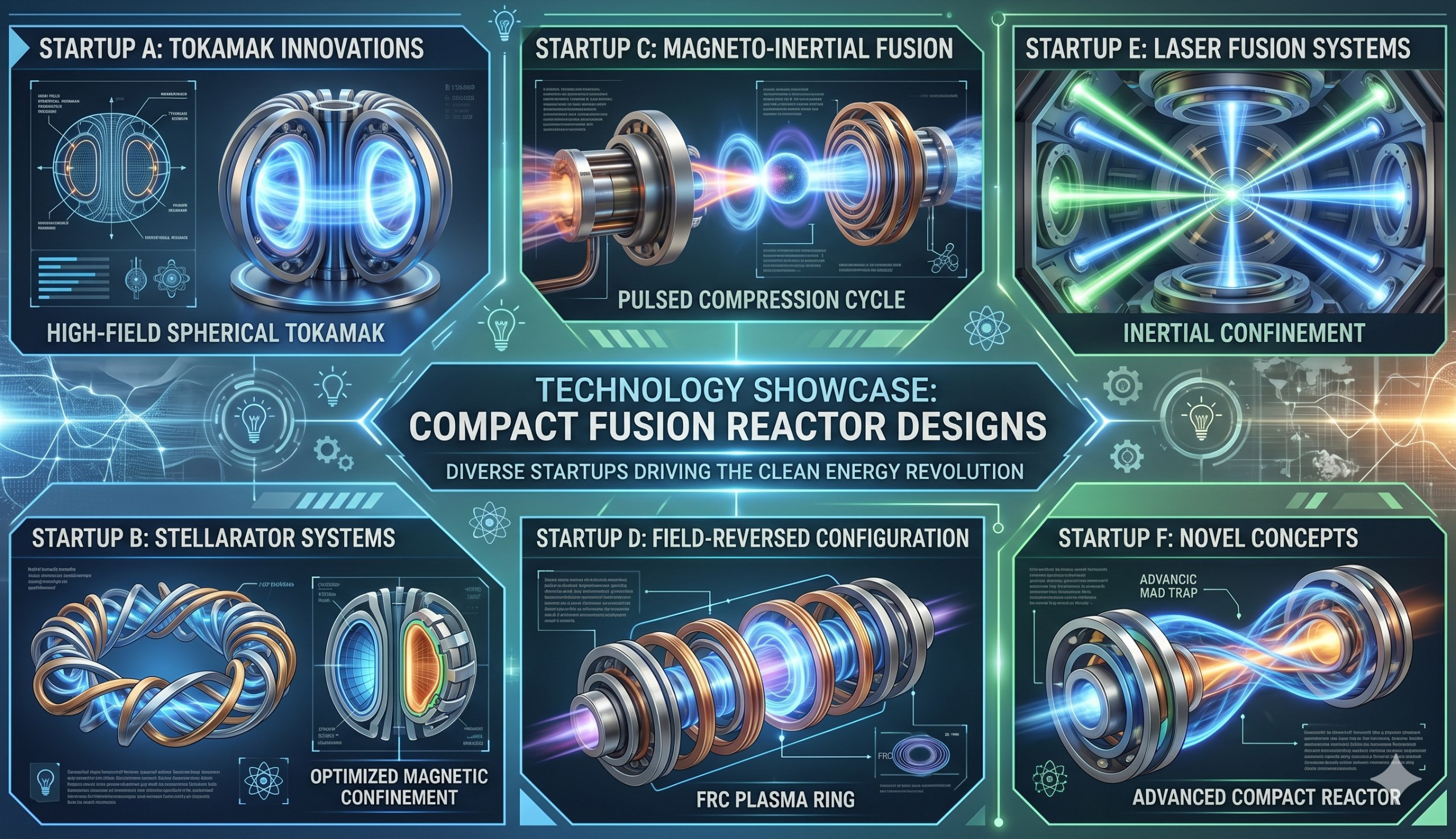
The global nuclear fusion industry is undergoing a quiet structural transformation. Over the past two years, public attention has focused on flagship devices such as SPARC, Polaris, and ITER. But a deeper shift is taking place — fusion is moving from a "device race" toward an "ecosystem competition."
Signals of Divergence at the Device Level
CFS completing all 18 toroidal field magnet coils for SPARC is undoubtedly a major technical milestone. The ability to mass-produce HTS magnets operating at 20 tesla has been validated, progressively unlocking the engineering feasibility of the tokamak pathway. However, the Observatory notes that SPARC's success does not equate to ARC's (its commercial successor) success. A vast engineering gulf lies between a device and a power plant — thermal management, tritium breeding, and continuous operation are challenges that SPARC's pulsed operation will not expose.
Meanwhile, ITER's management restructuring reveals deeper structural problems inherent in international collaboration projects. The coordination of seven member parties' interests, supply chain fragmentation, and governance efficiency are fundamentally at odds with the agile development models of private companies. The Observatory believes that ITER's experience is reshaping our understanding of large-scale scientific projects: when the technology itself is at the boundary, management complexity can become a bottleneck rather than a catalyst.
The Lessons of Japan's Strategy
Japan's ¥500 billion national fusion strategy deserves deeper interpretation. Unlike the purely private-driven US model or the government-dominated European approach, Japan has chosen a hybrid path — continuing support for the JT-60SA tokamak while establishing a dedicated fund for private fusion startups. This dual-track model of "national facility plus private incubation" may prove to be the optimal balance between risk and progress.
Crucially, Japan's strategy explicitly targets the 2040s — significantly more conservative than the timelines claimed by Helion and CFS. This difference in time scale is not about varying degrees of technological optimism; it reflects fundamentally different understandings of what fusion industrialization requires. Fusion is not merely a scientific problem — it is a problem of supply chains, standardization, and regulatory architecture, none of which can be solved in five years.
What the Talent Market Tells Us
Fusion engineer salaries rising 25% in 18 months, with job vacancies growing 40% — these figures tell us two things. First, private capital injection is creating real demand. Second, fusion is transitioning from a "physics problem" to an "engineering problem." When salary growth concentrates among HTS magnet engineers and plasma control software developers rather than theoretical physicists, it signals that the industry has passed the proof-of-concept stage and entered the engineering implementation phase.
Divergent Regulatory Paths
The United States, United Kingdom, and China are moving toward different regulatory models: the US is decoupling fusion from fission in regulatory terms; the UK is establishing a regulatory sandbox; China is issuing guideline frameworks. The Observatory believes that the US decoupling path has the most far-reaching implications — it fundamentally changes fusion's regulatory classification, providing private enterprises with a predictable approval pathway. The UK's sandbox model, while flexible, is difficult to scale. China's guideline framework reflects its characteristic cautious pilot approach.
Forward Outlook
Over the next 12-18 months, the fusion industry presents three key observation points:
-
The device-to-plant leap: SPARC and Polaris results will validate their respective technical approaches, but the critical factor is how each company designs the engineering pathway from device to power plant
-
Capital structure transition: As companies like Type One Energy close Series C rounds, fusion investment is shifting from venture capital to institutional capital — bringing different return expectations and timeline pressures
-
Supply chain formation: Industrial-scale HTS magnet production, tritium management infrastructure, standardized plasma diagnostics equipment — these factors will determine when the industry genuinely commercializes, far more than any single device's ignition moment
The commercialization of nuclear fusion will not begin with a dramatic headline event. It will happen quietly, through the gradual formation of an ecosystem. When supply chains, regulatory frameworks, talent reserves, and capital structures are all in place, a device's success will shift from "breakthrough" to "inevitability."
Disclaimer: This article is an original analysis by POC.HK Future Technology Observatory. It is for reference only and does not constitute investment advice. Fusion technology remains under development; actual developments may differ from the assessments herein.