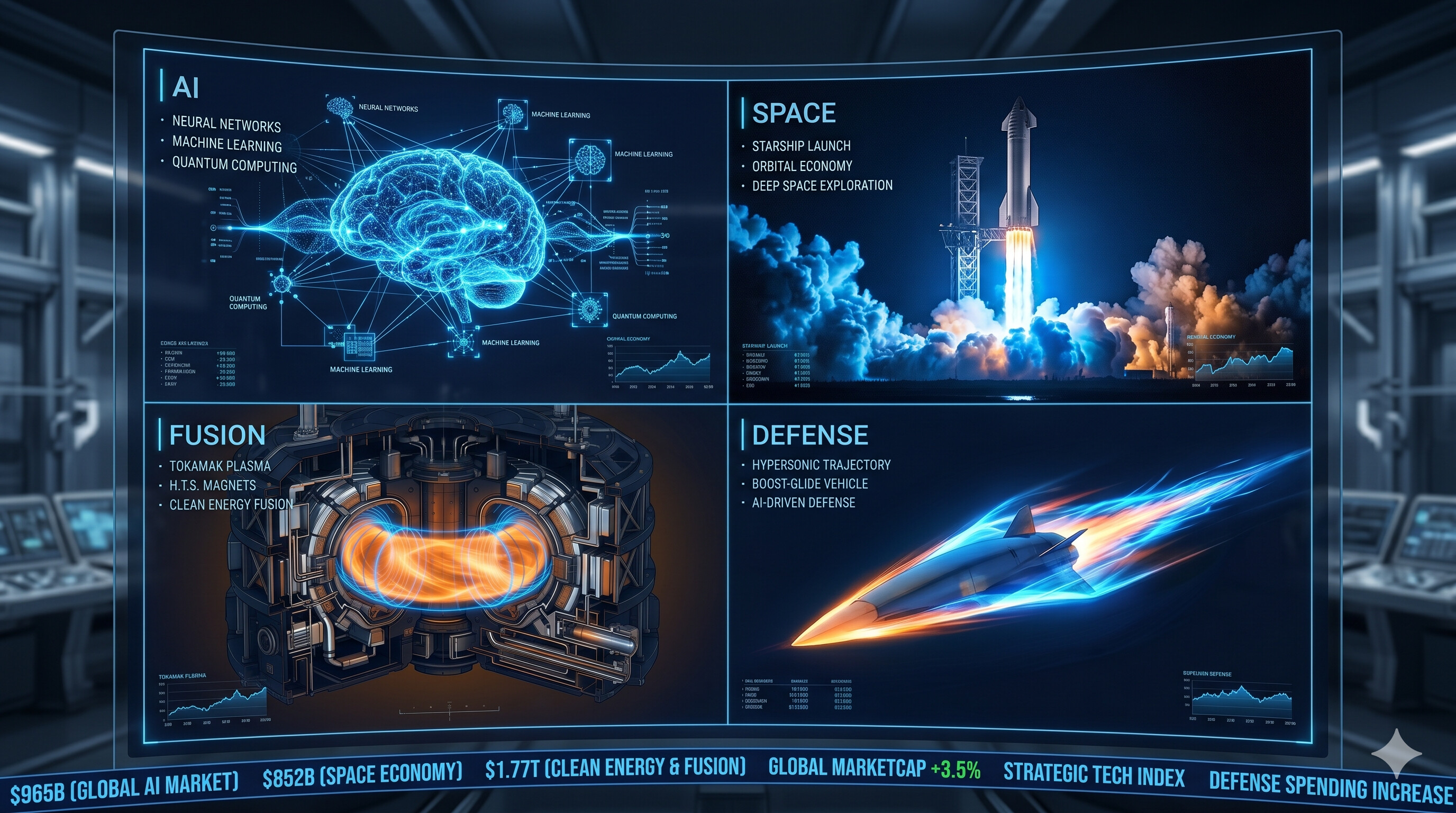
POC.HK Future Technology Weekly Digest #2 — Week 2 of June 2026
The week of June 4 to June 10, 2026 witnessed the largest capital markets event in technology history: Anthropic and OpenAI both filed for IPOs within a week of each other, joined by SpaceX's $1.77 trillion public offering process. The convergence of these three mega-IPOs is reshaping how global capital markets price the technology sector. Meanwhile, Starship Flight 12 completed the first test of the Block 3 variant, SuperAI Singapore brought 10,000 attendees to Marina Bay Sands, CFS's ARC fusion papers were published in Nature, and the strategic debate over space-based nuclear weapons intensified.
AI & Computing
Anthropic Files for IPO at $965 Billion Valuation
On June 1, Anthropic confidentially submitted an S-1 registration statement to the SEC at a $965 billion valuation, targeting a Nasdaq listing as early as fall 2026. This valuation makes Anthropic the highest-valued AI startup in history, surpassing OpenAI's $852 billion record set in March 2026.
Anthropic's IPO filing reveals astonishing growth: as of May 2026, the company's annualised revenue run rate reached $47 billion — nearly quintupling its $10 billion ARR at the end of 2025. This growth is primarily driven by rapid enterprise adoption of its flagship models, Claude 4 Opus and Fable 5. Anthropic signed multiple enterprise contracts exceeding $1 billion each in Q1 2026, with clients spanning financial services, healthcare, and government sectors.
The timing of Anthropic's IPO is notable. The company had just completed a $65 billion Series H round in late May at a $965 billion post-money valuation — and filed for IPO just one week later. This suggests the Series H round functioned as a pre-IPO valuation anchor rather than being driven by capital needs.
OpenAI Follows with $852 Billion IPO Filing
On June 8, OpenAI also submitted a confidential S-1 to the SEC at an $852 billion valuation, targeting a September 2026 Nasdaq listing with Goldman Sachs and Morgan Stanley as lead underwriters. OpenAI aims for a public market valuation exceeding $1 trillion.
OpenAI's filing shows Q1 2026 revenue of approximately $8 billion, primarily from ChatGPT subscriptions (~45%) and API services (~40%). The company continues to operate at a loss — approximately $12 billion net loss in 2025 — but management's filing emphasises that new pricing models based on reasoning (o3-pro at $0.15/1K tokens) are improving unit economics.
Notably, OpenAI chose to file just one week after Anthropic, creating a rare "dual IPO" landscape in the AI sector. Both companies will face direct investor comparison in the public market — Anthropic's safety-first positioning and enterprise focus versus OpenAI's consumer brand advantage and ecosystem breadth.
AI IPO Market Impact
The simultaneous IPOs of Anthropic and OpenAI are producing profound effects on global capital markets. Their combined valuation exceeds $1.8 trillion. Together with SpaceX's $1.77 trillion IPO, three technology companies will absorb over $300 billion from public markets in the second half of 2026, creating a significant crowding-out effect on other technology sectors.
From a regulatory perspective, Anthropic's choice to register as a Public Benefit Corporation (PBC) is a signal — it legally obligates the company to balance shareholder interests with public benefit, particularly regarding AI safety. This contrasts with OpenAI's controversial history of transitioning from non-profit to for-profit status.
Other AI Developments
SuperAI Singapore 2026 Sold Out: Held June 10-11 at Marina Bay Sands, Asia's largest AI conference attracted 10,000 attendees from over 150 countries. Key discussions included AI ecosystem restructuring following DeepSeek V4-Flash's open-source release, Southeast Asian AI infrastructure buildout, and Asian pathways for AI regulation. Singapore is actively positioning itself as an Asian AI regulatory and commercial hub, attracting Google, Microsoft, and Anthropic to establish regional AI research centres.
Tech Stock Correction and AI Capital Rotation
On June 5, the Nasdaq fell 4%, ending the S&P 500's nine-week winning streak. Analysts attributed the correction to capital rotation driven by the AI IPO frenzy — investors reduced positions in existing tech giants (NVIDIA, Microsoft) to reserve funds for upcoming AI IPOs. This is a classic "sell the news" event, but its magnitude reflects the AI IPO's influence on market structure.
Notably, NVIDIA announced a major upgrade to its Physical AI strategy in early June — partnering with Unitree to integrate the Omniverse platform into Unitree's humanoid robots. The Physical AI ETF (KOID) surged 6.2% on the day of the announcement. Unitree, as NVIDIA's key partner in the Chinese market, is filling the niche left by Figure AI and Tesla Optimus outside China.
Quantinuum Goes Public
On June 4, Honeywell-backed Quantinuum listed on Nasdaq under ticker QNT at a $15.7 billion market cap, raising $1.68 billion — the largest IPO in the quantum computing industry to date. Quantinuum's trapped-ion technology leads the industry in qubit fidelity and logical qubit error correction. (See today's standalone analysis.)
Space Exploration
Starship Flight 12: First Block 3 Test, Booster Lost
On May 22 (event occurred late last week but impact resonated through this week), SpaceX conducted its 12th Starship test flight from Starbase's second launch pad, debuting Block 3 vehicles (Ship 39 and Booster 19). While the ship achieved its planned trajectory, the Super Heavy booster lost control during return and failed to execute the planned Gulf of Mexico water landing.
Key Block 3 upgrades include improved heat shield design, enhanced avionics, and increased propellant capacity. Ship 39 successfully completed a propellant transfer test during flight — a critical technology demonstration for future orbital refuelling missions. While the booster loss is disappointing, SpaceX's testing philosophy remains "iterate fast, learn from failure," similar to the rapid fix cycles between Flights 7 and 8.
Following Flight 12, SpaceX will shift focus to Flight 13 preparations, expected to attempt orbital insertion for the first time. Success would mark Starship's first orbital velocity achievement, paving the way for large-scale Starlink V3 deployment.
MBRYONICS Space Optical Communications Breakthrough
On June 9, Irish company MBRYONICS unveiled STARLIGHT, the world's first 25-800G bidirectional coherent optical transceiver for space. The product targets LEO satellite constellations and orbital AI data centres, marking the first complete migration of terrestrial coherent optical technology to the space environment. (See today's standalone analysis.)
Roman Space Telescope Set for August 30
In early June, NASA confirmed the Nancy Grace Roman Space Telescope's launch date of August 30, 2026 — eight months ahead of the previously committed "no later than May 2027" timeline. Roman's field of view is 100 times larger than Hubble's, and it will observe billions of galaxies over five years. (See today's standalone analysis.)
Space Nuclear Weapons Debate Intensifies
On June 9, The Hill published an op-ed titled "Is America Ready for a Nuclear Explosion in Space?" sparking widespread discussion. The article argues that Russia's nuclear-powered anti-satellite weapons programme and China's SC-19 ASAT system are pushing space militarisation to a new level. UN PAROS (Prevention of an Arms Race in Outer Space) negotiations remain stalled, while the US National Security Council is reviewing a new space deterrence strategy including active defence satellites and space situational awareness sharing partnerships.
Energy
CFS ARC Papers Published in Nature
On June 8, Commonwealth Fusion Systems' five peer-reviewed papers on the ARC fusion reactor were published in Nature and related journals. The papers detail ARC's plasma physics design, including core confinement, heating systems, stability control, snowflake divertor, and alpha particle heating. This marks the first time a commercial fusion company's design has passed peer review in a top-tier academic journal.
CFS's ARC targets 400 MW net electricity generation by the early 2030s, with total investment estimated at $3-5 billion — a stark contrast to ITER's $25 billion cost and post-2035 timeline. (See today's standalone analysis.)
Fusion Startup Funding Trends
This week, Fast Company published an interview with Troy Carter, Oak Ridge National Laboratory's fusion energy director. Carter noted that fusion startups raised over $8 billion globally in venture funding from 2023-2025, but "having abundant funding doesn't mean technology is mature." He warned that the biggest obstacle to fusion commercialisation has shifted from plasma physics to engineering materials and supply chains — particularly HTS tape production capacity and neutron irradiation effects on structural materials.
Defense Technology
Space Nuclear Weapons: A New Strategic Frontier
This week's discussions on space nuclear weapons reflect a strategic inflection point: the Cold War-era Outer Space Treaty (1967) bans weapons of mass destruction in orbit but imposes no effective constraints on anti-satellite weapons, nuclear-powered space systems, or ground-launched ASATs. Russia's latest nuclear-powered satellite programme and China's ASAT tests are challenging this legal framework.
The US Space Force released a new threat assessment in Q2 2026, ranking "nuclear-powered anti-satellite systems" as the highest-level threat. The assessment states that a nuclear weapon deployed in LEO could destroy hundreds of satellites simultaneously through electromagnetic pulse (EMP), with effects covering an entire orbital altitude layer.
Meanwhile, Russia's Ministry of Defence released footage in early June of Poseidon-2 nuclear-powered unmanned underwater vehicle testing in Arctic waters. The US Department of Defense expressed "serious concern" and announced enhanced underwater surveillance cooperation with Nordic nations (Norway, Sweden, Finland), deploying new anti-submarine sonar arrays along the Greenland-Iceland-UK (GIUK) gap.
Macro Theme This Week: The AI IPO Supercycle
The first week of June 2026 may be the most important week in technology financial history. Anthropic ($965B), OpenAI ($852B), and SpaceX ($1.77T) — three companies advancing their IPOs nearly simultaneously, with a combined valuation exceeding $3.5 trillion. This is not just a capital markets event but a signal of structural industry transformation.
What unites these three companies is that each represents a paradigm inflection point — Anthropic and OpenAI embody AI's transition from laboratory technology to commercial infrastructure, while SpaceX represents space's transition from government monopoly to commercial market. Public markets will provide capital and pricing mechanisms for these transitions, but will also impose quarterly earnings pressure.
For investors, the question is not just "which one to buy" but the valuation impact on existing tech giants (Microsoft, Google, Amazon). If AI-native startups can command higher growth premiums in public markets than mature tech giants, we will witness a historic capital shift from FAANG to AI-native companies.
Key Data This Week
| Metric | Data | Source |
|---|---|---|
| Anthropic IPO Valuation | $965B | SEC S-1 |
| Anthropic Annualised Revenue | $47B (May 2026) | Fortune |
| OpenAI IPO Valuation | $852B | SEC S-1 |
| OpenAI Q1 Revenue | ~$8B | S-1 Filing |
| SpaceX IPO Valuation | $1.77T | CNBC |
| Starship Flight 12 | Block 3 debut, booster lost | SpaceX |
| SuperAI Singapore Attendance | 10,000 | SuperAI |
| CFS ARC Target | 400MW net, early 2030s | Nature |
| Roman Telescope Launch | August 30, 2026 | NASA |
| Nasdaq Weekly Decline | -4% (June 5) | Investopedia |
Next Week's Watchlist
- Initial reactions to Anthropic / OpenAI IPO roadshows
- SuperAI Singapore conference highlights summary
- Starship Flight 13 preparation progress (orbital target)
- Roman telescope pre-launch final testing
- UN PAROS space arms control negotiations
- CFS SPARC first plasma timeline update