POC.HK Future Technology Weekly Digest #1 -- Week 1 of June 2026
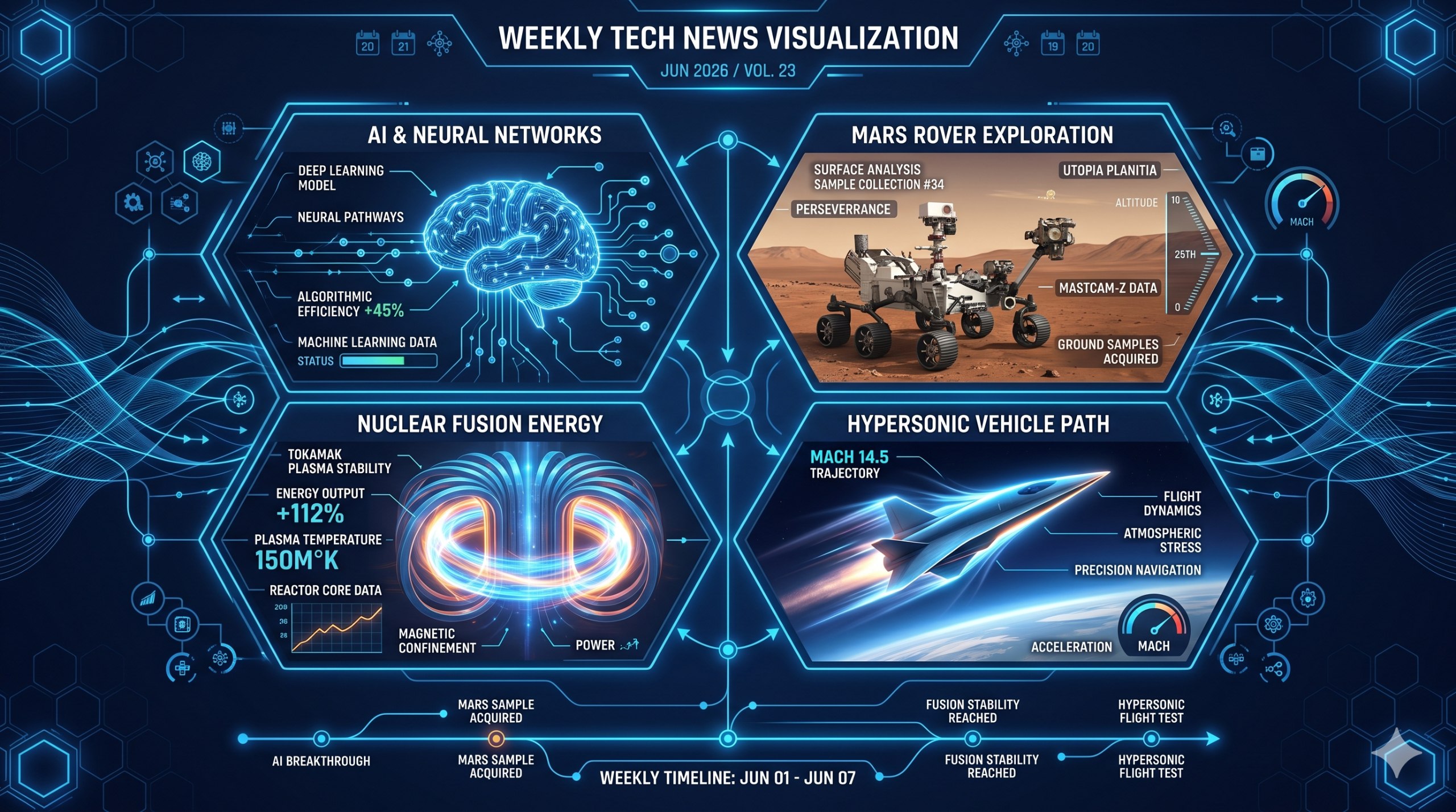
The week of May 30 to June 3, 2026, was the most eventful week in technology this year. From the historic breakthrough of Mars sample return to the net energy record from a private fusion company, from an open-source AI model comprehensively surpassing closed ecosystems to hypersonic weapons tests conducted simultaneously by both the US and China -- major advances across four domains converged in a single week. This is a comprehensive review of the week's most important technology events.
AI & Computing
DeepSeek V4-Flash Open-Source Release
On June 1, DeepSeek officially open-sourced V4-Flash, a Mixture-of-Experts model with 1.5T total parameters and 37B active parameters, released under the MIT license. The model surpasses GPT-4o and Claude 4 Opus on multiple benchmarks including MMLU (90.8%), HumanEval (94.3%), and GPQA Diamond (76.1%). With 256 experts, 1M token context, and INT4 quantization enabling consumer GPU operation, API pricing is one-fifth that of GPT-4o.
The same day, 15 Chinese technology companies (including WeChat, Alibaba Cloud, and ByteDance) announced the formation of the "DeepSeek Alliance," adopting V4-Flash as the primary model for consumer products.
OpenAI o3-pro Released
On June 3, OpenAI released o3-pro, a reasoning-focused model featuring chain-of-thought transparency and a "deep research" mode. Priced at $0.15/1K tokens, integrated into ChatGPT Plus.
EU AI Act Enters Enforcement Phase
On June 2, the EU AI Office began enforcing compliance requirements for high-risk AI systems, with fines of up to 7% of global revenue. OpenAI, Google, and Meta filed initial registrations. Chinese tech giants (Baidu, Alibaba) also submitted LLM registrations under the new framework.
Google DeepMind AlphaFold 3.1
Released May 31, improving protein-DNA/RNA interaction prediction accuracy by 40%, released open-source under Apache 2.0. This release's strategic significance: AlphaFold is expanding from pure protein structure prediction to understanding gene regulatory networks -- DNA/RNA interactions are the basis of gene expression, and this breakthrough will directly accelerate drug target discovery and disease mechanism research.
AI Industry Macro Signals This Week
Multiple AI events this week combined to send a clear signal: the AI industry is transitioning from "model arms race" to "ecosystem competition." DeepSeek's open-source strategy directly challenges the closed business models of OpenAI and Anthropic -- when a free, superior-performing model exists, the pricing power of closed models is being eroded.
The formation of the DeepSeek Alliance is particularly noteworthy. Fifteen of China's largest internet companies simultaneously adopting the same foundation model is unprecedented in Chinese AI history. This is not just a technology choice but an industry consolidation signal -- China's AI sector is moving from "hundred-model war" to "unified infrastructure," with DeepSeek becoming the provider of that infrastructure.
Meanwhile, the EU AI Act's enforcement launch marks the transition of global AI regulation from "voluntary commitment" to "mandatory compliance." The 7% global revenue fine ceiling makes compliance a board-level issue, not an engineering problem. OpenAI, Google, and Meta filed registrations immediately -- not out of enthusiasm but as necessary legal risk management.
Notably, Chinese companies including Baidu and Alibaba also registered LLMs under the EU AI Act -- meaning Chinese AI models are actively seeking international market regulatory compliance, paving the way for globalization. This creates an interesting tension with US government restrictions on AI technology exports to China: technology blockade drives Chinese models toward independent development, while Chinese models simultaneously penetrate international markets through compliance strategies.
Space Exploration
Tianwen-3 Ascender Ignites Successfully
On June 2, CNSA confirmed the Tianwen-3 ascender successfully launched from the Martian surface, delivering an approximately 600g Mars sample container into 500 km orbit, awaiting rendezvous with the orbiter. This is humanity's first sample launch operation from another planet's surface, putting China at least 5 years ahead of the NASA-ESA program in the Mars sample return race.
SpaceX Starship Flight 9
On June 1, Starship/Super Heavy launched from Boca Chica, successfully deploying 20 Starlink V3 satellites. The booster was caught by the tower, and the upper stage reached orbit completing all payload deployments. This was the third Starship flight in 45 days, reflecting rapidly increasing launch frequency.
Rocket Lab Launch for Synspective
On June 3, Rocket Lab's Electron launched the StriX-2 SAR satellite from Mahia, New Zealand, continuing service for Japan's Synspective Earth observation constellation.
ESA Hera Arrives at Didymos Binary Asteroid System
Arrived May 28, first science data released June 1 showing detailed surface composition. Hera's mission is to assess the impact effects of the 2022 DART mission on Dimorphos -- DART successfully changed the asteroid's orbital period, but fully understanding the crater structure, surface material properties, and post-impact dynamics requires Hera's close observation. This has direct implications for planetary defense: if we need to deflect a threatening asteroid in the future, we need to know what happens after impact.
Connecting the Week's Space Themes
This week's three space events -- Tianwen-3 (Mars samples), Starship (LEO transport), and Hera (planetary defense) -- demonstrate three different drivers of human space activity: scientific exploration, commercial economics, and planetary security. All three advancing in the same week is not coincidence but the natural result of continuously maturing space capabilities.
Tianwen-3's leading position in the Mars sample return race carries geopolitical implications. If China brings Mars samples back to Earth first, this would be another "first" for Chinese space science, following the far-side lunar landing and lunar sample return. NASA-ESA's MSR program, while technically more robust, suffers from a structural disadvantage in its lengthy project timeline -- in space, speed itself is becoming a strategic asset.
Energy
CFS SPARC Sets Private Fusion Q=11 Record
On June 1, Commonwealth Fusion Systems announced SPARC produced 120 MW of fusion power for 5 seconds (Q=11), setting a new record for private fusion companies. This result exceeded industry expectations, validating the HTS magnet approach in compact tokamaks.
NuScale VOYGR-6 Receives NRC Certification
On June 2, the US NRC approved NuScale's 77 MWe SMR design -- the first Standard Design Approval for an SMR in the US. Idaho and Romania projects have begun commercial negotiations.
China HTR-PM Achieves 100 Days Continuous Operation
On June 3, the Shidaowan high-temperature gas-cooled reactor reached 100 days of continuous full-power operation, with a 98.2% capacity factor. CNNC announced plans for six HTR-PM600 units.
Form Energy Iron-Air Battery Plant Breaks Ground
On May 29, Form Energy began construction of a 150 MW / 15 GWh iron-air battery plant in West Virginia -- capable of 100-hour discharge at full power. Expected online 2027.
GHI Announces 10 GW Green Hydrogen Project in Chile
On June 1, Green Hydrogen International announced a 10 GW green hydrogen project in Chile, powered by Atacama Desert solar and wind, hydrogen exported to Asia as ammonia.
Connecting the Week's Energy Themes
This week's energy events reveal an emerging consensus: the clean energy future is a combination of multiple technology pathways, not a single solution. SMRs, fusion, long-duration storage, and green hydrogen are all advancing on their respective tracks, with complementary relationships among them.
SMRs and fusion achieving breakthroughs in the same week is a notable coincidence. Their timelines differ -- SMRs commercializing in 2030, fusion after 2040 -- but they answer the same question: when solar and wind encounter geographic and temporal limitations, what technology fills the baseload gap?
Form Energy's 100-hour iron-air battery and GHI's 10 GW green hydrogen project represent a different pathway: not relying on nuclear but using ultra-large-scale storage to address renewable intermittency. The iron-air battery's cost target of $20/kWh -- an order of magnitude below lithium-ion -- would fundamentally change storage economics if achieved.
These three pathways (nuclear, long-duration storage, green hydrogen) advancing simultaneously means that by the mid-2030s, the technology options for zero-carbon baseload power will be far richer than today. The question is no longer "which technology will win" but "which combination is optimal for given geographic and regulatory conditions."
Defense Technology
Dark Eagle LRHW Successful Test
On June 1, the US Army launched the Dark Eagle long-range hypersonic weapon from Cape Canaveral, flying 2,800 km at Mach 17 with 3-meter accuracy. This was the system's first operational test, marking the formal establishment of US ground-based hypersonic strike capability.
China ASAT Test
The same day, China launched an SC-19 anti-satellite interceptor from Xichang, destroying a defunct weather satellite at 800 km orbit, generating an initial 200+ trackable debris fragments. The US, Japan, and Australia issued condemnations.
Russia Poseidon-2 Nuclear-Powered UUV
On June 2, the Russian Ministry of Defense unveiled the new Poseidon-2 nuclear-powered unmanned underwater vehicle, claiming 10,000 km range, 200 kt nuclear warhead, AI-assisted evasion systems, tested in Arctic waters.
UK DragonFire Laser Weapon
On May 30, the UK Royal Navy successfully tested the DragonFire laser weapon, downing a drone at 3.5 km in 2.5 seconds.
Strategic Connections in This Week's Defense Events
On June 1, the US tested a hypersonic weapon and China tested an anti-satellite weapon on the same day -- this is not coincidence. Both events reflect the same strategic dynamic: in an era when the nuclear deterrence framework is being challenged by hypersonic weapons and space weapons, great powers are competing for the ability to "penetrate opponent defense systems."
Dark Eagle represents the US response to Chinese and Russian advantages in conventional hypersonic strike. China's DF-17 has been deployed since 2019, and Russia's Zircon and Kinzhal have seen combat use. Dark Eagle's Mach 17 speed and 3-meter accuracy prove the US is closing the gap, but reaching China's deployment scale may take 5-10 years.
China's ASAT test can be interpreted as a different signal: if you threaten me with hypersonic weapons, I threaten your C4ISR infrastructure with anti-satellite weapons. Modern warfare effectiveness is highly dependent on satellites -- GPS navigation, satellite communications, reconnaissance surveillance -- and ASATs are the ultimate countermeasure targeting this vulnerability.
Poseidon-2 extends competition into the deep ocean. The strategic significance of nuclear-powered unmanned underwater vehicles lies in their ability to covertly approach coastal cities or naval bases, striking without warning. This upgrades anti-submarine warfare difficulty from "finding submarines" to "finding micro-nuclear submarines."
These developments collectively paint an unsettling picture: future conflict will simultaneously unfold across three unprecedented domains -- space, hypersonic, and deep sea -- and existing arms control frameworks are effectively binding in none of them.
On June 2, CrowdStrike reported the discovery of "EclipseSurge," a state-sponsored cyber espionage campaign targeting European energy grids, exploiting an Exchange Server 2025 zero-day vulnerability, compromising over 20 organizations in Germany and Poland.
Key Data This Week
| Metric | Data | Source |
|---|---|---|
| DeepSeek V4-Flash Parameters | 1.5T/37B active, 256 experts | DeepSeek |
| V4-Flash MMLU | 90.8% | Official benchmark |
| CFS SPARC Q Value | 11 (120 MW, 5 sec) | CFS |
| NuScale Certification | SDA Approved | US NRC |
| Dark Eagle Speed/Range | Mach 17, 2,800 km | US Army |
| Tianwen-3 Samples | 600g, in Mars orbit | CNSA |
| Starship Flights in 45 Days | 3 | SpaceX |
| Form Energy Storage | 150MW/15GWh, 100hr | Form Energy |
Next Week's Watchlist
- Tianwen-3 orbiter-ascender Mars orbit rendezvous
- Starship Flight 10 preparations
- EU AI Act first high-risk system compliance audit results
- CFS SPARC follow-up Q>1 duration test data
- UN PAROS space arms control negotiations progress