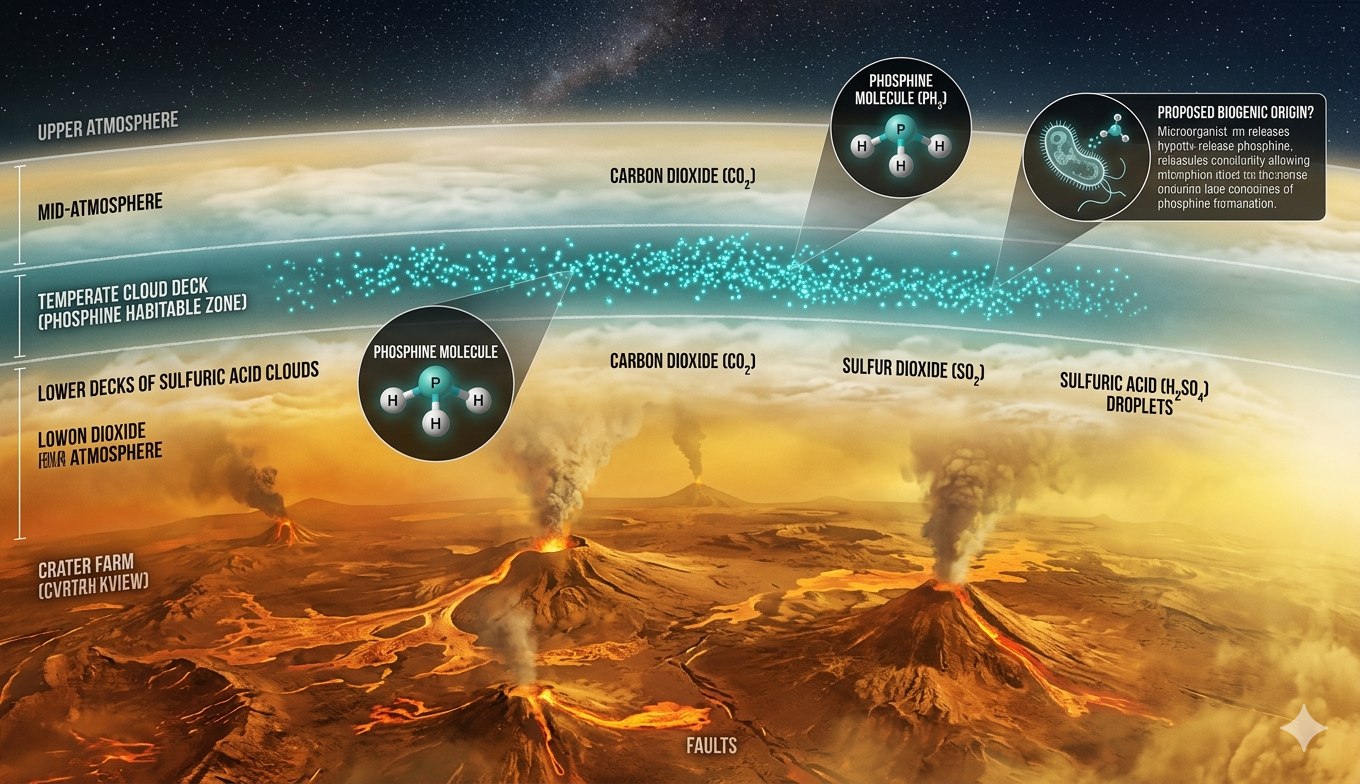
Venus Life Detection: The Phosphine Mystery — Scientific Reasoning and a New Wave of Exploration
In September 2020, a team led by Professor Jane Greaves published a paper in Nature Astronomy that shocked the astronomical community: phosphine (PH₃) had been detected in Venus's atmosphere — a gas that on Earth is almost exclusively produced by anaerobic microorganisms in oxygen-free environments. The discovery sparked years of intense debate, with critiques covering everything from data processing methods to non-biological production mechanisms. In 2026, after multiple independent telescope verification observations and new chemical model analyses, the presence of phosphine in Venus's atmosphere has been largely confirmed, but its origin remains one of the greatest unsolved mysteries in science.
Accumulation of Observational Evidence
Between 2024 and 2026, four independent observatories conducted high-resolution spectroscopic observations of the Venusian atmosphere: the James Clerk Maxwell Telescope (JCMT) in Hawaii, the Atacama Large Millimeter/submillimeter Array (ALMA) in Chile, the Royal Observatory Greenwich, and NASA's Stratospheric Observatory for Infrared Astronomy (SOFIA). These observations consistently detected phosphine absorption features at an altitude range of approximately 55 to 60 km in the Venusian atmosphere — where atmospheric temperatures are approximately 25°C to 30°C and pressure is about 0.5 Earth atmospheres.
The most compelling data came from ALMA's long-integration observations in 2025, with a signal-to-noise ratio approximately 10 times higher than the initial 2020 detection. ALMA not only confirmed phosphine's presence (abundance approximately 20 parts per billion, or 20 ppb) but also mapped its vertical and horizontal distribution in the atmosphere for the first time. Phosphine concentration is highest near the Venusian terminator and lowest on the noon-side — a distribution pattern inconsistent with atmospheric photochemical model predictions. If phosphine originated entirely from abiotic processes (such as volcanic eruptions or lightning), its distribution would be expected to be more uniform.
The Abiotic Source Debate
The abiotic alternative explanations for phosphine have been the core of the past five years' debate. Main hypotheses include: volcanic activity releasing mantle phosphides reacting with sulfuric acid to produce phosphine; lightning-triggered chemical reactions in the atmosphere generating phosphine; and products of ultraviolet-induced photochemical reactions. However, a comprehensive chemical kinetics simulation study published in 2025 — conducted by a French National Centre for Scientific Research (CNRS) team — showed that known abiotic processes can produce at most approximately 1 to 2 ppb of phosphine, far below the observed 20 ppb. This means either unknown chemical processes exist or there is a biological source.
Another intriguing clue is the anomalous distribution of ammonia (NH₃) and sulfur dioxide (SO₂) simultaneously detected in the Venusian atmosphere. On Earth, ammonia is a common metabolic byproduct. A Massachusetts Institute of Technology (MIT) astrobiology team proposed a hypothesis called the "aerial biosphere" in 2025: microorganisms similar to bacteria in Earth's atmosphere may exist in Venus's middle atmosphere, suspended within sulfuric acid droplets. These microorganisms might use ultraviolet light as an energy source, carrying out metabolism inside neutralized droplets, producing phosphine and ammonia as byproducts.
Specific Exploration Mission Plans
To directly answer the Venus phosphine mystery, both NASA and ESA have approved Venus exploration missions, completing detailed payload configurations in 2025.
NASA's DAVINCI+ (Deep Atmosphere Venus Investigation of Noble gases, Chemistry, and Imaging) mission is planned for launch in 2029, arriving at Venus in mid-2030. The mission's core is a probe sphere approximately 1 meter in diameter that will descend directly through the Venusian atmosphere, continuously sampling and analyzing atmospheric composition between approximately 45 and 65 km altitude. DAVINCI+ carries an instrument suite called the Venus Mass Spectrometer (VMS), capable of detecting organic molecules, biomarkers, and noble gases at parts-per-billion (ppb) sensitivity. The mission's uniqueness lies in being the first to conduct in-situ chemical analysis directly within Venus's atmosphere since the Soviet Vega missions in the 1980s.
ESA's EnVision mission is planned for launch in 2028, entering orbit in 2029. EnVision carries a synthetic aperture radar (SAR) and an infrared spectrometer, which will map the Venusian surface at high resolution from orbit while detecting the three-dimensional distribution of atmospheric trace gases. Its infrared spectrometer can map phosphine and other potential biomarkers at higher spatial resolution — approximately 5 km — helping to identify their source regions.
Notably, private companies are also actively participating. Rocket Lab plans to launch its first Venus exploration mission — the "Venus Life Signal Mission" (VLS) — in late 2026 or early 2027. The mission will use Rocket Lab's Photon satellite platform carrying asmallprobe, targeting the detection of organic molecules and phosphine concentration gradients in Venus's middle atmosphere. VLS's total cost is approximately $10 million to $15 million — one-hundredth to one-thousandth of traditional space mission costs — exemplifying the low-cost exploration model of new space companies.
Unsolved Questions in Venusian Atmospheric Chemistry
Even if phosphine's presence is confirmed, interpreting it as a life signal requires extreme caution. Venus's atmospheric chemical environment is extremely hostile to life: sulfuric acid cloud pH is near 0, atmospheric pressure at the surface reaches 90 Earth atmospheres, and surface temperature is approximately 462°C. However, conditions in the middle atmosphere (50 to 65 km) are relatively mild, with temperatures between 0°C and 50°C and pressures between 0.4 and 1 atmosphere — precisely the altitude range where phosphine was detected.
New chemical models suggest that if sulfuric acid droplets in Venus's middle atmosphere contain ammonia as a neutralizer, their internal pH might rise to approximately 3 to 5 — still acidic, but survivable for some extreme acidophilic microorganisms. The MIT team's model calculations show that if suspended microbial biomass in Venus's middle atmosphere were approximately 0.1 to 1 mg per cubic meter — just one ten-thousandth of microbial concentration in Earth's atmosphere — it would be sufficient to produce the observed phosphine abundance.
Observatory Analysis
From an independent analytical perspective, the field of Venus life detection is undergoing a "methodology revolution." Traditional planetary protection principles require avoiding contamination of environments where life might exist, while a new generation of probes adopts a "detect first, protect later" strategy — taking lightweight sterilization measures (such as VLS's "low biomass" rather than "sterile" standard) before confirming the existence of life indicators, to reduce mission costs and accelerate scientific iteration.
This reflects a deeper shift in the field of astrobiology: from "searching for evidence" to "eliminating hypotheses." In the past, the scientific community tended to require "conclusive evidence" to prove extraterrestrial life; now, the more pragmatic approach is to first eliminate all known abiotic explanations, and whatever remains — however improbable — becomes the strongest candidate hypothesis.
Looking Ahead
The next three years will witness a renaissance of Venus exploration. DAVINCI+ and EnVision launches will be concentrated around 2028 to 2029, while Rocket Lab's VLS may bring preliminary answers as early as 2027. If VLS's probe discovers a co-occurrence pattern of phosphine and ammonia in Venus's middle atmosphere, or clear spectral signatures of other organic molecules, it will compel the scientific community to seriously consider the possibility of "life existing in Venus's atmosphere."
Another important future direction is the feasibility study for "Venus sample return." NASA and ESA launched a joint concept study in 2025, evaluating technical pathways for a mission to collect and return Venusian atmospheric samples around 2035. Collecting aerosol samples from Venus's middle atmosphere and returning them to Earth for analysis would be the "gold standard" for confirming life's existence — but the technical difficulty and cost far exceed any currently planned mission.
Regardless of the outcome, the Venus phosphine mystery has fundamentally changed humanity's understanding of solar system habitability. Venus — long considered Earth's "evil twin" — may harbor the most accessible extraterrestrial life in the solar system within its churning sulfuric acid clouds. The answer to this question may be revealed before 2030.
Disclaimer: This article is written by POC.HK Future Technology Observatory based on publicly available information and independent analysis. The observational data and scientific models cited are from peer-reviewed papers and related institutional press releases; final conclusions await validation by subsequent missions.