Tianwen-3 Mars Sample Return: Ascender Engine Ignites Successfully -- Humanity's First Mars Sample Mission Takes a Critical Step
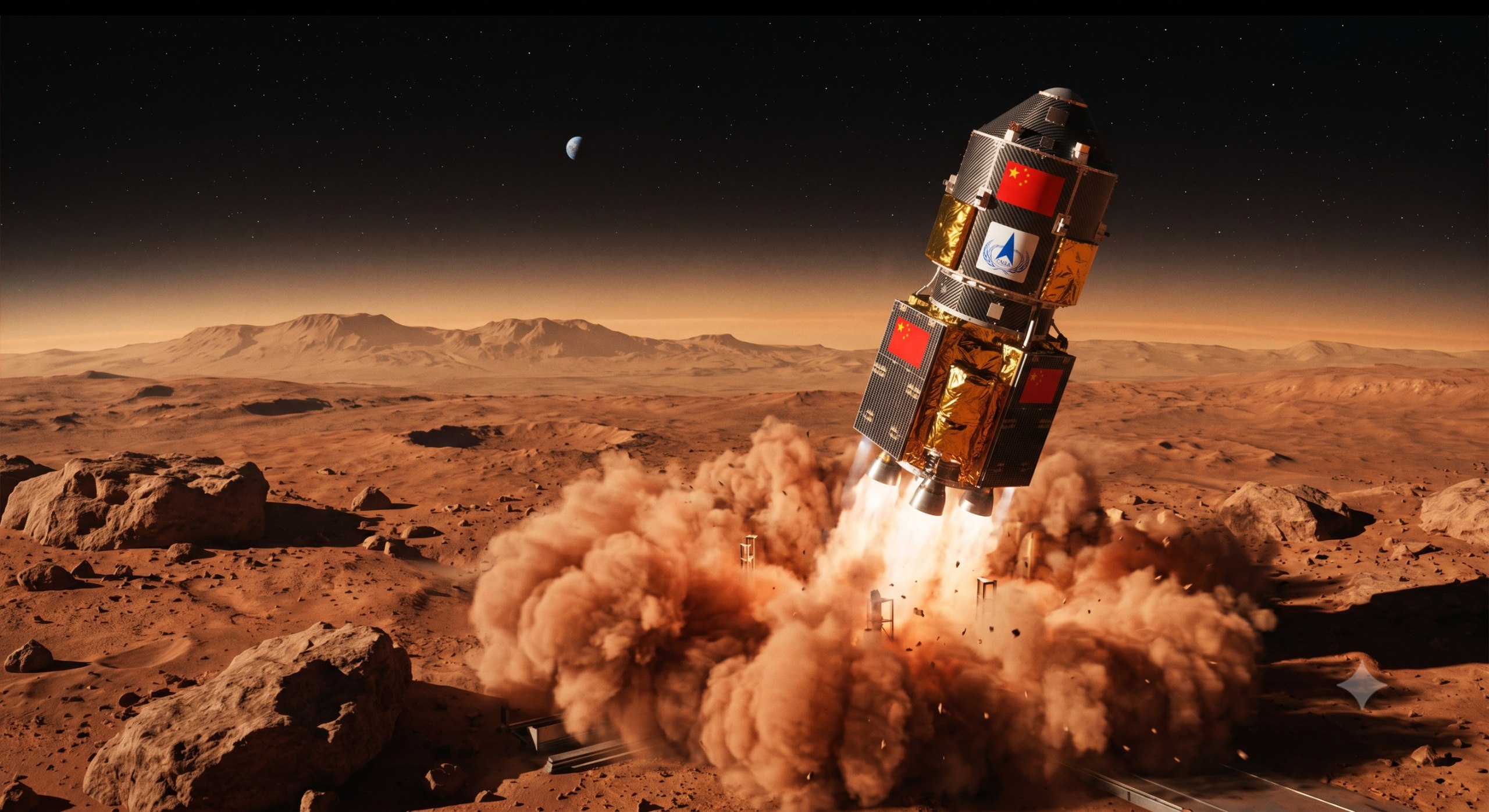
On June 2, 2026, the China National Space Administration (CNSA) confirmed that the Tianwen-3 mission's ascender successfully ignited and launched from the Martian surface, delivering a container of Mars rock and soil samples into orbit, awaiting rendezvous with the orbiter. This marks the first time in human history that a launch operation has been completed on another planet, transitioning the Mars sample return mission from the "surface collection" phase to the "orbital transfer" phase.
Mission Milestone: End-to-End Validation
Tianwen-3 is China's first Mars sample return mission. Launched from Earth in September 2025, it landed in the southern Utopia Planitia region of Mars after approximately 10 months of interplanetary travel. The mission comprises three core components: the lander (containing the ascender), the orbiter, and the reentry capsule.
The sample return process follows five key steps:
-
Landing and Sampling: In April 2026, the lander successfully touched down on the Martian surface. Over the following six weeks, a robotic arm and drilling system collected approximately 600 grams of Martian rock and soil, stored in the ascender's sample container.
-
Sample Sealing: By mid-May 2026, the sample container underwent multi-layer sealing to prevent contamination during launch, orbital transfer, and Earth reentry.
-
Ascender Ignition: On June 2, 2026, using the lander as a launch platform, the ascender's solid-fuel engine successfully ignited, delivering the sample container into a Mars orbit at approximately 500 km altitude.
-
Orbital Rendezvous: In the coming weeks, the orbiter will perform a rendezvous and docking with the ascender in Mars orbit, transferring the sample container to the reentry capsule.
-
Earth Return: The orbiter is expected to depart Mars orbit in early 2027, beginning an approximately 9-month journey back to Earth, with the reentry capsule landing in late 2027 or early 2028.
Technical Achievement: Launching a Rocket on Mars
The technical difficulty of successfully igniting an ascender on the Martian surface far exceeds Earth launch. Mars gravity is roughly one-third of Earth's, but atmospheric density is only 1% of Earth's. This creates fundamentally different challenges:
-
Gravity Compensation: While lower gravity makes launch easier, precise guidance algorithms must be calibrated for Mars' unique gravitational field.
-
Environmental Adaptation: The ascender and its fuel system needed to maintain reliability through Martian diurnal temperature swings (from 20°C daytime to -80°C nighttime) for two months waiting for the launch window.
-
Autonomous Navigation: With Earth-Mars communication delays of approximately 10-20 minutes, the ascender's ignition and ascent process had to be fully autonomous, without ground intervention.
-
Launch Platform Stability: The lander serving as a launch platform had to maintain extreme stability -- any tilt could send the ascender off its intended trajectory.
CNSA stated that the ascender's solid-fuel engine burned successfully for approximately 7 minutes on the Martian surface, precisely delivering the sample container into its target orbit. Preliminary orbital parameters show the container at approximately 500 km altitude, 87-degree inclination, very close to the intended target.
Scientific Value: Mars' "Time Capsule"
The Tianwen-3 samples come from southern Utopia Planitia, a region scientists believe to be the sedimentary basin of an ancient Martian ocean. Analysis of these samples will help answer the most fundamental questions in Mars science:
-
Did Mars ever host life? -- Searching for microbial fossils or biosignatures in the samples
-
History of the Martian water cycle -- Analyzing clay minerals and salt deposits to reconstruct Mars' climate evolution
-
Martian geological activity -- Determining precise surface ages through isotope dating
-
Martian atmospheric evolution -- Analyzing volatile elements to understand how Mars transformed from a thick atmosphere to today's tenuous one
Compared to samples collected by NASA's Perseverance rover, Tianwen-3's advantage lies in returning a larger sample volume (600g vs Perseverance's total of approximately 30 tubes) from a completely different location (Utopia Planitia vs Jezero Crater), providing complementary perspectives for Mars science.
International Comparison: Three-Way Mars Sample Race
Three major Mars sample return programs are currently underway globally:
-
China Tianwen-3: Samples collected, ascender launched, samples in Mars orbit, expected Earth return 2027-2028. Currently the most likely to complete the full mission first.
-
NASA-ESA Mars Sample Return (MSR): Perseverance has been collecting samples since 2021 and storing them in tubes. However, the Sample Retrieval Lander and ESA's Earth Return Orbiter are expected to launch in 2030 and 2027 respectively, with sample return no earlier than 2033.
-
JAXA MMX (Martian Moons eXploration): Aiming to collect samples from Phobos, launched in 2024, expected return in 2029. While not Martian surface samples, Phobos may preserve material ejected from Mars by impacts.
China's Tianwen-3 has a mission cycle of approximately 2.5 years from launch to return, far shorter than the NASA-ESA plan's 12+ years. This speed difference stems from fundamentally different mission design philosophies: China chose an "all-in-one" approach integrating all components into a single spacecraft, while NASA-ESA adopted a more robust but more protracted phased approach.
Technical Route Analysis: China's "All-in-One" Design
Tianwen-3's approach integrates the lander, ascender, orbiter, and reentry capsule into a single spacecraft. The advantage is a compact mission timeline, but the technical complexity is extreme:
-
Requires successful Mars Entry, Descent, and Landing (EDL) -- itself described as "seven minutes of terror"
-
The lander must simultaneously carry the sampling system and the ascender
-
The orbiter must serve dual roles for both Mars orbit operations and Earth return
By comparison, the NASA-ESA phased approach requires three separate launches -- sample acquisition (Perseverance), sample return ascender (SRL), and Earth return orbiter (ERO) -- reducing individual mission technical risk but extending the overall timeline and introducing inter-mission dependencies.
Tianwen-3's progress demonstrates that China's space program is transitioning from "follower" to "leader" in certain domains. Mars sample return -- considered by NASA to be its most challenging flagship mission of the decade -- may ultimately be completed first by China.
Outlook: Next Steps
Following the ascender's successful entry into orbit, the next critical mission milestone is the rendezvous and docking between the orbiter and ascender in Mars orbit. This will be humanity's first autonomous docking operation between two spacecraft in Mars orbit.
CNSA estimates the rendezvous will occur between late June and early July 2026, after which the sample container will be transferred to the reentry capsule. The orbiter will ignite its engines to depart Mars orbit in early 2027, beginning the long voyage back to Earth.
If all goes well, in early 2028, humanity will for the first time hold in their hands material from the deep surface of another planet -- one of the greatest achievements in space exploration history.