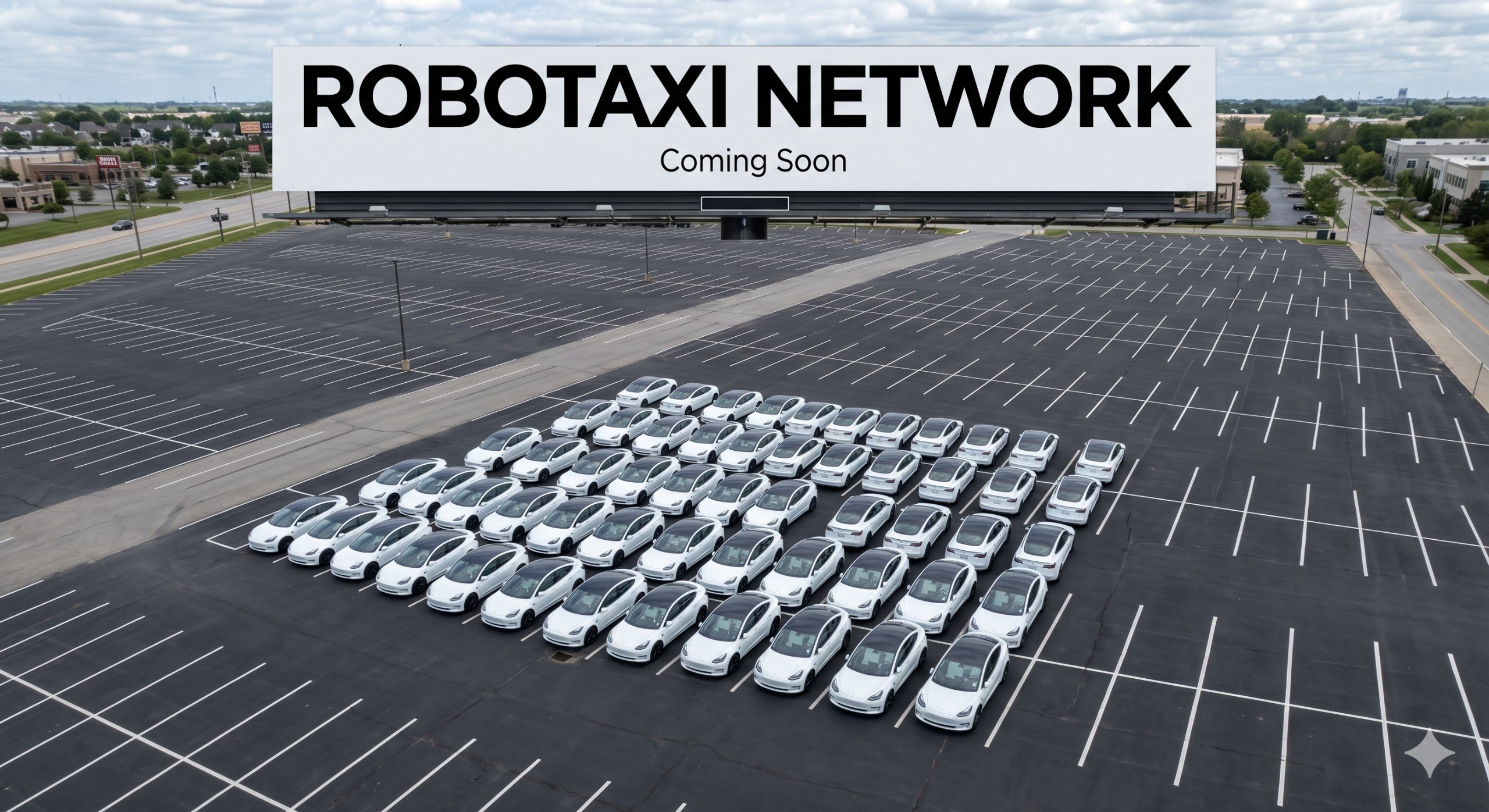
In June 2026, Tesla's fully autonomous robotaxi fleet operating across three Texas cities was disclosed to consist of just 59 vehicles — far below Elon Musk's July 2025 earnings call claim of "500 or more vehicles in the Austin area alone by the end of 2025." The figure, revealed through new Texas regulatory disclosure requirements, lays bare the vast gap between promise and reality in Tesla's autonomous driving commercialization.
From "Half the U.S. by Year-End" to 59 Vehicles
In July 2025, Tesla launched its unsupervised robotaxi service in Austin, initially available only to carefully selected internal testers. Musk declared on the quarterly earnings call: "We've already expanded our service area in Austin... by the end of the year, we'll probably have autonomous ride-hailing in about half the population of the US."
Twelve months later, the reality:
- Fleet size: 59 vehicles (as of June 2026)
- Service area: just three Texas cities (Austin and two surrounding cities)
- Reports indicate the active fleet once dipped to approximately 20 vehicles
- Expansion plans: California, Nevada, Arizona, and Florida deployments remain unrealized
This is not merely a timeline delay. Musk additionally claimed just six months ago that Austin alone would host "500 or more" vehicles — the actual figure is 12% of that target. Even by the generous standards of Musk's famously ambitious projections, this gap is striking.
Real-World User Experience
Field investigations by Mercury News and Bloomberg in June 2026 revealed actual user experience issues:
Long wait times. Unlike Waymo's "minutes-to-arrival" service in San Francisco and Los Angeles, Tesla robotaxi wait times in Austin frequently exceed 20-30 minutes, even during off-peak hours. This reflects both insufficient fleet size and inefficient dispatch algorithms.
Ride interruptions. Some users report vehicles stopping mid-route without explanation or requiring human intervention. While Tesla emphasizes its "end-to-end" neural network approach enables autonomous driving without high-definition maps, the system occasionally encounters edge cases it cannot handle in complex urban environments.
Fleet size volatility. Reports indicate the active fleet once dropped to approximately 20 vehicles, possibly reflecting maintenance cycles, software updates, or deployment strategy adjustments. For a service purportedly scaling aggressively, such dramatic fleet fluctuations are not a positive signal.
Tesla vs. Waymo: Divergent Approaches Under Scrutiny
Tesla and Waymo have pursued fundamentally different technological approaches to autonomous ride-hailing, and empirical data is providing an initial test of their competing philosophies:
Waymo uses a multi-sensor fusion approach (LiDAR + radar + cameras + HD maps), with per-vehicle sensor costs in the $50,000-100,000 range. The advantage is higher reliability in complex urban environments; the downside is high cost and slower expansion. Waymo operates in San Francisco, Los Angeles, Phoenix, Austin, and other cities, with a fleet exceeding 700 vehicles and over 50 million autonomous miles accumulated by early 2026.
Tesla pursues a vision-only approach (cameras + neural networks only), with sensor costs at just a few thousand dollars, theoretically enabling faster scaling. However, operational data suggests the vision-only approach still faces significant edge-case handling limitations in urban environments. The 59-vehicle fleet size itself speaks volumes — if the technology were mature, there would be no reason not to deploy more vehicles.
Notably, Musk frequently ties Tesla's autonomous driving narrative to total Tesla vehicle sales — claiming millions of cars are collecting FSD training data. But the gap between data collection and reliable service delivery remains vast, as the operational data demonstrates.
Wall Street's Response: Stock Price Diverges from Fundamentals
Strikingly, despite robotaxi deployment data falling far short of expectations, Tesla's stock price reached all-time highs in the first half of 2026. This reflects the disconnect between long-term autonomous driving expectations and short-term operational reality.
Bloomberg analysts note: "At a time when Tesla's carmaking business is mired in a multiyear decline, the company's market value has soared to new highs almost exclusively on the billionaire CEO's fantastical promises of a future in which all cars will drive themselves and robots will babysit the kids."
Tesla's 2026 vehicle sales are projected to decline approximately 5-10% year-over-year, with traditional automotive margins remaining under pressure. Yet the market capitalization remains at approximately $800 billion to $1 trillion — far above traditional automaker valuation multiples. This valuation premium is predicated on robotaxi revenue, yet 59 vehicles generate revenue that is essentially negligible within Tesla's overall financial picture.
Rivian launched its R2 electric SUV in June 2026, emphasizing "breakthrough AI features" while adopting a more conservative and transparent approach to autonomous driving development. Traditional automakers (GM's Cruise, Volkswagen's Mobileye partnership) continue investing in autonomous driving but have avoided Tesla-style aggressive promises.
Signs of Industry Maturation
Tesla's robotaxi struggles should not be misread as failure of the entire autonomous driving industry. Instead, it may signal an industry maturing — shifting from marketing-driven hyperbole to operationally data-grounded assessment.
Key indicators include:
Waymo achieved a safety record of 5x fewer accidents per mile than human drivers in 2025, expanding its driverless operating area further in 2026.
Cruise (GM), after its 2023 accident and regulatory setbacks, redeployed limited fleets in select cities during 2025-2026 with a more cautious expansion strategy.
Autonomous trucking is also advancing — Aurora, TuSimple (post-restructuring), and Waabi have made progress on highway-automated driving.
China's autonomous driving sector — Baidu Apollo and Pony.ai — operate hundreds of robotaxis across multiple cities with competitive intensity matching the U.S. market.
These developments indicate that autonomous driving technology is progressing steadily but slowly — not as rapidly as Musk promises, but genuinely advancing nonetheless.
Observatory Analysis
Tesla's 59-vehicle robotaxi fleet is one of the most concrete case studies of the "promise vs. reality" gap in autonomous driving. We derive three observations:
First, the vision-only approach's commercialization validation remains incomplete. While performing well in structured highway environments (FSD V13 achieves extremely low intervention rates on highways), SAE Level 4/5 urban robotaxi operation likely requires redundancy closer to Waymo's multi-sensor fusion approach. This may not be an algorithmic problem but a physical limitation — the inherent vulnerability of a single sensor modality under extreme weather, low light, and irregular obstacles.
Second, Tesla's autonomous driving valuation premium faces a reality check. Whether the market re-prices Tesla's valuation when the true scale of the robotaxi business is disclosed will be one of the most important investment themes of H2 2026. If investors begin valuing Tesla as an automaker rather than a technology company, the stock adjustment could be significant.
Third, the autonomous driving industry's progress is shifting from a "who gets there first" race to a "who can operate at scale" test. 59 vehicles may suffice for technology validation but fall far short of supporting a business model. Autonomous driving scalability — from dozens to tens of thousands of vehicles — requires systemic capabilities in manufacturing, operations, customer support, and regulatory compliance, not merely algorithmic improvements.
Disclaimer: The information in this article is for reference only and does not constitute investment advice or business decision-making basis. Data and time-sensitive information are accurate as of publication date and may change with subsequent developments. Neither the author nor POC.HK accepts liability for any losses resulting from the use of this information.