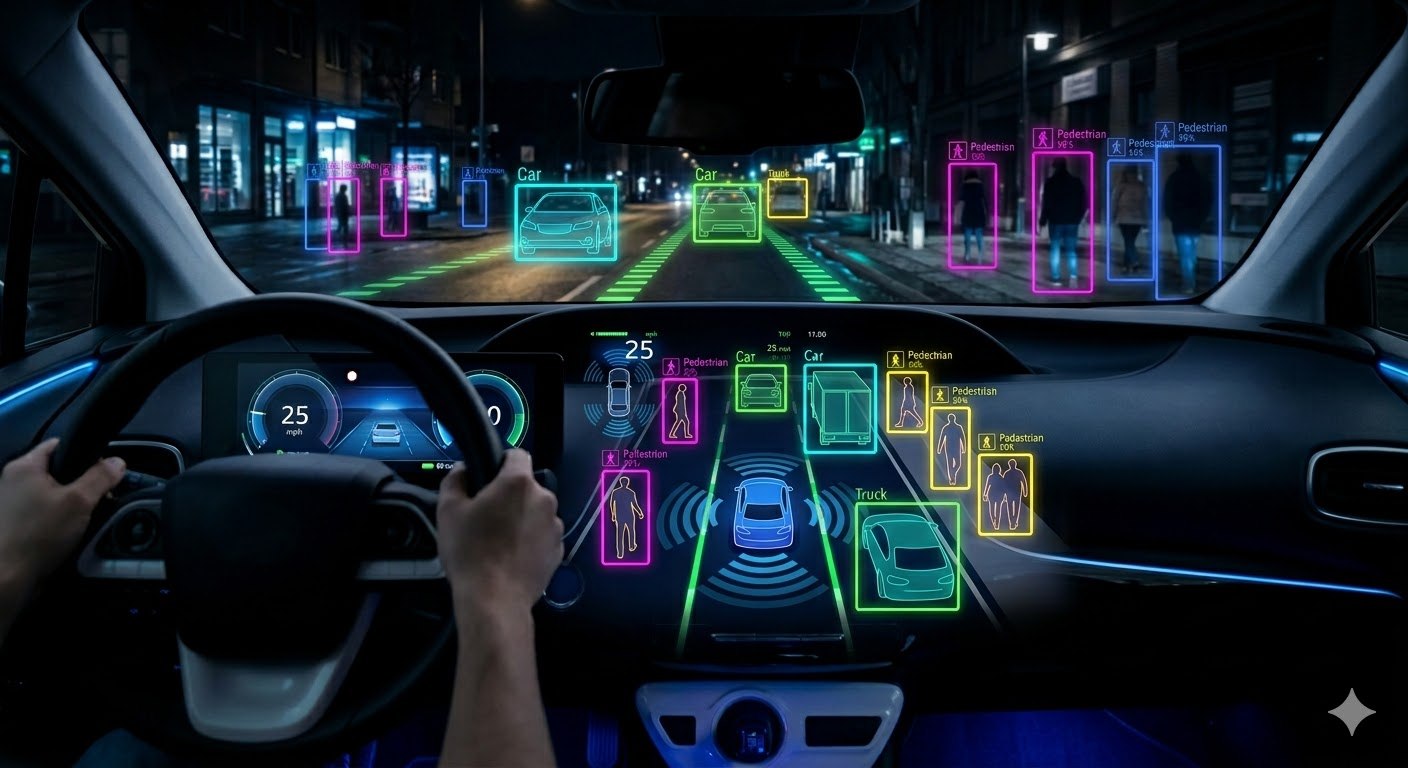
Tesla has released Full Self-Driving (FSD) version 13.0 to its early access fleet, and the consensus among testers is unambiguous: this is the most significant software release in the company’s history. The update represents a fundamental architectural shift from the hybrid rule-based and neural network approach of prior versions to a true end-to-end neural network that processes camera inputs directly into vehicle control outputs — steering, acceleration, braking — without intermediate hand-coded logic for perception, prediction, or planning. The result is a system that handles unprotected left turns, multi-lane roundabouts, narrow two-way residential streets, and dense urban traffic with a fluidity that previous versions could not approach.
FSD v13 is not merely an incremental improvement. It is the culmination of a strategic bet that Tesla CEO Elon Musk articulated years ago: that the path to full autonomy lies in training a single, massive neural network on enough real-world driving data, rather than in writing increasingly complex rules to cover an infinite set of edge cases. With v13, that bet appears to be paying off.
The End-to-End Architecture
To understand what makes FSD v13 different, it helps to understand how prior versions worked. FSD v12, released in early 2024, already represented a major step toward end-to-end learning: it replaced the traditional perception-planning-control pipeline with a unified neural network for perception and planning. However, v12 still used hand-coded trajectory optimization for the final control decisions, and its performance varied dramatically depending on driving conditions.
FSD v13 eliminates the remaining hand-coded components. The architecture now consists of a single, monolithic neural network that accepts time-sequential video streams from the vehicle’s eight external cameras (front, side, rear, and pillar cameras) and directly outputs steering angle, acceleration pedal position, and braking pressure at a frequency of 36 hertz. There is no intermediate representation of “objects detected” or “path planned” — the network learns to map pixels to control actions through billions of parameters optimized on millions of driving clips.
The network processes video in 2-second temporal windows at full camera resolution (1,280 x 960 pixels per camera, compressed to 640 x 480 for inference). Input from all eight cameras is fused at the first layer through a transformer-based attention mechanism that learns spatial and temporal relationships across the 360-degree field of view. The network’s backbone is a video transformer with approximately 1.2 billion parameters, distilled from a larger “teacher” model that was trained at 8-camera full-resolution with no temporal compression.
Crucially, the network is trained entirely on real-world driving data collected from Tesla’s fleet of over 6 million vehicles worldwide. Each time a Tesla owner engages FSD or Autopilot — and particularly when the driver disengages the system or takes over manually — the vehicle uploads a short video clip of the preceding 30 seconds. This creates an enormous training dataset of both successful autonomy and human-corrected edge cases. Tesla processes approximately 4 petabytes of new training data per week, continuously expanding the coverage of rare and unusual driving scenarios.
Training Infrastructure
The scale of the training effort behind FSD v13 is difficult to overstate. Tesla operates one of the largest AI training clusters in the world at its facility in Palo Alto, California, supplemented by a newer cluster at the Gigafactory Texas site in Austin. The cluster comprises approximately 100,000 NVIDIA H100 GPUs — though Tesla is rapidly transitioning to its custom-designed Dojo D1 chips, which are purpose-built for the video transformer workloads that dominate FSD training.
Training a single FSD v13 checkpoint takes approximately 14 days on the full GPU cluster, consuming an estimated 50 exaflops of compute. The training process involves multiple stages: pre-training on a large corpus of diverse driving data, fine-tuning on safety-critical scenarios identified by Tesla’s safety analysis pipeline, and adversarial training where the network is tested against deliberately challenging scenarios generated by a separate “red team” network.
The training data labeling pipeline is itself a sophisticated AI system. Rather than relying on human annotators to label objects and scenarios in each video frame — a process that would be impossibly slow at the petabyte scale — Tesla uses a combination of automated labeling from the fleet’s existing sensor suite (which includes radar and ultrasonic sensors on older vehicles, though newer vehicles are vision-only) and a neural-network-based “pseudo-labeler” that generates high-quality training labels automatically. Human annotators review only the most challenging edge cases where the automated system’s confidence is low.
Unprotected Left Turns: The Benchmark
The single scenario that best illustrates the improvement from v12 to v13 is the unprotected left turn — a maneuver where the vehicle must cross one or more lanes of oncoming traffic without a dedicated turn signal or green arrow. This is widely considered the most difficult common driving scenario for autonomous systems, as it requires simultaneous processing of multiple moving objects with different speeds and trajectories, prediction of driver intent, and a narrow time window for execution.
In FSD v12, unprotected left turns were the category most frequently requiring driver intervention. The system was often overly cautious, waiting for impossibly large gaps, or occasionally too aggressive, committing to turns that left insufficient margin. The rule-based components of v12’s trajectory planner could not generalize well to the infinite variety of intersection geometries, traffic densities, and driver behaviors encountered in the real world.
FSD v13 handles unprotected left turns with a fluency that rivals experienced human drivers. The network appears to have learned a nuanced strategy: it approaches the intersection at a moderated speed, begins to creep forward as it identifies a potential gap, and commits to the turn with smooth, continuous acceleration. The decision to go or wait is made in a fraction of a second and is sensitive to subtle cues — the deceleration profile of an approaching vehicle, the presence of a turn signal on a cross-traffic car, the posture of a pedestrian waiting at the curb. Testers report that the system now completes unprotected left turns successfully in over 95 percent of attempts without intervention, up from approximately 60 percent in v12.
Urban and Residential Driving
Beyond intersection handling, FSD v13 demonstrates dramatically improved performance in complex urban and residential environments. Narrow two-way streets with parked cars on both sides — creating a “single lane” that both directions must share — are handled with smooth negotiation: the system slows, assesses oncoming traffic, and pulls aside at a natural passing point. It handles speed bumps, potholes, and uneven road surfaces by adjusting speed and suspension preemptively.
Roundabouts, historically a weak point for autonomous systems, are now navigated reliably. The network handles single-lane, multi-lane, and mini-roundabouts with appropriate lane selection, yield behavior, and exit signaling. The system uses the vehicle’s turn signals to communicate intent to other road users — a subtle but important aspect of human driving that many autonomous systems neglect.
Construction zones remain challenging but are markedly improved. The network can handle lane shifts, temporary traffic signals, and flagger-directed traffic with reasonable competence, though caution is still warranted in highly complex or poorly marked construction areas. Tesla’s continuous training pipeline means that as more fleet vehicles encounter construction scenarios, the network improves through direct exposure to those specific conditions.
Pedestrian and Cyclist Interaction
FSD v13’s treatment of vulnerable road users — pedestrians, cyclists, scooter riders, and others — has been a focus of safety improvements. The network now predicts pedestrian trajectories with greater accuracy, anticipating crossing decisions, path deviations, and sudden movements. At crosswalks, the system yields with generous margins, often stopping further back than necessary to communicate clear intent to the pedestrian.
Cyclist interaction is particularly nuanced. The network learns to give cyclists a wide berth when passing (typically 1 to 1.5 meters, consistent with safe passing laws in most jurisdictions), to anticipate cyclists making left turns across traffic, and to avoid the “door zone” when passing parked cars on streets where cyclists are present. These behaviors are not programmed explicitly — they emerge from the network learning optimal driving policies from the training data, which includes millions of examples of how human drivers interact with cyclists.
Safety Metrics and Validation
Tesla has published limited but encouraging safety data for FSD v13. The company reports that vehicles operating on FSD v13 experience an average of 0.21 safety-critical disengagements per 1,000 miles, compared to 0.55 for v12 and approximately 1.2 for the standard Autopilot system. A safety-critical disengagement is defined as an event where the driver must take immediate control to avoid a collision, a traffic violation, or a hazardous situation.
The validation process for v13 was the most extensive in Tesla’s history. Before release to the early access fleet, the network was validated on a closed-course test facility using a fleet of 50 test vehicles that collectively drove over 1 million miles of structured scenarios. Each scenario — there are approximately 150,000 in total — was derived from real-world collision and near-miss data, designed to stress-test specific aspects of the system’s behavior. Only scenarios where the system demonstrated a 99.9 percent or higher success rate were considered validated.
Post-release, the system continues to learn. Tesla operates a continuous evaluation pipeline where every disengagement event from the fleet is analyzed, the relevant video clip is labeled, and the clip is added to the training set with an appropriate importance weight. The result is a system that improves with every mile driven, with new training checkpoints deployed to the fleet on a roughly bi-weekly cadence.
The Hardware Question: HW4 vs. HW3
FSD v13 requires Tesla’s Hardware 4 (HW4) computer, which debuted in 2023 on the refreshed Model S and Model X and has since been rolled out across the Model 3, Model Y, and Cybertruck. HW4 features a dual-system-on-chip (SoC) design with twice the neural network inference bandwidth of the previous HW3, enabling the higher-resolution video processing and larger network size that v13 demands.
Owners of HW3-equipped vehicles — the vast majority of the Tesla fleet from 2019 to early 2023 — will receive a reduced-capability version of v13, designated v13.3 Lite. This version uses a distilled network with approximately 600 million parameters (half the full size) and processes video at reduced resolution. Performance on unprotected left turns and complex intersections is expected to be comparable to v12.4, though other aspects of urban driving are improved. Tesla has indicated that a computational upgrade path for HW3 owners is under development but has not provided pricing or availability timelines.
The Cybertruck, with its unique form factor and camera positions, required a separate training run. The Cybertruck variant of FSD v13 was trained using a specialized dataset collected from a fleet of pre-production and early-production Cybertrucks. Early reports indicate that the system handles the vehicle’s larger dimensions and different steering geometry competently, though the blind spots created by the Cybertruck’s angular design require extra caution.
Regulatory Landscape
FSD v13’s release occurs against a complex regulatory backdrop. In the United States, the National Highway Traffic Safety Administration (NHTSA) has multiple open investigations into Tesla’s advanced driver assistance systems, including a probe into FSD’s performance in low-visibility conditions and a broader investigation into the adequacy of Tesla’s driver monitoring system.
The current regulatory framework classifies FSD as a Level 2 driver assistance system — meaning the driver must remain attentive and ready to take over at all times — regardless of its actual capabilities. Tesla’s driver monitoring system uses the cabin camera to detect driver attentiveness, issuing alerts if the driver looks away from the road for more than a few seconds. The system has been criticized for being too permissive, particularly when the vehicle is operating in simple highway environments where the driver is tempted to disengage.
FSD v13 does not change the Level 2 classification. However, the system’s dramatically improved performance — particularly its ability to handle unprotected turns and urban driving — has reignited debate about whether the regulatory framework should distinguish between systems that handle highway driving only and those that can navigate complex urban environments. Tesla has argued for a “capability-based” regulatory framework that would allow higher levels of autonomy in geofenced or conditional operating domains, but federal regulators have not yet acted on this proposal.
In China, Tesla’s largest international market, FSD v13 has been submitted for regulatory approval but has not yet been released. The Chinese regulatory environment requires mapping data to be stored locally and all autonomous driving features to be approved by the Ministry of Industry and Information Technology. Tesla has partnered with Baidu for mapping and navigation services to comply with local requirements.
In Europe, FSD v13 is unlikely to be approved in its current form. The European Union’s recently enacted UN Regulation 157 for Automated Lane Keeping Systems (ALKS) imposes stringent requirements for driver monitoring, operational design domain, and cybersecurity that go beyond what Tesla’s current system implements. Tesla has not announced plans for a European-compliant version of FSD.
The False Promises Problem
Tesla’s history of overpromising autonomy timelines creates a unique credibility challenge for FSD v13. The company has repeatedly claimed that “next year” would bring full self-driving capability, only to deliver incremental improvements that fell short of those promises. The result is a skeptical audience that has heard it all before.
FSD v13 genuinely appears to be a step change in capability, but it is not yet full self-driving. The system requires attentive driver supervision, cannot handle all scenarios (particularly severe weather, unmapped roads, and extremely complex construction zones), and does not provide the door-to-door autonomous driving that the name “Full Self-Driving” implies. Tesla’s safety data suggests that v13 is safer than v12, but the absolute number of disengagement events — 21 per 100,000 miles — is still orders of magnitude above what would be acceptable for unsupervised operation.
The question of whether and when FSD will achieve true Level 4 or Level 5 autonomy — where the vehicle can operate without any driver supervision in defined or all conditions — remains open. Tesla’s vision-only approach is controversial: most other autonomous driving companies, including Waymo, Cruise, and Zoox, use sensor fusion that combines cameras with lidar and radar. Tesla’s argument is that vision alone is sufficient if the neural network is large enough and the training data comprehensive enough. FSD v13 provides the strongest evidence yet that this argument has merit, but the debate is far from settled.
The Competitive Landscape
FSD v13 enters an increasingly competitive autonomous driving market. Waymo operates a commercial robotaxi service in San Francisco, Phoenix, and Los Angeles using a fleet of modified Jaguar I-PACE vehicles equipped with lidar, radar, and cameras. Waymo’s system is already fully unsupervised (Level 4) in its operational domain, and the company has demonstrated safe operation without a safety driver in urban environments.
Cruise, a General Motors subsidiary, has resumed testing after a suspension following a pedestrian-dragging incident in 2023. The company is deploying a next-generation autonomous vehicle based on the Origin platform, designed from the ground up for driverless operation.
Zoox, acquired by Amazon, is developing a purpose-built autonomous vehicle with bidirectional driving capability and a passenger-cab configuration. The company has begun limited public testing in San Francisco and Las Vegas.
Mobileye, the Israeli autonomous driving company, has demonstrated Level 4 capability in Jerusalem and plans commercial robotaxi deployments in multiple cities by 2027. Mobileye’s approach combines cameras, radar, and lidar with a responsibility-sensitive safety (RSS) model that mathematically guarantees safe driving behavior.
Tesla’s competitive advantage lies in scale. With over 6 million vehicles on the road capable of collecting training data, and a vertically integrated hardware-software platform, Tesla operates a data flywheel that competitors cannot easily replicate. Every mile driven in FSD mode generates data that makes the system better. Every new vehicle sold adds another sensor platform to the fleet. FSD v13 is the product of this flywheel, and its capabilities will continue to improve as the fleet grows.
However, the commercial path for Tesla is different from its competitors. Tesla sells FSD as a consumer product, with a purchase price of $12,000 or a subscription of $199 per month in the United States. The business model depends on convincing millions of individual consumers that the system is worth paying for, rather than deploying a fleet of purpose-built robotaxis in geofenced areas. This is a harder sell in the short term but potentially more valuable in the long term if Tesla can achieve unsupervised autonomy.
What Comes Next
Tesla’s roadmap for FSD beyond v13 includes several planned milestones. The next major release, v14, is expected to introduce “unlatching” — the ability for the vehicle to operate without requiring the driver to touch the steering wheel for extended periods, relying solely on cabin camera-based driver monitoring.
The milestone after that is the much-promised “robotaxi” capability: fully unsupervised operation where the vehicle can navigate any route without a human behind the wheel. Tesla has announced plans to launch a robotaxi service in Austin, Texas, in 2027, using a mixture of customer-owned vehicles and purpose-built Cybercab vehicles. The Cybercab, a two-passenger vehicle with no steering wheel or pedals, is expected to begin production in 2027.
The neural network architecture itself will continue to evolve. Tesla is researching video generation models that can predict future frames of the driving scene, enabling the system to “imagine” possible future trajectories and select the safest one. The company is also exploring multimodal architectures that could integrate data from other sensors — such as the Cybertruck’s side-facing cameras — without sacrificing the end-to-end learning approach.
Conclusion
FSD v13 represents a genuine breakthrough in Tesla’s autonomous driving journey. The end-to-end neural network architecture, trained on millions of real-world driving clips, delivers a qualitative improvement in handling complex driving scenarios — particularly unprotected left turns, urban navigation, and interaction with vulnerable road users. The system drives more smoothly, more safely, and more “human-like” than any previous version.
It is not yet full self-driving. Tesla’s name for the system remains aspirational rather than descriptive. But the gap between what the system can do and what full autonomy requires is narrowing, and v13 represents the largest single reduction in that gap in the system’s history.
For the autonomous driving industry as a whole, FSD v13 validates the end-to-end approach: a single neural network, trained on enough data, can learn to drive in complex urban environments without hand-coded rules. This has implications far beyond Tesla, informing the design of autonomous systems under development by competitors, researchers, and regulators.
The road to full autonomy is long, and FSD v13 is not the end of the journey. But it may be remembered as the point where the technology stopped being a promise and started being a capability.
Disclaimer: This article is for informational purposes only and does not constitute investment advice or an endorsement of Tesla’s Full Self-Driving technology. FSD v13 is a Level 2 driver assistance system that requires continuous driver supervision. Safety data is based on Tesla’s internal reporting and has not been independently verified. Autonomous driving technology involves significant risks and regulatory uncertainties. Readers should conduct their own research before making purchasing or investment decisions.