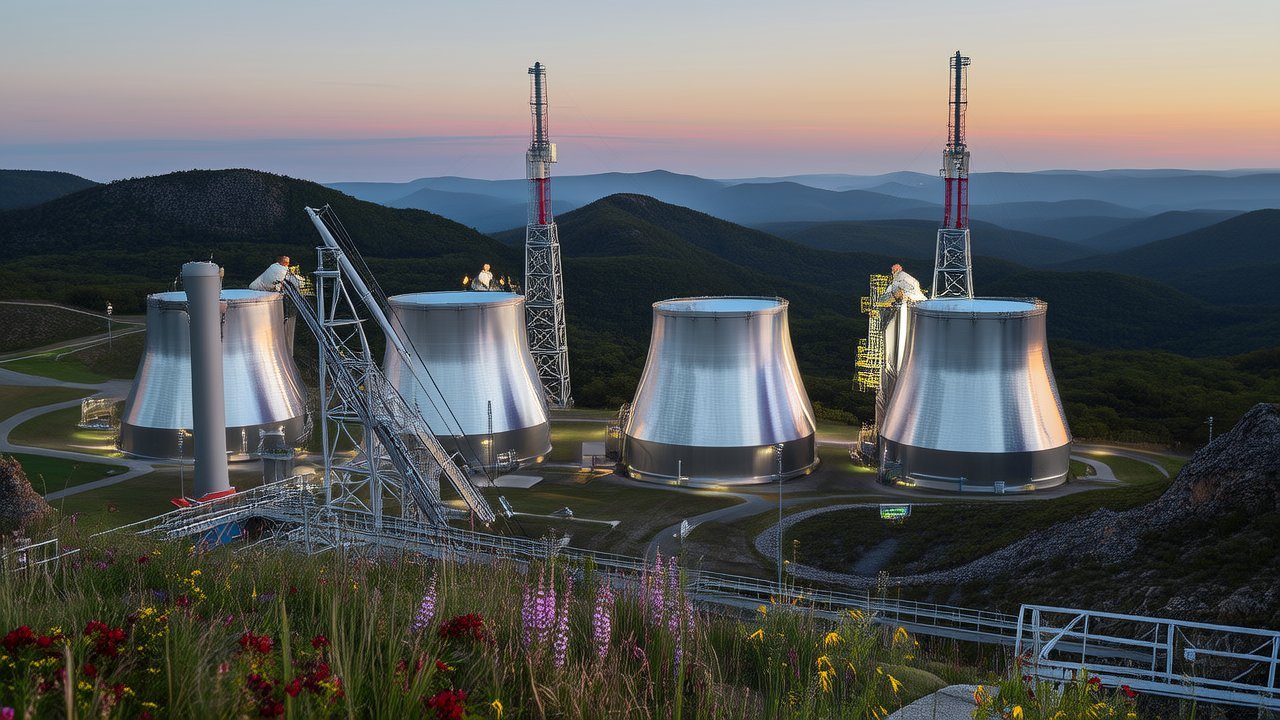
On June 9, 2026, Tennessee became the first state in the United States to establish a regulatory framework specifically for nuclear fusion machines. The new rules, codified as Chapter 0400-20-14 of the Tennessee Effective Rules and Regulations, mark a pivotal moment in the commercialisation of fusion energy — shifting the conversation from whether fusion can work to how it will be governed at scale.
The technology-neutral framework draws on Tennessee's more than 60 years of experience as a Nuclear Regulatory Commission Agreement State, a status that allows the state to administer its own regulatory programmes for certain nuclear materials. The regulations establish clear definitions and licensing requirements for fusion machines and fusion-related operations, distinguishing them from fission-based nuclear facilities and creating a dedicated pathway for fusion developers.
The Regulatory Architecture
The Tennessee framework defines a fusion machine as any device capable of transforming atomic nuclei through fusion processes into different elements, isotopes, or other particles, and directly capturing and using the resultant products — including particles, heat, or other electromagnetic radiation. This definition is intentionally broad and technology-neutral, designed to accommodate the wide variety of fusion approaches currently under development, from tokamaks and stellarators to laser inertial confinement and field-reversed configurations.
This technology-neutral approach is critical. Unlike fission regulation, which is built around specific reactor geometries and fuel cycles, fusion machines vary dramatically in their underlying physics, engineering architecture, and operational characteristics. A regulatory framework that prescribes specific technologies would risk locking out promising approaches and creating an uneven playing field. Tennessee's approach instead defines the outcome — fusion energy production — and establishes safety and licensing requirements that apply regardless of the specific technology used.
Type One Energy and the Oak Ridge Ecosystem
The anticipated first licensee under the new framework is Type One Energy, which plans to build its Infinity Two stellarator power plant near Oak Ridge. The Infinity Two is a 400 MWe fusion power plant using stellarator technology, a magnetic confinement approach that offers inherent steady-state operation without the need for current drive or plasma position control systems required by tokamaks.
Type One Energy's Oak Ridge site will function as a fusion development campus, coordinating projects between Oak Ridge National Laboratory, the Tennessee Valley Authority, and the University of Tennessee. The company first submitted plans to the Tennessee Department of Environment and Conservation in January 2026, and construction could begin as early as 2028 under the new regulatory rules.
The Oak Ridge location is no accident. The site is one of the world's most concentrated centres of nuclear expertise, hosting ORNL's decades of fusion research, the US ITER contributions programme, key materials science facilities, and the Spallation Neutron Source. TVA's adjacent operating nuclear fleet provides both a skilled workforce familiar with nuclear operations and a clear path for grid interconnection.
Why State-Level Regulation Matters
For the fusion industry, the absence of a dedicated regulatory framework has been a persistent obstacle. The NRC's existing fission-based regulatory structure does not cleanly accommodate fusion machines, which operate on fundamentally different physical principles — fusion reactions produce no long-lived transuranic waste, cannot sustain a runaway chain reaction, and involve far lower quantities of radioactive material.
The Tennessee framework addresses this gap at the state level, and its impact extends well beyond Tennessee's borders. The regulations serve as a template that other states can adopt or adapt, creating a patchwork of state-level fusion regulation that could accelerate commercial deployment while the NRC continues its longer process of developing federal fusion-specific rules. The NRC's own fusion rulemaking process, initiated in response to the 2023 ADVANCE Act, is expected to take several more years.
Tennessee's move also sends a powerful signal to the investment community. Regulatory clarity is one of the most frequently cited requirements by fusion investors, who face the risk that a technically successful fusion plant could be delayed for years by regulatory uncertainty. Tennessee's framework reduces that risk for projects within the state, potentially concentrating fusion investment and development activity in the Volunteer State.
Observatory Analysis
The Tennessee fusion regulations represent an underappreciated category of fusion progress: governance innovation. While the fusion community naturally focuses on plasma physics milestones — Q > 1, confinement time records, tritium breeding demonstrations — the regulatory pathway to commercial operation is equally consequential. A fusion plant that works perfectly in the laboratory is worthless if it cannot receive a construction and operating licence.
The state-level approach is particularly significant in the context of US federalism and energy policy. The US has no single national energy regulatory framework for new technologies; instead, regulation emerges from the interaction of federal agencies, state governments, and utility commissions. Tennessee's first-mover advantage in fusion regulation mirrors similar dynamics in other technology domains — California's early leadership on emissions standards, Texas's pioneering renewable energy grid, and New York's first-mover status on carbon pricing.
There is, however, a risk of regulatory fragmentation. If every state develops its own fusion framework with different standards, safety requirements, and licensing timelines, fusion developers face a compliance burden that scales with geographic scope. A national standard — whether through NRC federal rulemaking or interstate compact — would ultimately be more efficient. But Tennessee's framework provides a real-world test bed for fusion regulation, generating operational experience that can inform whatever national framework emerges.
The Type One Energy project at Oak Ridge will be the crucible in which these regulations are stress-tested. The combination of a specific power plant design, a defined regulatory pathway, and a world-class research infrastructure creates conditions for the first end-to-end demonstration of fusion commercialisation — from plasma physics through regulatory approval to grid connection.
Disclaimer: The information contained in this article is for reference purposes only and does not constitute investment advice or any form of commercial decision-making basis. Data and time-sensitive information are accurate as of the date of publication and may change with subsequent developments. The author and POC.HK assume no responsibility for any losses arising from the use of the information herein.