Orbital Refueling: The Infrastructure Tipping Point for Human Space Activity
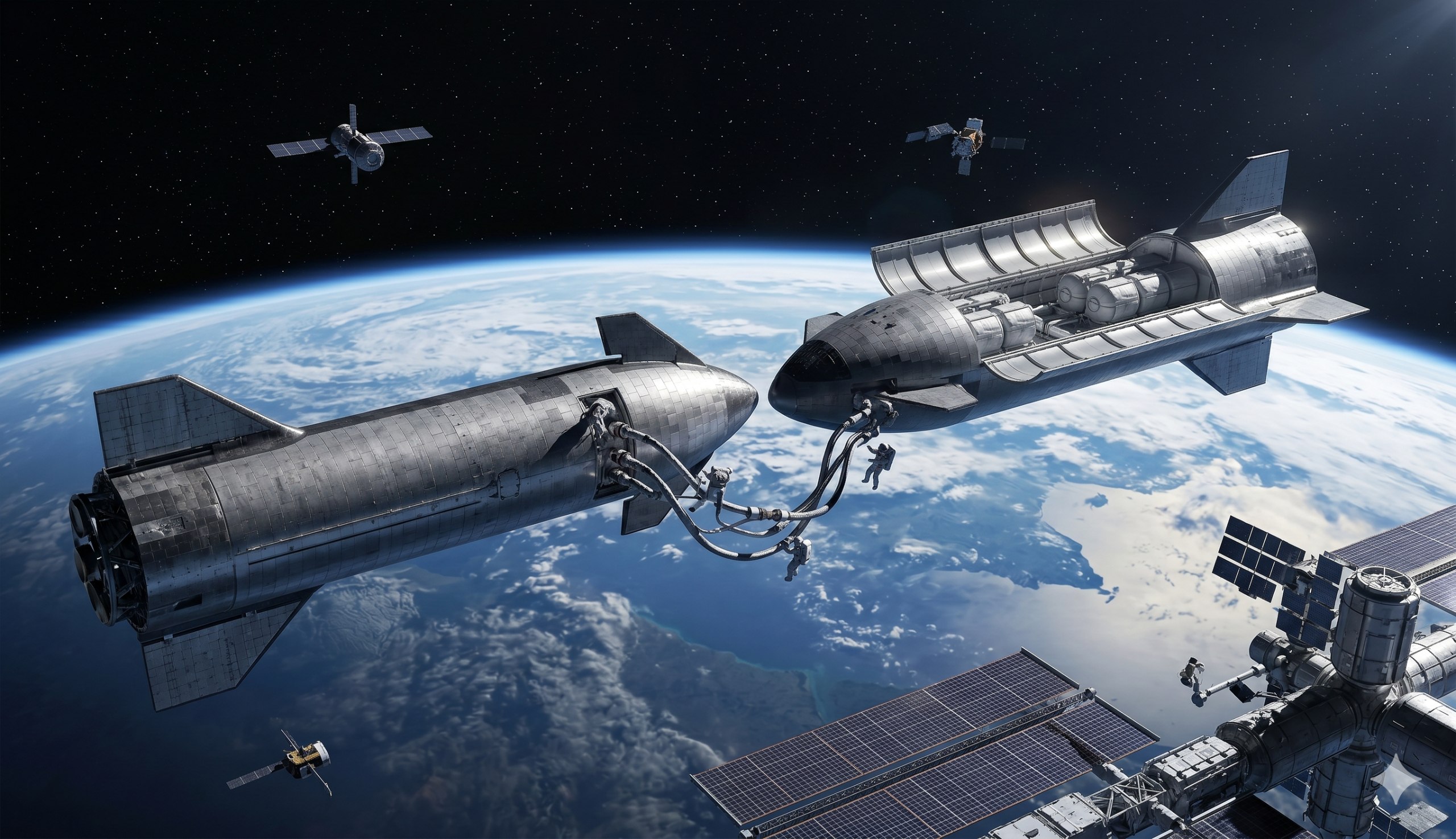
On January 10, 2026, SpaceX achieved the historic first propellant orbital transfer during the ninth Starship Integrated Flight Test (IFT-9). Two Starship vehicles — "Wave Rider" and "Tanker One" — precisely docked at an altitude of 280 km in low Earth orbit, successfully transferring approximately 100 tons of liquid methane and liquid oxygen from the tanker to the target spacecraft. The significance of this moment far surpasses any single launch mission. It marks humanity's formal transition from "single-use consumption" to "sustainable operations" in space.
From the Rocket Equation to Infrastructure Thinking
The most fundamental constraint of rocket science comes from the Tsiolkovsky rocket equation: to deliver 1 kg of payload to Mars, you might need to carry over 100 kg of propellant at launch. The traditional solution has been to build larger rockets — from Saturn V to Starship, each leap in scale accompanied by exponentially growing engineering challenges and costs.
Orbital refueling fundamentally rewrites this equation. A spacecraft can first carry a small amount of propellant into orbit, then "fill up" in space through multiple refueling missions. Taking Starship's Mars mission as an example, a complete Mars transfer requires approximately 1,200 tons of propellant. Through 8 to 12 orbital refueling dockings, this can be accomplished in Earth orbit without building a historically unprecedented giant rocket on the ground.
Key Technical Breakthrough Details
IFT-9's refueling demonstration involved three key technologies. First was cryogenic fluid management — in microgravity, liquid methane and liquid oxygen do not settle at the bottom of tanks as they do on Earth, but form randomly distributed droplet clouds. SpaceX employed a technique called "pressure-controlled settling": using slight attitude control thrust to generate artificial gravity, settling the propellant near the outlet.
Second was the docking interface sealing and transfer. The two spacecraft connected through a modified Starship docking port, which integrated cryogenic fluid couplings, data links, and power transmission channels. Achieving high-flow, leak-free transfer of cryogenic liquids in zero gravity represents an engineering standard never before reached by any spacecraft.
The third breakthrough was precise control of autonomous docking and separation. Two spacecraft, each 120 meters long and weighing over 5,000 tons, made contact in orbit at a relative velocity below 0.02 m/s, with the docking mechanism's damping system absorbing the tiny residual velocity difference. The entire process was handled by Starship's autonomous navigation system without ground intervention.
Commercial Ripple Effects
The commercialization of orbital refueling will have ripple effects on the entire space industry similar to containerization's impact on global trade. SpaceX has announced plans to deploy an "orbital fuel depot" network of 4 to 6 dedicated tanker spacecraft by 2027, capable of serving multiple customer missions simultaneously.
For lunar missions, a Starship refueled in orbit can fly directly to the Moon and land, without relying on the lunar orbit rendezvous and staging architecture of the Apollo era. This reduces the ground launch mass for each lunar mission by approximately 60%, significantly lowering mission costs. NASA signed a contract worth approximately $4.8 billion with SpaceX in 2025 to develop Artemis lunar landing services based on orbital refueling.
For the commercial satellite market, in-orbit refueling means the lifespan of geosynchronous orbit (GEO) satellites is no longer limited by the propellant carried at launch. Several satellite operators — including Intelsat and SES — have begun planning "refueling-friendly" satellite platforms equipped with standardized docking and fueling interfaces. According to Northern Sky Research, the in-orbit services market could reach approximately $17 billion annually by 2030.
Observatory Analysis
From an independent analytical perspective, the true strategic significance of orbital refueling lies in the "multiplier effect" it creates for the space economy. Every infrastructure element deployed in orbit — whether communications satellites, space stations, or scientific platforms — can achieve multiplicative improvements in endurance through refueling. This bears a striking resemblance to Metcalfe's law for the internet: the value of a network is proportional to the square of the number of connected nodes, and orbital refueling is key to enabling the "logistical connections" between these nodes.
Three indicators are worth monitoring: first, the unit cost curve of refueling missions — SpaceX's internal target is to reduce orbital delivery costs per ton of propellant to below $5 million, compared to the current approximately $20 million; second, progress on refueling interface standardization — the International Organization for Standardization (ISO) has begun discussing universal protocols for space propellant transfer; third, the evolving competitive landscape — beyond SpaceX, both Blue Origin and Rocket Lab have announced their own in-orbit refueling technology roadmaps.
Looking Ahead
The next 24 months will be a critical window for orbital refueling to transition from technical validation to operational routine. In the second half of 2026, SpaceX plans to complete the first "fuel depot transfer" demonstration — where one tanker spacecraft refuels two different customer spacecraft. In 2027, the Artemis III mission will use an orbitally-refueled Starship Human Landing System (HLS) to execute the first crewed lunar landing, marking the first operational application of orbital refueling in a crewed mission.
Looking further ahead, the maturation of orbital refueling infrastructure will unlock missions currently considered too expensive or impossible. These include: orbital assembly of large space telescopes (such as NASA's future flagship observatory concepts), regular cargo flights between the Moon and Mars, and ultimately — asteroid resource development. Just as seaports and gas stations changed how humans move on Earth, orbital refueling nodes will change humanity's mode of existence in the solar system. This is not an incremental improvement, but an infrastructure-level paradigm shift.
Disclaimer: This article is written by POC.HK Future Technology Observatory based on publicly available information and independent analysis. All viewpoints represent the editorial position of the Observatory. The technical parameters and timelines mentioned are from publicly disclosed sources; actual progress may differ due to technical, regulatory, and funding factors.