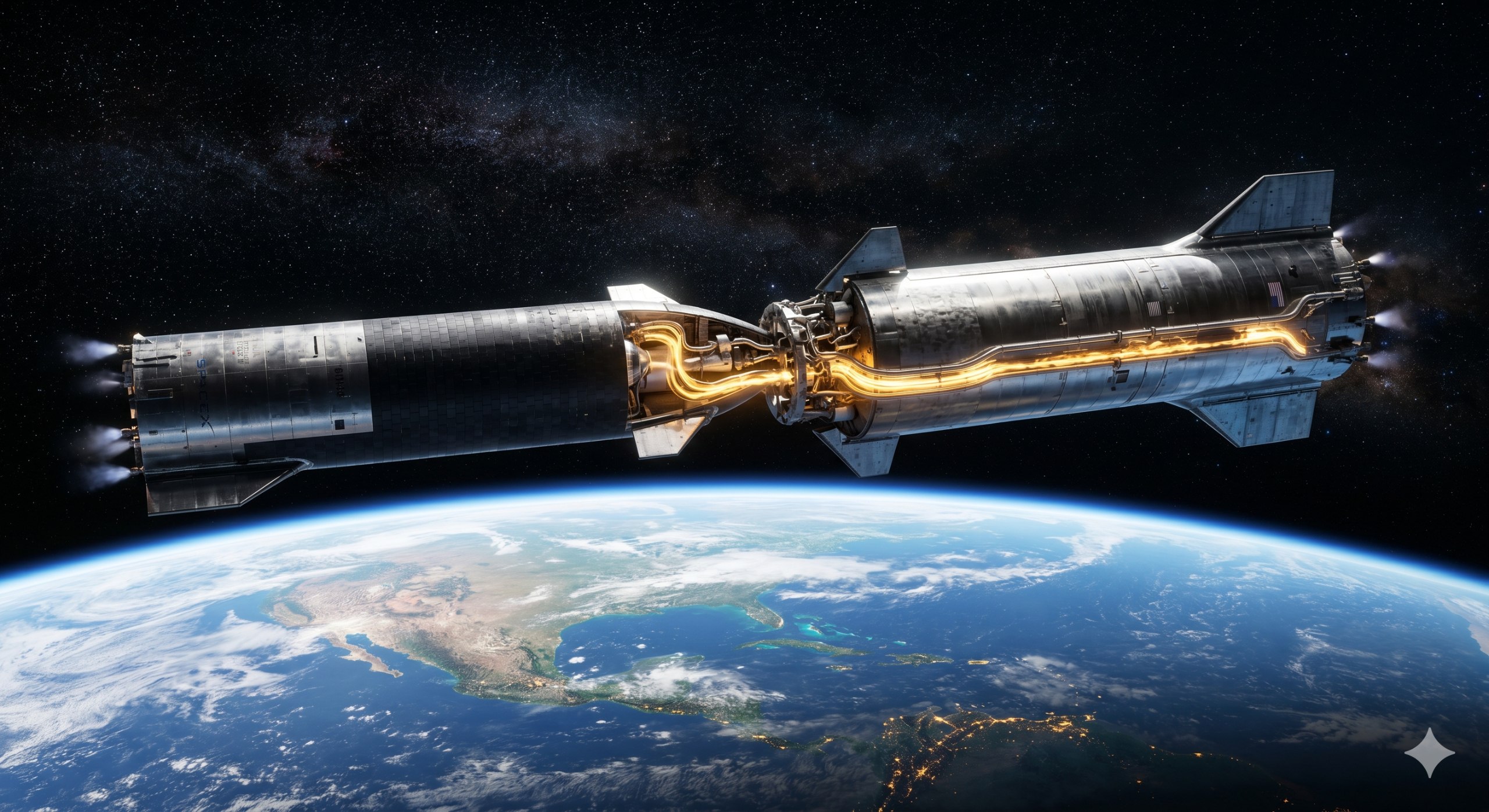
SpaceX has achieved what many considered the single most critical technical milestone for humanity’s expansion into the solar system: two Starship vehicles have successfully docked in low Earth orbit and transferred superchilled propellant between them, demonstrating a capability that makes crewed missions to the Moon, Mars, and beyond economically and logistically viable. The demonstration, conducted in a carefully choreographed sequence over two orbital passes, involved an uncrewed tanker Starship transferring approximately 100 metric tons of liquid methane and liquid oxygen to a waiting Starship depot vehicle.
The implications of this achievement cannot be overstated. Orbital refueling is the key that unlocks Starship’s full potential. Without it, Starship’s payload capacity to destinations beyond low Earth orbit is severely limited by the tyranny of the rocket equation. With it, Starship can depart Earth orbit fully fueled, carrying 100-plus tons of cargo or 100 passengers to the Moon, Mars, or even the outer planets. This single capability transforms Starship from an ambitious heavy lifter into the true workhorse of interplanetary transportation.
Why Orbital Refueling Matters
The rocket equation is unforgiving. To accelerate a spacecraft from Earth’s surface to a trajectory toward Mars requires a staggering amount of propellant — roughly 95 percent of the launch mass must be fuel and oxidizer. This leaves only 5 percent for payload, structure, and the vehicle itself. Starship’s fully reusable design already improves on this ratio compared to expendable rockets, but even Starship cannot reach Mars with a meaningful payload without refueling.
The solution is what SpaceX calls the “depot model.” A Starship launched with a heavy payload — say, a Mars habitat module or a full crew complement — reaches orbit with its tanks partially depleted. A tanker Starship, launched with minimal payload and maximized propellant, meets it in orbit and transfers fuel. Multiple tanker flights can fully replenish the payload-carrying Starship, giving it the delta-v needed for trans-lunar or trans-Martian injection.
The economics work because tanker launches are relatively cheap. Each tanker carries propellant worth roughly $200,000 at methane-and-oxygen commodity prices. Even accounting for Starship’s reusable launch costs, a full orbital refueling campaign — requiring between five and fifteen tanker flights depending on the destination — adds only a few million dollars to the mission cost. This is transformative compared to the alternative: building ever-larger expendable upper stages or accepting minimal payload fractions.
The Mission Profile
The orbital refueling demonstration was the culmination of months of preparation and two preparatory test flights. The final mission unfolded over approximately 36 hours, comprising multiple distinct phases.
Phase 1: Tanker Launch. The tanker Starship, designated S31, launched from SpaceX’s Orbital Launch Mount A at Starbase, Texas. It carried no payload beyond the propellant transfer system and docking hardware, maximizing its propellant load. The launch window was timed to achieve orbital parameters matching the pre-positioned depot Starship, designated S29.
Phase 2: Orbital Phasing. Over the course of approximately 90 minutes and two orbits, the tanker performed a series of burns to match its orbit with the depot. The two vehicles entered a co-orbital configuration at approximately 280 kilometers altitude, maintaining a safe separation distance as ground-based mission control verified systems status.
Phase 3: Rendezvous and Docking. The tanker executed an automated approach sequence, closing the distance from 50 kilometers to the docking interface in a carefully choreographed spiral. The final approach was conducted at a relative velocity of less than 0.1 meters per second. The docking mechanism — a modified version of the system used for Crew Dragon’s International Space Station dockings — captured the depot’s docking port with sub-centimeter precision.
Phase 4: Propellant Transfer. With the two vehicles securely mated, the transfer sequence began. The tanker’s internal transfer pumps — specially designed for the cryogenic temperatures of liquid methane (-162°C) and liquid oxygen (-183°C) — moved propellant across the docking interface through a set of fluid couplings. The transfer required precise pressure management to prevent cavitation or boiling. Approximately 100 metric tons of propellant was transferred over a period of approximately 45 minutes.
Phase 5: Undocking and Disposal. After transfer completion, the two vehicles verified the quality and quantity of the transferred propellant, sealed the depot’s tanks, and executed a controlled undocking. The tanker performed a deorbit burn over the Pacific Ocean, splashing down in a designated exclusion zone. The depot remained in orbit, demonstrating the ability to store and manage transferred propellant over multiple orbital passes.
Technical Challenges Overcome
Orbital propellant transfer at cryogenic temperatures is extraordinarily difficult, and SpaceX’s engineering team has spent years developing the necessary technologies. Three challenges stand out as particularly demanding.
Settling Propellant in Microgravity. On the ground, gravity keeps propellant settled at the bottom of the tank. In orbit, propellant floats, forming a distributed mixture of liquid and vapor that cannot be reliably pumped. The solution is a combination of settling thrust — small, precisely controlled burns that create a simulated gravity field inside the tank — and advanced propellant management devices (PMDs) that use surface tension to separate liquid from vapor.
Cryogenic Fluid Management. Both methane and oxygen must be kept at extreme cryogenic temperatures to remain liquid. Any heat leak into the tank causes boil-off — propellant lost to vaporization. Active cooling systems, multi-layer insulation, and strategic tank placement within the vehicle structure are all employed to minimize heat ingress. During the hour-long docking and transfer sequence, maintaining propellant temperature was a continuous engineering battle.
Leak-Free Cryogenic Couplings. The interface between two vehicles must transfer fluids at cryogenic temperatures without leaking. Thermal contraction of the coupling materials, differential expansion between the two vehicles, and the need for rapid connection and disconnection all compound the engineering difficulty. SpaceX developed a custom “chill-and-seal” coupling that precools the interface before full mating, then uses a combination of metallic seals and active thermal management to maintain leak-free operation.
Verification and Validation
How did SpaceX confirm the transfer actually worked? The verification system was multi-layered.
Flow meters at the tanker’s transfer port measured the volume of propellant leaving the tanker throughout the burn. Simultaneously, the depot’s receiving flow meters and tank level sensors tracked the incoming volume. The two measurements were cross-correlated to confirm that no significant propellant was lost to leaks or boil-off during the transfer.
Post-transfer, the depot performed a series of small thruster firings to demonstrate that the transferred propellant was usable. The firing durations and resulting acceleration were consistent with the expected mass of transferred propellant, providing an independent confirmation. Onboard telemetry — including temperature sensors, pressure sensors, and accelerometer data — was downlinked in real-time to SpaceX’s Hawthorne mission control, where engineers analyzed the data to confirm nominal performance.
The final piece of evidence came from orbital tracking data. The depot’s orbital plane and altitude changed subtly after the propellant was received, and these changes were consistent with the added mass. Ground-based radar tracking confirmed the orbital parameters matched the expected post-transfer configuration.
Implications for NASA Artemis
The refueling success has immediate implications for NASA’s Artemis program, which has selected Starship as the Human Landing System (HLS) for Artemis III and subsequent missions. The HLS variant of Starship must be refueled in orbit before it can descend to the lunar surface with astronauts aboard.
The Artemis III mission architecture calls for launching the HLS Starship into an Earth orbit rendezvous with a tanker, transferring enough propellant for trans-lunar injection and lunar landing, then waiting for the crew to arrive on a separate Orion spacecraft. The crew transfers to Starship in lunar orbit, descends to the surface, performs their mission, and returns to Orion for the journey home. Without orbital refueling, the entire mission architecture collapses.
NASA officials have expressed confidence that the successful demonstration clears a major technical risk item for the Artemis III timeline. The space agency had identified orbital refueling as one of the highest-priority milestones required before committing to the crewed lunar landing, and the demonstration’s success substantially de-risks the remaining Artemis III preparations.
The Path to Mars
While the Moon is the immediate beneficiary, the long-term significance of orbital refueling is the Mars mission. SpaceX’s Mars architecture calls for a fleet of Starship vehicles — cargo pre-deployment missions, fuel production infrastructure, and crew vehicles — all enabled by the ability to refuel in orbit.
Without refueling, a Starship launched to Mars would arrive with minimal cargo capacity and insufficient propellant to return. With multiple tanker flights, a crewed Starship can depart Earth orbit with full tanks, perform a high-energy trans-Mars injection, deliver 100 tons of cargo or 100 crew to the Martian surface, and still retain enough propellant for a return journey after ISRU (in-situ resource utilization) fuel production on Mars.
Elon Musk has consistently stated that orbital refueling is “the hardest technical challenge” in the Starship development program — harder than reentry heating, landing precision, or engine reliability. Now that this challenge has been met, the remaining obstacles to Mars are largely issues of scale, manufacturing rate, and orbital infrastructure — all solvable problems.
Competitive Landscape
SpaceX is not the only player pursuing orbital refueling, but the company has established a clear lead. NASA has funded several orbital propellant transfer technology demonstration projects, including the Boeing-led Cryogenic Fluid Management (CFM) program and the United Launch Alliance’s (ULA) work on distributed launch architectures for the Vulcan Centaur rocket. However, these efforts remain in earlier stages of development and testing.
ULA’s concept for the Vulcan Centaur involves an “Advanced Cryogenic Evolved Stage” (ACES) that would enable in-space refueling, but the program has not yet advanced to orbital testing. Rocket Lab’s Neutron rocket is being designed with future refueling capability in mind, but the vehicle itself has not yet flown.
Blue Origin’s New Glenn, still awaiting its maiden flight, does not currently include orbital refueling in its baseline operational plan, though the company has discussed future variants that could support propellant transfer. The Chinese space program has announced plans to develop orbital refueling capability for its Long March 9 heavy-lift rocket, but technical details remain scarce.
The Road Ahead
SpaceX’s orbital refueling demonstration is not the end of the development process — it is the beginning. The company is already planning a series of increasingly ambitious follow-up missions.
The next major milestone is a multi-tanker campaign: launching multiple tanker Starships in rapid succession to fully fuel a single depot or payload Starship for a beyond-Earth-orbit mission. This requires launch cadence that SpaceX has not yet demonstrated — the company has cited a goal of 24-hour turnaround for tanker launches, significantly faster than current Starbase operations.
Long-duration cryogenic propellant storage in orbit is another development priority. The current demonstration involved transfer and near-immediate verification burns, but future missions will require storing propellant for days or weeks while waiting for crew or cargo integration. Heat leaks, micrometeoroid damage, and propellant boil-off all become more significant over extended periods.
SpaceX is also developing the “StarTanker” variant: a dedicated tanker vehicle optimized for maximum propellant delivery rather than payload capacity. This variant may eliminate the payload bay entirely, using the extra volume for additional tankage and achieving higher propellant delivery per launch.
Conclusion
The successful orbital refueling of two Starship vehicles is the most significant spaceflight achievement since the first Falcon 9 landing. It is the kind of breakthrough that changes what is considered possible, expanding the design space for missions that were previously constrained by the brutal physics of the rocket equation.
The capability unlocks the Moon for sustained human presence, makes Mars accessible for the first time in a technically and economically feasible manner, and opens the door to missions to the asteroid belt, the outer planets, and beyond. It is, in the truest sense, the infrastructure development that makes humanity a multi-planetary species.
The engineering challenges remaining are substantial, but the fundamental physics have been demonstrated to work. The tankers are coming, the fuel depots are being built, and the path to the stars is being paved — one docking at a time.
Disclaimer: This article is for informational purposes only and reflects publicly available information regarding SpaceX operations and technical developments. Spaceflight involves inherent risks, and timelines for future missions may change. Readers should consult official SpaceX and NASA channels for authoritative mission updates.