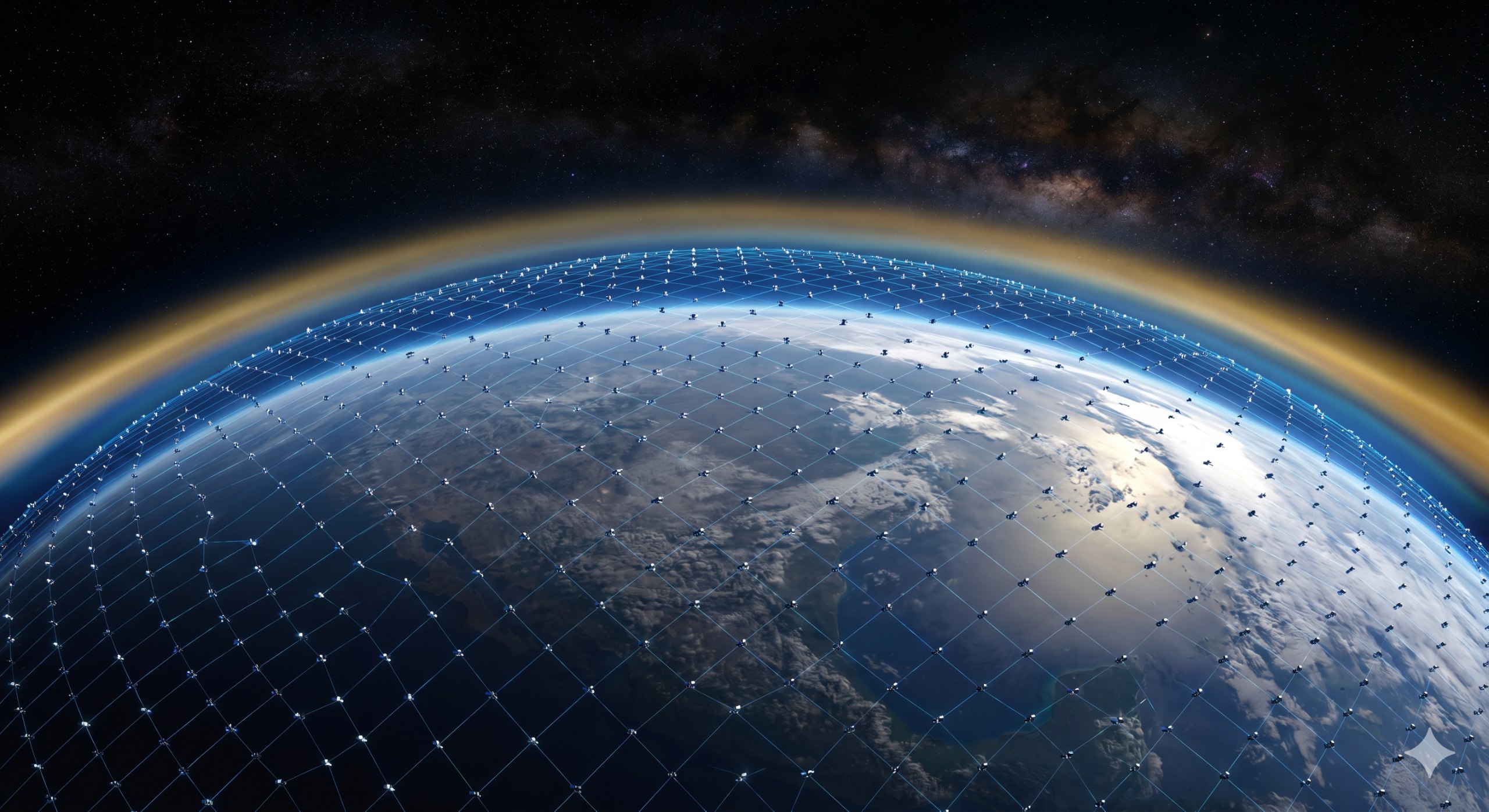
SpaceX’s Starlink constellation has crossed a transformative threshold: more than 7,500 satellites are now operational in low Earth orbit, forming the largest artificial constellation in human history. But the headline number, impressive as it is, tells only part of the story. The third-generation Starlink satellites — designated Gen-3 or “V3” — represent a fundamental architectural advance over their predecessors, featuring next-generation laser crosslink terminals that create a fully meshed optical network in space, eliminating the need for ground station relay and enabling true global coverage over oceans, poles, and unserved land masses.
The Gen-3 deployment represents the maturation of a technology that SpaceX first conceptualized in 2015 and began deploying in prototype form in 2019. After six years of iterative development, over 150 dedicated launches, and billions of dollars in investment, the constellation has evolved from a proof-of-concept experiment into a commercial infrastructure asset with over 4 million subscribers across more than 100 countries and territories.
From Gen-1 to Gen-3: The Evolution
The original Starlink Gen-1 satellites, launched between 2019 and 2021, were relatively simple spacecraft. Each weighed approximately 260 kilograms and carried a single solar array, four phased-array antennas for user downlink, and two parabolic antennas for gateway uplink. They operated in orbits between 540 and 570 kilometers at inclinations of 53 degrees, providing coverage only between roughly 57 degrees north and south latitude. Critically, Gen-1 satellites lacked inter-satellite laser links, meaning each satellite required a ground station within approximately 1,000 kilometers to route traffic to the internet backbone.
The Gen-2 satellites, introduced in 2022, were a significant improvement. They added laser crosslink terminals — initially two per satellite, later expanded to four — enabling optical communication between satellites at speeds of up to 200 Gbps per link. This allowed the constellation to route traffic across space without ground station relay, extending coverage to the poles and oceans. Gen-2 satellites also featured improved phased-array antennas, more efficient power management, and a slightly higher mass of approximately 300 kilograms.
The Gen-3 satellites, first deployed in late 2024 and now constituting the majority of new launch payloads, are a generational leap. Each satellite weighs approximately 1,500 kilograms — five times heavier than Gen-1 — and is roughly the size of a small car. The increased mass is not wasted: Gen-3 satellites carry eight laser crosslink terminals, allowing each satellite to maintain simultaneous optical connections with eight neighboring satellites. This creates a truly redundant, self-healing mesh network where traffic can be rerouted around failed or obstructed links in milliseconds.
The Laser Crosslink Mesh
The laser crosslink system is the defining technological achievement of the Gen-3 architecture. Each terminal uses a solid-state laser operating at 1,550 nanometers — the same wavelength used in terrestrial fiber optics — modulated at speeds up to 200 Gbps per link. With eight terminals per satellite, a single Gen-3 satellite can handle up to 1.6 Tbps of aggregate optical throughput.
The terminals are mounted on gimbaled platforms that can track neighboring satellites with sub-arcsecond precision, maintaining lock over distances ranging from a few kilometers during orbital insertion to more than 5,000 kilometers at the edge of the optical horizon. The acquisition sequence — finding and locking onto a target satellite moving at 7.5 kilometers per second — takes less than 30 seconds, enabled by a combination of GPS-predicted ephemeris data and a wide-angle acquisition camera that captures the target satellite’s laser beacon.
The mesh topology is designed for resilience. Each satellite maintains connections with four in-plane neighbors (ahead and behind in the same orbital plane) and four cross-plane neighbors (in adjacent orbital planes). This creates a grid-like network where data can travel from any satellite to any other satellite through a maximum of approximately six optical hops. The routing algorithm — a custom implementation of optimized link-state routing (OLSR) — continuously adapts to changing topology as satellites drift, are raised or lowered in orbit, or fail.
SpaceX has demonstrated end-to-end latency of less than 20 milliseconds between two user terminals connected via the laser mesh, even when the terminals are separated by 5,000 kilometers and the data path crosses multiple satellites. This compares favorably with terrestrial fiber, where the speed of light in glass introduces approximately 8 milliseconds of latency per 1,000 kilometers, and with Gen-2 systems that required ground station relay for long-distance traffic.
Coverage and Capacity
With 7,500-plus satellites operational, the Gen-3 constellation provides continuous coverage from 70 degrees north to 70 degrees south latitude — essentially the entire inhabited world plus the Arctic and Antarctic research stations. The polar coverage gap has been closed by the deployment of satellites in high-inclination orbits (97.6 degrees), which dwell over the polar regions for extended periods.
The system’s total capacity is staggering. Each Gen-3 satellite can serve approximately 4,000 user terminals simultaneously at an average throughput of 50 Mbps per terminal, giving a per-satellite capacity of 200 Gbps. With 7,500 satellites, the constellation’s aggregate capacity exceeds 1.5 Tbps of user-facing throughput, before accounting for the laser mesh backbone.
In practice, capacity is constrained by spectrum allocation, gateway connectivity, and the density of user terminals in a given geographic area. In low-density regions — rural Alaska, the Australian outback, the Sahara — individual users can experience speeds of 500 Mbps or higher during off-peak hours. In high-density urban areas, where Starlink competes with terrestrial fiber and cable, speeds are more modest — typically 50 to 150 Mbps — but still competitive with many terrestrial broadband offerings.
The Gen-3 satellites also support mobile applications. The laser crosslink mesh enables seamless handoffs for aircraft, maritime vessels, and ground vehicles, maintaining connectivity as the user terminal moves between satellite coverage cells. Starlink Aviation now offers in-flight connectivity with speeds of up to 350 Mbps per aircraft, and Starlink Maritime provides similar capability for commercial shipping, cruise lines, and offshore energy platforms.
Launch Cadence and Deployment Strategy
SpaceX’s ability to build and launch satellites at unprecedented scale is central to the Gen-3 deployment strategy. The company operates a dedicated satellite manufacturing facility in Redmond, Washington, capable of producing approximately 120 Gen-3 satellites per week. This rate is enabled by a highly automated production line that integrates solar panel layup, antenna assembly, laser terminal alignment, and environmental testing into a continuous flow.
The launch cadence matches the production rate. SpaceX is currently conducting Starlink-dedicated Falcon 9 launches approximately every two to three days from both Cape Canaveral and Vandenberg Space Force Base. Each Falcon 9 carries 22 to 24 Gen-3 satellites, depending on the specific orbit and mission profile. The first stage boosters used for Starlink missions are typically flown 15 to 20 times before retirement, and payload fairings are recovered and reused, driving per-satellite launch costs below $200,000.
The orbital deployment strategy is methodical. Satellites are released into an initial parking orbit at approximately 280 kilometers, then raise themselves to their operational orbit (typically 550 kilometers) using their onboard ion thrusters. The raise takes two to four months, during which the satellite undergoes a comprehensive checkout process. Once at operational altitude, the satellite opens its laser terminal covers, acquires its neighbors, and begins routing traffic.
SpaceX’s Federal Communications Commission (FCC) license authorizes up to 12,000 Gen-3 satellites in the current filing, with an additional 30,000 proposed in a supplementary application. Given the current launch rate and satellite production capacity, the constellation could reach 12,000 satellites within 12 to 18 months if regulatory approvals remain in place.
Impact on Astronomy and Space Sustainability
The rapid expansion of the Starlink constellation has not been without controversy. The astronomical community has raised persistent concerns about satellite brightness, particularly during twilight hours when sunlight reflects off the satellites’ solar panels and antennas. Early Gen-1 satellites were bright enough to leave visible streaks in astronomical exposures, interfering with both professional survey telescopes and amateur observations.
SpaceX has responded with a series of mitigations. Gen-2 satellites introduced a dielectric mirror coating on the solar panels that reduced reflected sunlight by approximately 50 percent. The Gen-3 satellites go further, incorporating visors that shade the reflective surfaces, a satellite orientation scheme that minimizes the cross-section visible from the ground, and a “dark sky” operating mode that dims the satellite’s body during twilight. The International Astronomical Union has acknowledged these improvements, though some observatories — particularly the Vera C. Rubin Observatory in Chile — remain concerned about the cumulative impact of 12,000-plus satellites.
Space sustainability is another dimension of concern. Starlink satellites are designed to be fully demisable — they burn up completely on reentry without leaving debris large enough to survive reentry — and they carry ion thrusters for active collision avoidance and end-of-life deorbiting. The satellites have a planned operational lifespan of approximately five years, after which they perform a controlled deorbit burn that brings them into the atmosphere within one to two years. SpaceX reports a satellite disposal success rate exceeding 97 percent, with the remaining 3 percent accounted for by satellites that failed shortly after deployment and could not be actively deorbited.
Despite these mitigations, the scale of the constellation raises systemic concerns. With 7,500 satellites in orbit, the probability of collision with other objects increases nonlinearly. SpaceX operates an automated collision avoidance system that screens each satellite’s orbit against the U.S. Space Force’s catalog of tracked objects and performs avoidance maneuvers as needed — at a rate of approximately 25,000 maneuvers per year across the constellation. In the rare cases where collision risk exceeds thresholds, the relevant satellite conducts a pre-planned burn to alter its trajectory.
Competitive Landscape
SpaceX’s dominance in the satellite broadband market is not going unchallenged. Amazon’s Project Kuiper has received FCC authorization for 3,236 satellites and has begun launching production satellites, though the constellation is still in its infancy. Kuiper promises comparable performance to Starlink Gen-3, with laser crosslinks and phased-array user terminals, but faces a multi-year launch deficit.
The European Union’s IRIS² (Infrastructure for Resilience, Interconnection and Security by Satellites) program plans a constellation of approximately 290 satellites for government and commercial use, though with a significantly smaller footprint than Starlink. Canada’s Telesat is deploying the Lightspeed constellation, focused on enterprise and government customers. China has announced the “Guowang” constellation, a 13,000-satellite LEO broadband network, though deployment appears to be in early stages.
OneWeb, which operates a constellation of approximately 650 satellites, was acquired by Eutelsat in 2023 and is pivoting toward government and enterprise connectivity, leaving the consumer broadband market largely to Starlink. The constellation size and throughput capabilities of all competitors combined remain dwarfed by Starlink’s Gen-3 deployment.
Economic and Geopolitical Implications
The Gen-3 constellation’s most profound impact may be economic and geopolitical. Universal, high-speed internet connectivity has historically been constrained by the economics of terrestrial infrastructure: laying fiber to remote areas is expensive, and wireless backhaul is limited by line-of-sight and spectrum availability. Starlink bypasses these constraints entirely, delivering connectivity anywhere the sky is visible.
For developing nations with limited terrestrial infrastructure, Starlink offers a path to leapfrog the fiber era entirely. Schools in rural Zambia, hospitals in the Amazon basin, and government offices in Pacific island nations can now access the global internet at speeds comparable to urban fiber connections. The economic multiplier effects of universal connectivity are well-documented: every 10 percent increase in broadband penetration is associated with a 1 to 2 percent increase in GDP growth.
The geopolitical dimension is more complex. Starlink has become a critical infrastructure asset for Ukraine’s defense against Russian aggression, providing resilient connectivity even as terrestrial networks are bombarded. This has elevated SpaceX to a quasi-geopolitical actor — a private company whose technical decisions about which regions to serve, and on what terms, have national security implications.
The Gen-3 constellation’s global coverage also raises questions about sovereignty and control. Traffic routed through the laser mesh passes through no national jurisdiction — it travels entirely through space — making it difficult for nations to intercept or regulate. This has prompted concerns from governments accustomed to controlling internet traffic within their borders, and has led to Starlink being denied operating licenses in several countries including China, Iran, North Korea, and parts of the Middle East.
The Future: Direct-to-Cell and Beyond
SpaceX’s long-term vision for the Starlink constellation extends beyond conventional broadband. The Gen-3 satellites include experimental payloads for “Direct-to-Cell” service — the ability to connect standard unmodified smartphones directly to the satellite, bypassing the need for a dedicated user terminal.
Direct-to-Cell operates in the cellular spectrum bands (specifically, the 1.9 GHz band for voice and SMS, and various mid-band frequencies for data). The satellites carry phased-array antennas optimized for terrestrial smartphone signals, which are orders of magnitude weaker than dedicated Starlink terminal signals. Initial service will support text messaging, with voice and basic data connectivity planned for subsequent phases.
The potential impact is enormous. Hundreds of millions of people live in areas without any cellular coverage — remote villages, wilderness areas, open ocean. Direct-to-Cell Starlink would provide a basic connectivity safety net, enabling emergency communications, location sharing, and essential messaging. SpaceX has partnered with T-Mobile in the United States and with carriers in several other countries to provide the service.
Beyond Direct-to-Cell, SpaceX’s long-range planning for the constellation includes Earth observation capabilities (potentially competing with Planet Labs and Maxar), hosted payloads for government and scientific customers, and eventually, space-based data centers that process and store data in orbit rather than transmitting it to ground stations.
Conclusion
The Starlink Gen-3 deployment, now surpassing 7,500 operational satellites with a fully meshed laser crosslink network, represents one of the most ambitious infrastructure projects ever undertaken. It is the largest constellation in history by an order of magnitude, built at a pace that has surprised even industry veterans, and it is already transforming connectivity in regions that traditional telecom infrastructure has never reached.
The technology is impressive — the laser terminals, the phased arrays, the autonomous collision avoidance, the mass-manufacturing of spacecraft — but the real achievement is the system-level integration. A network of 7,500 satellites, each communicating with its neighbors at 200 Gbps, routing traffic dynamically around failures and congestion, serving millions of users across more than 100 countries, operating 24 hours a day, 365 days a year: this is the kind of engineering that changes what civilization considers possible.
The constellation is not without its challenges — astronomical interference, space debris risks, geopolitical complexities, and the sheer hubris of building a global communications infrastructure under private control. But the trajectory is clear: LEO satellite broadband is no longer an experimental technology or a niche service. It is a fundamental layer of the global internet, and Starlink’s Gen-3 deployment has made it so.
Disclaimer: This article is for informational purposes only. Starlink service availability, speeds, and pricing vary by region and are subject to regulatory approval. Satellite constellation data is based on publicly available tracking and SpaceX disclosures. Orbital operations involve inherent risks, and future deployment timelines may change.