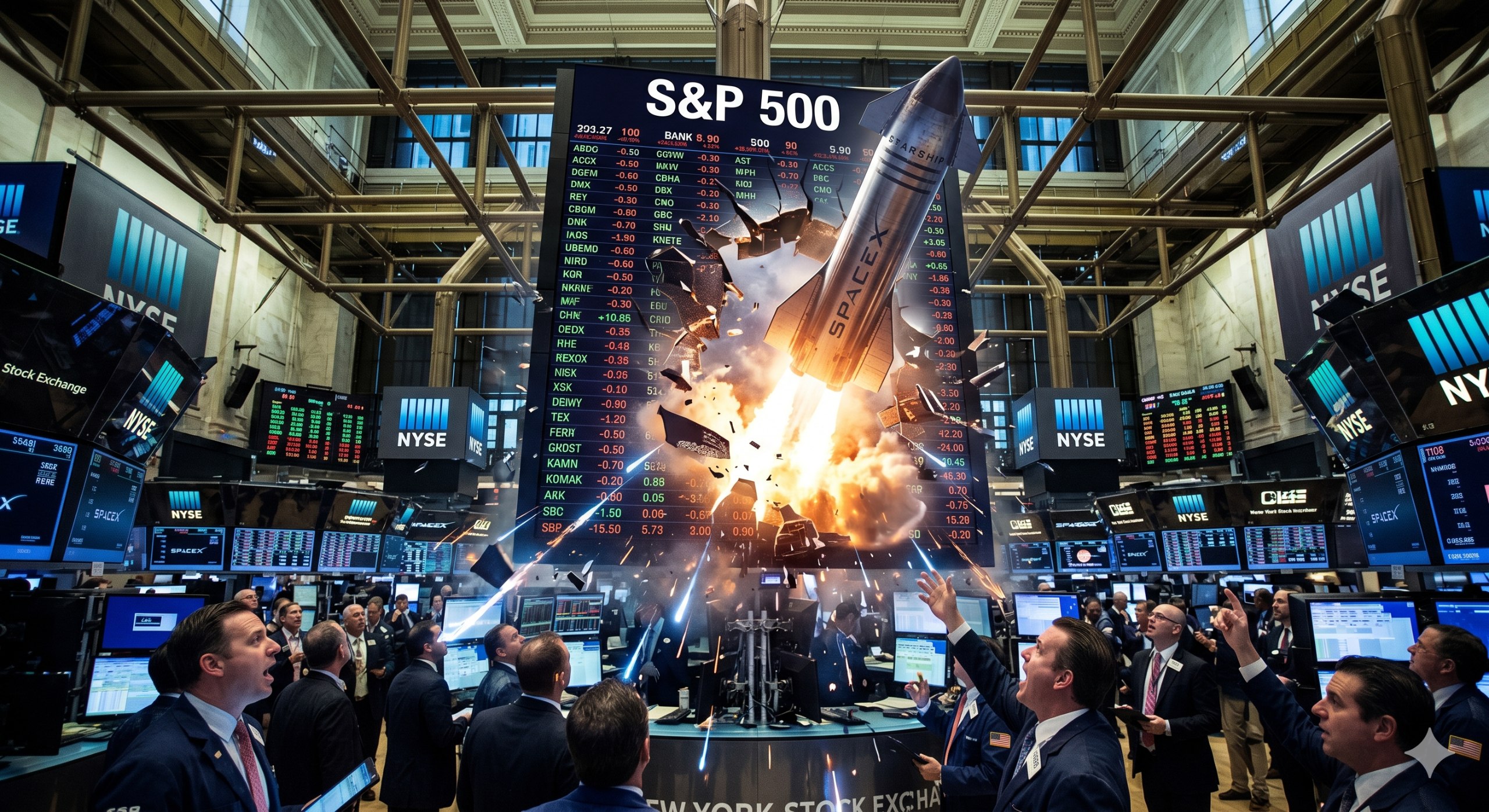
S&P 500 Closes Fast Track: SpaceX Mega IPO Loses Index Fund Buying
June 5, 2026 — A formal ruling from S&P Dow Jones Indices sent a collective gasp through Wall Street investment banks and the global space investment community. S&P explicitly announced that SpaceX, as well as other potential mega IPOs, will no longer be permitted to use the fast-track mechanism for inclusion in the S&P 500 or related benchmark indices. The brief, unusually resolute statement landed like a bombshell on SpaceX's $1.75 trillion valuation and its $75 billion fundraising.
Why This Matters
S&P's decision directly strips away what would have been the single most important stock catalyst for SpaceX post-IPO: the Index Effect. In an era when passive investing dominates Wall Street, joining the S&P 500 is far more than a badge of honor. Academia and trading floors have long reached a broad consensus on the "Index Effect": once a stock is announced for inclusion in a benchmark index, it typically generates 4% to 8% excess returns between announcement and effective date. The reason has nothing to do with fundamentals — it's structural compulsion. Index funds have no choice but to buy.
Global ETF and mutual fund assets tracking the S&P 500 total approximately $5 trillion. At SpaceX's $1.75 trillion market cap, its weighting in the index would fall around 3% to 3.5%. That means, had the fast track been available, passive funds would have been forced to buy roughly $175 billion worth of SpaceX stock in an extremely short timeframe. This capital represents pure "inelastic demand" for the share price.
With the fast track officially closed, that massive wave of buying power will be postponed until the next regular quarterly rebalancing (as early as September 2026, subject to profitability threshold requirements). SpaceX's share price in the early days of trading will be fully exposed to sentiment-driven positioning by active fund managers, hedge funds, and retail investors — stripped of the safety net that index funds would have provided as "default buyers."
Historical Precedent: Fast Track Is Extremely Rare
S&P's hardline stance is not without precedent. Historically, true fast-track treatment has been exceedingly rare:
- Meta (Facebook, 2012–2013): Waited nearly a year and a half after IPO, finally joining through regular quarterly rebalancing in December 2013.
- Tesla (2020): S&P made an exception in November 2020 by adding all outstanding shares at once, but this was an emergency rescue due to unacceptably large index tracking error, not a standard fast track.
- Google (2006): Accepted the normal queue, waited for quarterly rebalancing.
- Coinbase / Palantir: High-profile recent IPOs, neither received any special track treatment.
S&P almost exclusively opens the fast track for large M&A deals or corporate spin-offs (such as the Kraft Heinz merger, AT&T spin-off). For SpaceX, the door has slammed shut more decisively than anticipated.
Five Impacts on the SpaceX IPO
1. IPO Pricing Ceiling Under Pressure
A $75 billion fundraising requires immense buy-side digestion capacity. Without index funds as default buyers, the underwriting syndicate must invest significantly more effort in roadshow presentations to active funds. Active fund managers focus solely on free cash flow and market moats, which may force conservative pricing and impair fundraising efficiency.
2. Shareholder Structure Shifts Toward Higher Volatility
Without the long-term underlying position of index funds, retail speculators and momentum traders will fill the gap. Daily price swings in SpaceX shares during early listing could be unusually violent — reminiscent of meme stocks rather than traditional blue-chip tech stocks.
3. VC Exit Path Extends
For early investors (a16z, Founders Fund, Fidelity, etc.), the expected ultimate buyer — index funds — has disappeared. They must recalibrate valuation expectations and wait patiently for regular buying when the half-year window arrives.
4. Free Float Scarcity Reassessed
S&P imposes strict requirements on free-float market capitalization. A substantial portion of SpaceX shares is held by Musk and early employees. If the free-float ratio is too low, the actual index weighting could be heavily discounted.
5. Market Sentiment Cools
Following the announcement, concept stocks such as Rocket Lab (RKLB) and AST SpaceMobile (ASTS) experienced notable late-day sell-offs. The market interpreted this as a cautionary signal on the space concept bubble.
Ripple Effects on the Space Industry IPO Ecosystem
SpaceX's rejection is not just a single company's problem. Rocket Lab, Redwire, and others — though far smaller in scale — share the same conceptual category: commercial space. When the leading index shows such caution toward the sector's dominant player, the entire segment's "index expectation value" will inevitably be revised sharply downward.
Long-Term Outlook
SpaceX's eventual inclusion in the S&P 500 is almost certain, provided it meets the profitability threshold. Based on recent financial filings, Starlink revenue has already pushed the company into stable profitability, so the earnings hurdle should not be an issue.
The real variables are time and price re-anchoring. S&P's ruling pulls SpaceX out of the "hunger games of index share-grabbing" and onto the "calm track of long-term fundamental reassessment." For Elon Musk, this may not be entirely a bad thing — the company's grand strategy will have more time to be independently absorbed into the share price, rather than being swept along by hasty index capital flows.
For visionary investors, this means a more rational entry opportunity. Before the tide of "inelastic buying" surges in, true space believers have the chance to secure a ticket to interplanetary civilization at a more reasonable price.