Mars Transport Architecture: SpaceX's Technical Roadmap for Starship Colonization
When Elon Musk first presented the "Interplanetary Transport System" (ITS) at the 2016 International Astronautical Congress (IAC), most industry insiders dismissed it as a science-fiction vision. A decade later in 2026, that vision has crystallized into a detailed engineering architecture document — SpaceX Mars Architecture v4.0 — containing specific vehicle performance parameters, propellant refueling schemes, Mars surface operation procedures, and human physiological protection measures. This is no longer a paper exercise but a transportation system under construction.
Core Logic of the Transport Architecture
The core design principle of the Starship Mars transport system is "full reusability" and "in-situ resource utilization." The entire architecture is built on a closed-loop logic: the Starship Super Heavy booster sends the Starship spacecraft into orbit then returns to the launch pad; the Starship receives propellant refueling in orbit before flying to Mars; upon arrival on Mars, it uses local carbon dioxide and subsurface water to produce methane and oxygen for the return journey via the Sabatier reaction.
The current architecture operates on a 26-month Mars launch window cycle. During each window, SpaceX plans to launch a convoy of 4 to 6 cargo Starships and 2 crewed Starships. Each cargo Starship carries approximately 100 tons of supplies, equipment, and construction materials, while the crewed Starship can accommodate up to 100 passengers. The target launch window for the first crewed mission is 2031, requiring at least 4 cargo verification missions beforehand.
Orbital Refueling: The Prerequisite for Everything
Whether Mars transportation can be realized critically depends on orbital refueling technology maturity. According to SpaceX's engineering models, a Starship bound for Mars requires approximately 1,200 tons of propellant to be loaded in Earth orbit, equivalent to 8 to 12 refueling docking missions. Considering that each tanker spacecraft itself also needs refueling to return to Earth, the entire system requires an "orbital fuel depot" network of dedicated tanker spacecraft.
In 2025, SpaceX completed qualification testing of the next-generation "Raptor 3" vacuum engine at its McGregor, Texas test facility, achieving a specific impulse (Isp) of 380 seconds — approximately a 5% improvement over Raptor 2. This improvement comes at just the right time — higher specific impulse means each refueling mission can carry more usable propellant, reducing the number of required refueling dockings. SpaceX's target is to reduce refueling dockings to 6 to 8 by 2028, further simplifying mission planning.
Survival Solutions on the Martian Surface
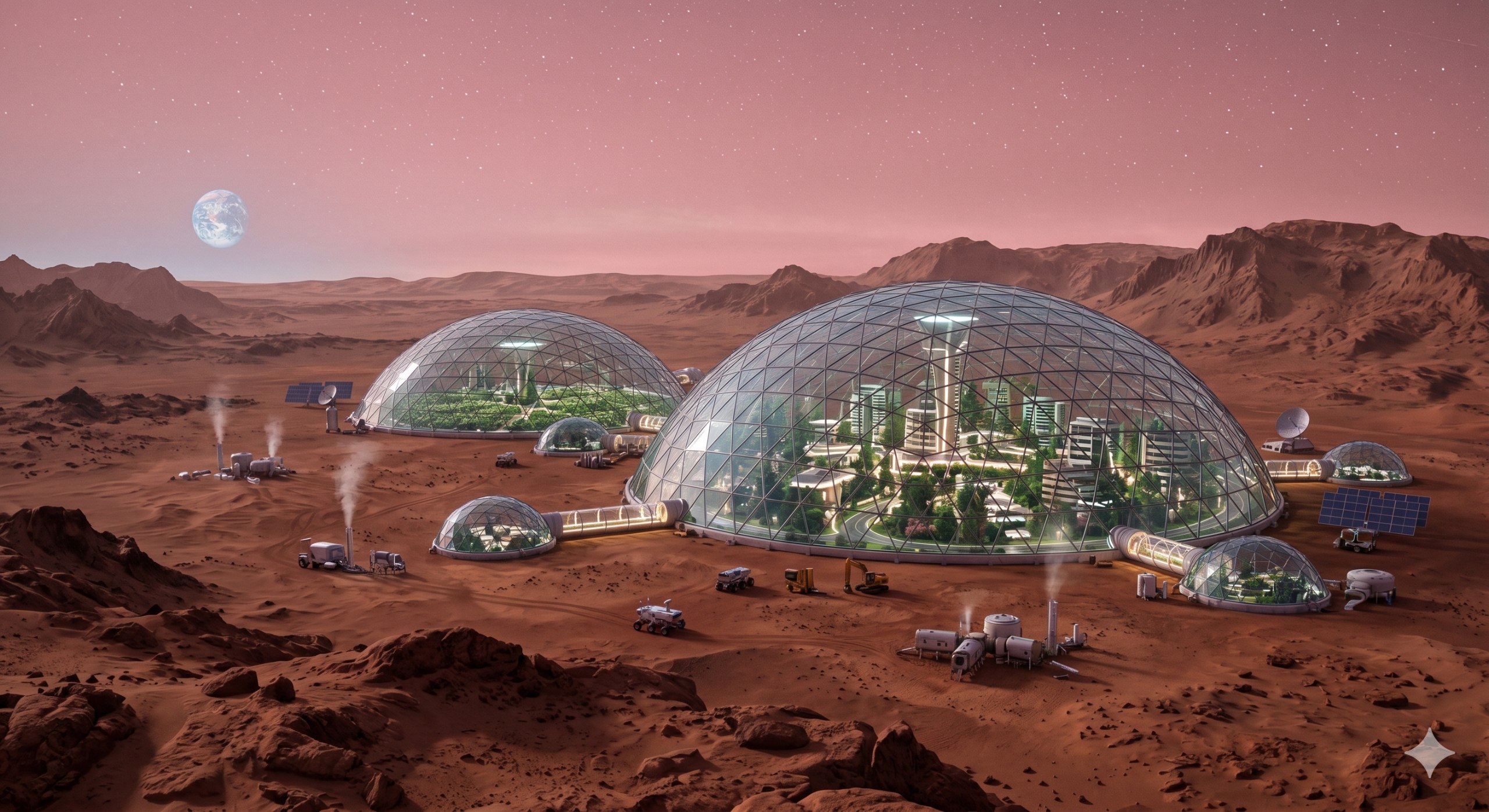
Once Starship lands on Mars, it serves not merely as a transport vehicle but as a prefabricated base core. Starship's cargo bay contains deployable living modules, airlocks, solar arrays, and ISRU (In-Situ Resource Utilization) equipment. The first cargo Starships to land will automatically deploy solar arrays — totaling over 5,000 square meters with total power generation of approximately 1.5 MW — and activate the ISRU plant.
The ISRU plant is the technological cornerstone of the entire Mars colonization plan. Through a series of chemical reactions, it combines carbon dioxide — which constitutes approximately 96% of the Martian atmosphere — with water extracted from subsurface ice to produce methane (rocket fuel) and oxygen (fuel oxidizer and breathing air). SpaceX's engineering prototype achieved 24-hour continuous production in a simulated Mars environment in Texas in 2025, producing about 1 ton of methane-oxygen mixture per day. At this efficiency, a single ISRU plant could produce the approximately 480 tons of propellant needed for a return Starship within 26 months.
For habitation, Starship's pressurized living space is approximately 1,100 cubic meters — equivalent to the volume of a three-story building. The first colonists will face extreme environmental conditions: average Mars temperature is -63°C, atmospheric pressure is only 0.6% of Earth's, and there is no magnetic field protection. Starship's steel hull structure provides basic radiation protection, but the long-term solution involves covering the hull exterior with Martian regolith to form an additional approximately 1-meter-thick radiation shielding layer.
Physiological and Psychological Challenges
Perhaps the most severe challenge of crewed Mars missions is not engineering but human physiology. The Earth-to-Mars transit flight takes approximately 6 to 9 months, during which astronauts are continuously exposed to cosmic radiation and microgravity. NASA's Human Research Program (HRP) data indicates that deep-space flights exceeding 6 months could result in bone density loss of 10% to 15%, along with significant cardiovascular system degradation.
SpaceX's architecture includes multiple mitigation measures. Starship is equipped with a rotating artificial gravity section — approximately 12 meters in diameter, rotating at 4 revolutions per minute to generate approximately 0.3 G of equivalent gravity. While far below Earth's 1 G, this is sufficient to prevent the most severe physiological deterioration. Additionally, Starship's radiation shielding includes a dedicated "storm shelter" — a compact space surrounded by polyethylene and aluminum composite materials that provides protection during solar proton events.
Observatory Analysis
Examined from a techno-economic perspective, Starship's Mars transport architecture faces a core contradiction: enormous upfront investment versus uncertain return timelines. According to aerospace industry estimates, developing and completing the entire Mars transport system requires cumulative investment of approximately $20 billion to $50 billion. While SpaceX's revenue base — Starlink projected to generate over $12 billion in 2026 — provides unprecedented financial support, the business model for Mars colonization still has fundamental uncertainties.
Key milestones to watch include: the first orbital refueling demonstration in the second half of 2026 (initial verification completed), Starship's first uncrewed lunar landing in 2027 (Artemis-related mission), and the launch of the first uncrewed Mars cargo mission in 2028. If these milestones are achieved on schedule, the credibility of the entire blueprint will be greatly enhanced.
Another angle worth observing is the global competitive landscape. CNSA detailed its Mars sample return mission plans in 2025, scheduled for execution around 2030. While not comparable in scale to crewed Mars missions, it signals that Mars has become a strategic focus for major space powers.
Looking Ahead
Looking forward five years, the Starship Mars transport architecture will transition from paper design to physical construction and testing. In 2027, the first dedicated Mars Starships — equipped with ISRU modules and pressurized habitation compartments — will begin construction at Starbase. During the 2028 Mars window, SpaceX plans to launch an uncrewed verification Starship named "Red Dragon" to test landing precision and initial ISRU functionality on the Martian surface.
The true turning point will come in 2031. If everything proceeds according to plan, the first human colonists will set foot on the Martian surface that year. Just as Neil Armstrong's "one small step" marked the beginning of an era, the footprints of the first Mars colonists will mark the historical starting point of humanity becoming a multi-planetary species. And in this process, Starship is not merely a rocket — it is the transport artery of human civilization's future, the lifeline connecting Earth and Mars.
Disclaimer: This article is written by POC.HK Future Technology Observatory based on publicly available information and independent analysis. The timelines and technical parameters mentioned are from SpaceX public disclosures and third-party estimates; actual progress may vary significantly due to technical, regulatory, and funding factors.