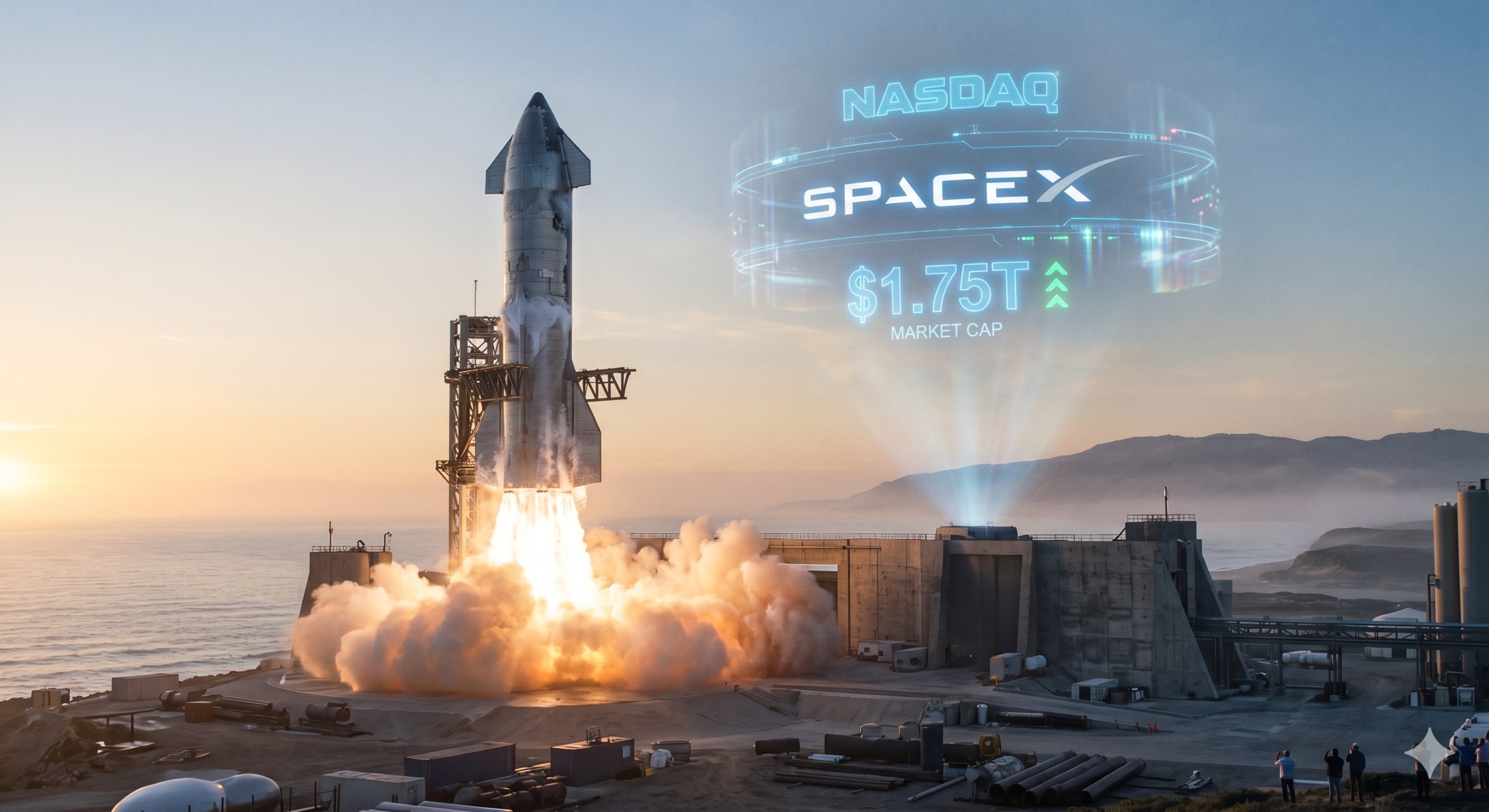
The Largest IPO in History Arrives: The Deep Logic Behind SpaceX's $75 Billion Raise at a $1.75 Trillion Valuation
On June 4, 2026, SpaceX submitted an updated IPO prospectus to the U.S. Securities and Exchange Commission (SEC), officially unveiling the most spectacular public offering in human capital markets history. The company plans to issue 555.5 million shares of Class A common stock at $135 per share, raising at least $75 billion and implying a valuation exceeding $1.75 trillion — not only a milestone for the space industry, but a potential rewrite of global IPO market history.
I. From the PayPal Mafia to Space Unicorn: SpaceX's Road to IPO
Founded in 2002, SpaceX remained privately held for twenty-four years. Founder Elon Musk repeatedly stated publicly that SpaceX would wait until the Starship Mars transportation system was more mature before considering an IPO. This stance was consistent with his criticism of public companies driven by quarterly earnings pressure, making it difficult to pursue long-term goals.
However, a decision in February 2026 changed the landscape — SpaceX acquired Musk's AI company xAI in an all-stock transaction. This deal not only brought the Grok large language model and AI computing infrastructure into SpaceX's fold, but also gave birth to a new strategic direction: the "orbital data center." According to the prospectus, SpaceX plans to deploy up to 1 million orbital data center satellites to accommodate growing AI computing loads.
On May 20 of the same year, SpaceX confidentially submitted an S-1 registration statement to the SEC, followed by a public update on June 3 containing share quantities and offering prices. The speed of this process reflects the company's acute judgment of the market window — in a macro environment where AI mania is driving tech valuations higher and global liquidity remains abundant, going public now captures the most favorable strategic timing.
II. $1.75 Trillion: How to Understand This Unprecedented Valuation?
To understand SpaceX's $1.75 trillion valuation, one cannot simply look at the fundamentals of its traditional business. The valuation must be deconstructed into three layers of logic.
Layer One: The Core Business Foundation
SpaceX's core revenue comes from launch services and Starlink satellite broadband. According to the prospectus and market reports, SpaceX generated $18.7 billion in revenue for full-year 2025, with Starlink having become the primary cash flow engine. Q1 2026 revenue was $4.7 billion.
Under a traditional valuation framework, this corresponds to a price-to-sales (P/S) ratio of approximately 9.4x. For comparison, Lockheed Martin (LMT) trades at roughly 1.7x sales, and Boeing (BA) at approximately 2.2x. Even accounting for SpaceX's high-growth profile, a P/S ratio above 9x reflects a substantial market premium for future business.
Layer Two: Starship and Mars Colonization Option Value
The prospectus explicitly lists Starship development and production as one of the use cases for the raised funds. Starship is not only a critical vehicle for NASA's Artemis program, but also carries Musk's ultimate vision of making humanity a "multi-planetary species." The fully reusable system composed of the Super Heavy booster and Starship upper stage could theoretically reduce per-kilogram launch costs to tens of dollars, fundamentally disrupting the economic model of space transportation.
For long-term investors, Starship is not just a rocket — it is a "real option" for Mars. Its potential value is so enormous that it cannot be measured by traditional DCF (Discounted Cash Flow) models.
Layer Three: The AI + Space Convergence Narrative
What truly pushes SpaceX's valuation past the trillion-dollar threshold is the deep integration of AI and space infrastructure. In Q1 2026, SpaceX's capital expenditures reached $10.1 billion, with $7.7 billion going to the AI division. The company posted a net loss of $4.3 billion in the quarter, compared to a full-year 2025 net loss of $4.9 billion — the driver of losses is not launch or satellite operations, but massive AI investment.
The xAI acquisition gave SpaceX large-scale AI computing infrastructure, while the "orbital data center" concept envisions putting GPU clusters into space. Although this vision faces formidable technical hurdles — heat dissipation, radiation hardening, and massive solar array scale among them — Musk's track record of making the impossible possible in reusable rockets and electric vehicles gives the market strong confidence.
Space industry analyst Armand Musey commented: "The pricing of SpaceX's IPO is a bet on Elon Musk and his team's ability to deliver new products and services — products that either don't exist yet or that we haven't even imagined."
III. Use of Proceeds: Strategic Allocation of the Largest Arsenal in History
After deducting offering expenses, SpaceX expects net IPO proceeds of $74.4 billion. If underwriters fully exercise their overallotment options, the total could reach $85.7 billion. The use of these funds is clearly directed toward four areas:
- AI Computing Infrastructure Expansion: Including the construction of terrestrial data centers and orbital data center constellations
- Launch Infrastructure and Rocket Upgrades: Starship engineering iteration and production line expansion
- Satellite Constellation Scale and Capacity Enhancement: Starlink Gen2 system and V3 satellite deployment
- General Corporate Purposes: Working capital and potential strategic acquisitions
Notably, the $85.7 billion fundraising scale far exceeds the $29.4 billion record set by Saudi Aramco in 2019, previously the world's largest IPO. Moreover, the shares being issued in this offering represent less than 5% of SpaceX's total outstanding shares — in other words, an extremely small equity dilution, reflecting Musk's and early investors' intense desire to retain control.
IV. Corporate Governance: Musk's Super Voting Power and "Controlled Company" Status
A critical detail in the prospectus is that Elon Musk will hold 82.4% of the voting power. SpaceX employs a dual-class stock structure: publicly issued Class A shares carry one vote per share, while Musk's Class B shares carry ten votes per share. This means that even with substantial economic interests held by the public market, Musk retains absolute control over major corporate matters, including board elections, mergers and acquisitions, and charter amendments.
Upon listing on Nasdaq, SpaceX will be classified as a "controlled company." Under Nasdaq rules, such companies are not required to have a majority of independent directors on their board. This structure is not uncommon among Silicon Valley technology companies — Alphabet, Meta, and Snap have all employed similar designs — but SpaceX's case binds Musk's individual decision-making authority to a company valued at $1.75 trillion, which will inevitably spark debate under Wall Street's ESG and corporate governance standards.
V. The Far-Reaching Impact on the Space Industry
SpaceX's IPO is not merely a capital markets event — it could become a watershed moment for the global space economy.
The Capital Markets Demonstration Effect
For years, space startups have faced the challenge of "unclear exit paths." Traditional space companies have largely relied on government contracts, making their valuation models difficult to compare with SaaS or semiconductor companies. SpaceX's mega-scale IPO will attract a wave of mainstream institutional investors to reassess the space asset class. As attorney Ross Carmel put it: "When you combine the world's most advanced space company with the greatest dreamer and entrepreneur of our generation, you can't determine valuation based on current metrics — you have to look at SpaceX's future potential in space, AI, and energy."
Ripple Effects Across the Industry
A successful SpaceX IPO will open a financing window for other space companies. Competitors such as Blue Origin, Rocket Lab, and Relativity Space may accelerate their own capital markets strategies. Applied Aerospace and Defense completed a $650 million IPO on June 3, in a sense securing investor attention before the "SpaceX effect."
Retail Investor Participation
According to reports, SpaceX plans to allocate up to 30% of shares to retail investors. Given the enthusiastic demand from global retail investors — the company's shares have consistently traded at a premium in secondary markets — this allocation ratio will dramatically reshape the landscape of retail participation in space investing.
VI. Risks and Questions: Can the $1.75 Trillion Valuation Hold?
Despite the compelling narrative, SpaceX's valuation faces risks that cannot be ignored.
- Temporal Mismatch in Profitability: Full-year 2025 net loss of $4.9 billion, Q1 2026 net loss of $4.3 billion — the loss trend is clearly widening. When massive AI capital expenditures will translate into positive cash flow remains unknown.
- Feasibility of Orbital Data Centers: Armand Musey stated bluntly: "Space data centers face challenges including space-grade hardware costs, launch costs, giant solar arrays, and thermal management. All things considered, it's hard to see why space would be better than Earth for data centers."
- Regulatory and Geopolitical Risks: Starlink faces spectrum allocation and landing rights regulation in many countries. Starship launch licenses are subject to FAA and other agency approvals. Intensifying US-China space competition could also impact supply chains and market access.
- Musk Concentration Risk: 82.4% voting power means the company's strategic direction is highly dependent on one individual's judgment. Musk simultaneously manages Tesla, xAI, X (formerly Twitter), and other companies — the risk of attention fragmentation is material.
VII. Looking Ahead: A New Era of Space Capitalism
SpaceX's IPO is expected to close in mid-June, at which point it will trade on Nasdaq under the ticker "SPACEX." This is not just a new chapter in Musk's personal story, but marks a historic inflection point where the space economy transitions from government-led and institution-dominated to broad public participation.
When a space company's valuation exceeds that of Visa, Meta, or Tesla itself, we must fundamentally rethink the definition of "space" as an asset class. Against the backdrop of exploding AI computing demand and increasingly constrained terrestrial resources, SpaceX's story is ultimately about how humanity extends economic activity beyond Earth's atmosphere — and this $75 billion raise is the largest bet humanity has ever placed on that future.
What investors receive is not just stock in a company, but a ticket to an interplanetary civilization.
References
- SpaceNews, "SpaceX to raise at least $75 billion in IPO", Jeff Foust, June 4, 2026
- SpaceNews, "SpaceX quietly files for big bang IPO", Jason Rainbow, May 20, 2026
- SpaceX SEC Filing, S-1 Registration Statement (Updated), June 3, 2026
- Bloomberg, "SpaceX Confidentially Files for IPO", May 2026
- Reuters, "SpaceX revenue estimated at $15-16 billion in 2025", January 2026