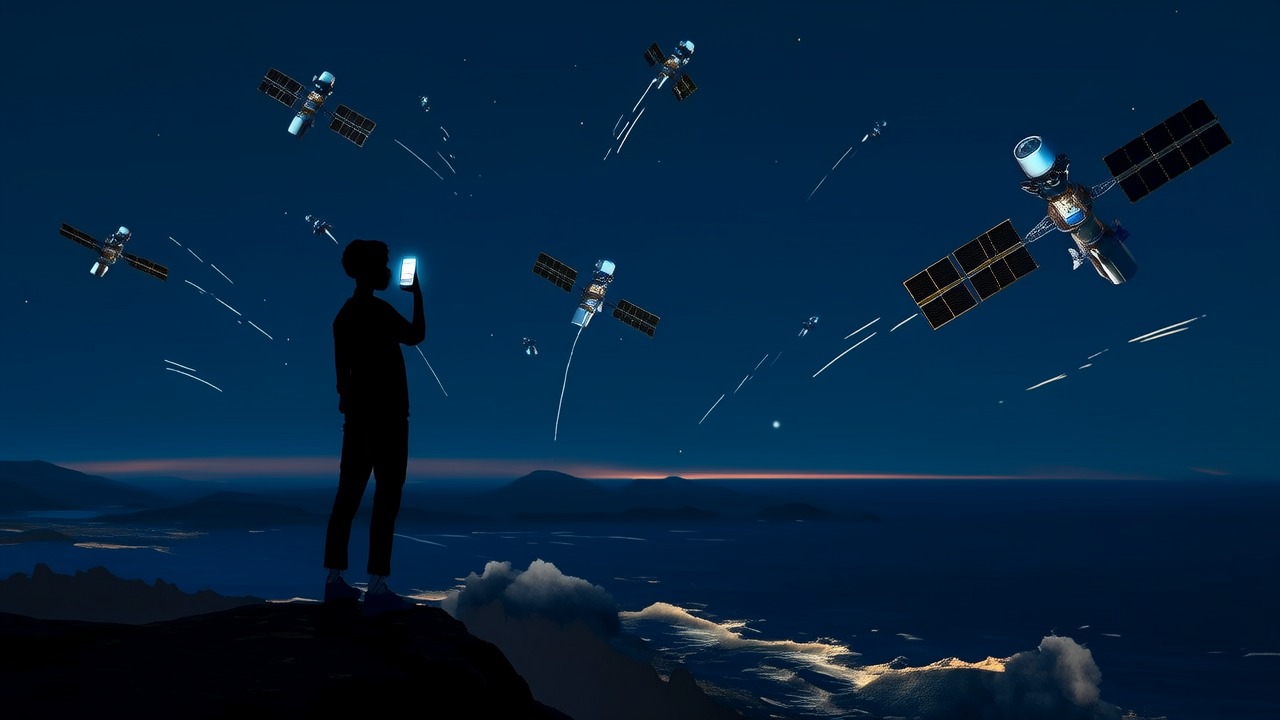
On June 20, 2026, Chinese satellite internet operator Spacesail (Shanghai Stack Satellites Technology, SSST) announced a milestone achievement: completing a voice call using an unmodified standard commercial smartphone, connected through its Qianfan (“Thousand Sails”) constellation. Call quality was described as “comparable to terrestrial 5G.” The news reverberated through global tech media from June 22-24, as it formally inserted China into the Direct-to-Cell (DTC) race previously dominated by SpaceX Starlink and AST SpaceMobile.
Technical Details: How Satellite Signals Reach Ordinary Phones
The test used the Spacesail DTC 01 satellite, launched on June 9 aboard a LandSpace Zhuque-2E rocket. The key technical breakthroughs lie in L-band digital phased array antenna technology and proprietary frequency offset compensation algorithms.
Standard smartphones transmit at only 200-600 milliwatts, while the satellite orbits at approximately 500-1,200 km altitude—equivalent to shouting from Earth and expecting someone hundreds of kilometers away to hear clearly. To solve this enormous link budget challenge, Spacesail’s satellite carries a large phased array antenna that creates a “gain hotspot” over thousands of square kilometers, precisely locking onto the test phone’s location.
Another critical challenge is Doppler shift compensation. Satellites travel at approximately 7.5 km/s, causing significant frequency偏移 that would disrupt calls without compensation. Spacesail’s proprietary algorithm calculates and compensates for this shift in real time, requiring no special configuration on the ground phone.
Importantly, Spacesail’s technical approach integrates deeply with 5G/6G standards rather than creating a separate satellite communications standard. This means future 5G Advanced and 6G networks can natively integrate terrestrial cellular and satellite direct links, enabling seamless handoffs without additional hardware or software.
Qianfan Constellation Deployment: Strategic Tempo
Spacesail’s Qianfan constellation—also known as “G60 Starlink”—experienced dramatic deployment acceleration in May 2026. In just 11 days, the company completed three launches using three different rocket types: Long March 8, Long March 6A, and Zhuque-2E, deploying satellites into different orbital planes. As of June 5, the constellation had reached 200 satellites in orbit.
This multi-rocket, high-density launch strategy reflects a two-layer strategic intent. The first layer is technical validation: by deploying across different orbital planes, Spacesail rapidly validates constellation coverage and inter-satellite link performance. The second layer is policy signaling: demonstrating to markets and competitors China’s commitment to satellite internet—Qianfan is a strategic industrial initiative backed by the Shanghai municipal government and central authorities alike.
Viewed more broadly, Qianfan synergizes with China’s “Space Silk Road” strategy. Combining Qianfan’s communications coverage with the Beidou navigation satellite system’s positioning capability, China could offer “communications + navigation + remote sensing” integrated space infrastructure services along Belt and Road countries—particularly attractive for developing nations lacking ground communications infrastructure.
Global DTC Three-Way Race: Technical Paths Compared
With Spacesail’s entry, the global satellite direct-to-cell market has formally formed a three-way competitive structure. Key technical differences:
SpaceX Starlink Direct to Cell: Uses T-Mobile’s mid-band PCS spectrum with modified satellites (V2 Mini and V3) carrying custom antenna arrays. As of mid-2026, covers 30+ countries with 7.4 million monthly active D2C devices. Starlink’s greatest advantage is its massive existing constellation—over 7,500 satellites in orbit—providing denser coverage and lower latency.
AST SpaceMobile Bluebird: Deploys the largest commercial communications satellite phased array (approximately 64 m²) to connect standard phones on cellular bands (LTE/5G NR). AST’s advantage lies in its antenna array’s ability to deliver bandwidth and latency comparable to terrestrial cellular networks, but each satellite’s manufacturing and launch cost is significantly higher than Starlink’s D2C satellites.
Spacesail Qianfan: Partners with Chinese telecom operators using L-band spectrum. Technically closer to AST SpaceMobile’s large-antenna approach, but benefits from strong Chinese government industrial policy support. Its greatest structural advantage: China’s 1.7 billion+ smartphone subscribers—the world’s largest single DTC addressable market.
All three share a common premise: approximately 3 billion people—primarily in developing countries and remote areas—still lack reliable mobile network access. Juniper Research projects satellite direct-to-cell users reaching 133 million by 2031, while MarketsandMarkets estimates the market at $17.1 billion by 2030.
Structural Challenge: Spectrum and Regulation
Despite technical success, Spacesail faces greater regulatory obstacles than Starlink and AST in international market expansion. Satellite direct-to-cell requires spectrum authorization from each country’s regulatory body, and spectrum allocation frameworks vary dramatically across jurisdictions.
Starlink solves this by partnering with local telecom operators (T-Mobile in the US, KDDI in Japan, Optus in Australia). AST SpaceMobile has established partnerships with over 40 global telecom operators. Spacesail’s international pathway remains unclear—it may rely on bilateral cooperation agreements between China and developing countries, or seek access through ITU spectrum coordination mechanisms.
Another key issue: device-side ecosystem compatibility. While Spacesail’s test used unmodified phones, different phone models’ RF front-end designs vary significantly. Apple has included satellite SOS in iPhone 14 and later models but has not yet opened general satellite data communications. Android’s satellite communications support remains fragmented.
Outlook: From Voice to Data, Emergency to Everyday
Spacesail’s voice call test is only the first step. The real commercial test lies in data services—SMS and data connectivity—stability and cost. Starlink Direct to Cell already provides SMS service across all partner operator coverage areas. AST SpaceMobile is progressing toward full commercialization.
The DTC market path from emergency communications to everyday use is likely gradual: remote area emergency communications (already partially deployed), rural and maritime basic data connectivity (2027-2028), and finally urban supplementary coverage (2029+). Whether Spacesail’s Qianfan constellation can deliver these capabilities on the same timeline as Starlink and AST depends on its deployment speed (500+ satellites required) and operational experience accumulation.
From a structural perspective, the ultimate DTC market winner may not be the most technically advanced company, but the one that fastest establishes regulatory partnerships and operator ecosystems. Spacesail’s “China speed” has been demonstrated in constellation deployment, but its international path remains uncertain.
Disclaimer: The information in this article is for reference only and does not constitute investment advice or business decision-making basis. Data and time information are current as of the publication date and may change with subsequent developments. Neither the author nor POC.HK assumes any responsibility for losses resulting from the use of this information.