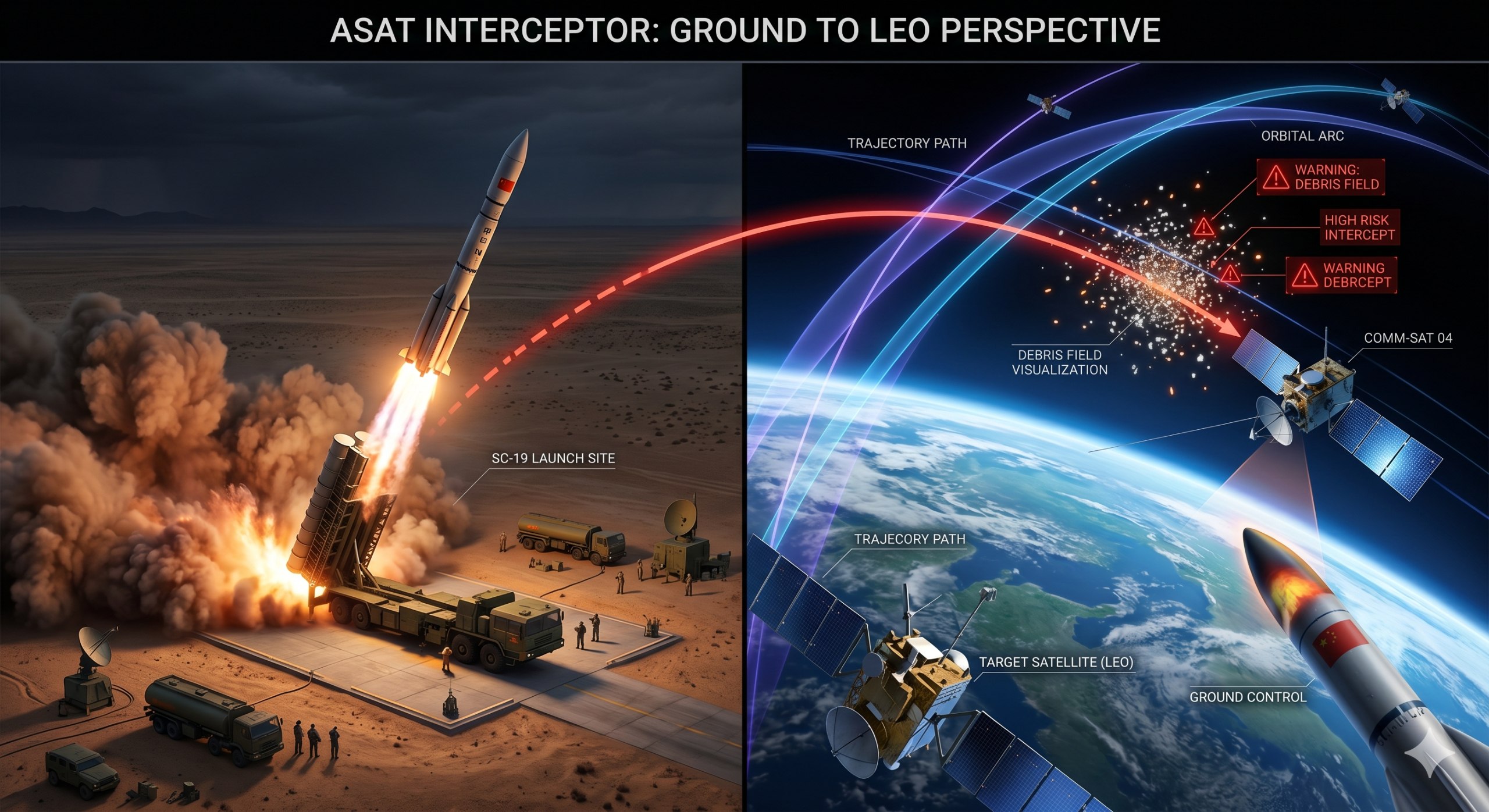
Space Weaponization Countdown: China's ASAT Test and the Global Orbital Security Tipping Point
On June 1, 2026, China launched an SC-19 direct-ascent anti-satellite interceptor from the Xichang Satellite Launch Center, successfully destroying a defunct weather satellite in an 800 km Sun-synchronous orbit (LEO). The US, Japan, and Australia swiftly issued condemnations, stating the test exacerbated the space debris crisis and undermined international strategic stability. Occurring on the same day as the US hypersonic weapon test, this event underscores an alarming reality: great power competition is extending from land, sea, air, and cyberspace into Earth orbit -- space weaponization is no longer a warning but an unfolding fact.
China's Anti-Satellite Weapons Family
The SC-19 is the most representative of China's known anti-satellite (ASAT) weapons. Derived from the KT-1 launch vehicle, it uses a kinetic kill (hit-to-kill) approach -- directly impacting the target satellite at a relative velocity exceeding 7 km/s, destroying it through pure kinetic energy.
China's known counterspace weapons system includes multiple types:
Direct-Ascent ASAT (DA-ASAT):
- SC-19: Based on KT-1 rocket, intercept altitude 500-1,000 km. First tested in 2007 (destroying FY-1C weather satellite, generating massive debris), retested June 2026
- DN-3: Based on DF-21 ballistic missile, intercept altitude up to 30,000+ km (GEO orbit). Successfully tested in 2021
Co-Orbital ASAT:
- Shijian series satellites: Orbital maneuvering-capable satellites that can approach, inspect, or if necessary, collide with other spacecraft. Between 2021-2022, multiple Chinese Shijian satellites demonstrated proximity maneuvers near Western satellites.
Directed Energy ASAT:
- Multiple ground-based laser sites deployed in Xinjiang and Anhui, theoretically capable of blinding or damaging satellite optical sensors
- Microwave weapon systems reportedly capable of interfering with satellite electronics in testing
Electronic Warfare:
- China's satellite navigation jamming and communication jamming capabilities have been combat-validated, enabling regional suppression of GPS and satellite communication signals
The Debris Crisis: One Test's Generational Impact
The most direct and lasting consequence of ASAT testing is not military -- it is the irreversible degradation of the debris environment.
In 2007, China's first ASAT test destroyed the FY-1C weather satellite (at 865 km altitude), generating over 3,000 trackable debris fragments (larger than 10 cm) and over 150,000 untrackable micro-debris. Nearly 20 years later, FY-1C debris remains one of the densest debris clouds in LEO -- approximately 40% of it remains in orbit.
The June 2026 test likewise left a new debris cloud. US Space Command confirmed tracking over 200 trackable objects in the initial debris field, distributed across 780-850 km altitude. Because this test occurred in Sun-synchronous orbit -- the most densely populated orbital region for Earth observation and weather satellites -- collision risk with operational satellites has increased significantly.
| Major ASAT Tests | Country | Year | Altitude | Trackable Debris |
|---|---|---|---|---|
| FY-1C | China | 2007 | 865 km | >3,000 |
| USA-193 | US | 2008 | 241 km | 0 (low orbit, atmospheric decay) |
| Cosmos 1408 | Russia | 2021 | 480 km | ~1,500 |
| Weather satellite target | China | 2026 | 800 km | >200 (initial, increasing) |
The core issue is Kessler Syndrome -- when LEO debris density reaches a critical threshold, debris-satellite collisions generate more debris, triggering a cascade reaction that could render certain orbital regions unusable for centuries. The 2026 test adds another layer of pressure to an already near-critical LEO environment.
International Response and the Space Governance Dilemma
Reactions to the June 1 ASAT test reveal the structural dilemma of international space governance.
The US, Japan, and Australia issued strongly worded condemnations. A US State Department spokesperson called the test "a direct violation of China's public commitments to responsible space behavior at the UN Conference on Disarmament" and stated the US would assess whether further sanctions against Chinese entities involved in ASAT testing are warranted.
China's Ministry of National Defense responded that this was a "routine national defense science and technology test," not targeting any country, and accused the US of refusing to negotiate a space weapons ban within the UN framework.
The root of the problem: there is currently no legally binding international treaty prohibiting ASAT testing. The 1967 Outer Space Treaty prohibits deploying weapons of mass destruction in orbit but does not prohibit ground-launched ASAT weapons. The UN Conference on Disarmament has discussed a "Prevention of an Arms Race in Outer Space" (PAROS) treaty since the 1980s, but fundamental disagreements between the US and China on space weapon definitions and verification mechanisms have prevented substantive progress.
The Vulnerability of Space Commercialization
Space weaponization poses the most profound threat to commercial space. Total satellite numbers for constellations like Starlink, Kuiper, and OneWeb are projected to exceed 100,000 by 2030 -- these commercial satellites not only have military value (communications, surveillance, positioning) but their sheer numbers make the space environment more fragile.
An ASAT test near commercial satellite orbits could simultaneously destroy dozens of operational satellites -- causing billions of dollars in economic losses and potentially disrupting global communications, navigation, and weather services.
More alarming is the possibility of warning confusion. When an ASAT interceptor launches, its trajectory characteristics are nearly indistinguishable from a ballistic missile. On June 1, 2026, after the Xichang SC-19 launch, early warning systems in both the US and Japan detected the launch -- in the first minutes, the systems could not determine whether it was an ASAT or a ballistic missile targeting ground infrastructure. In a crisis, such ambiguity could lead to catastrophic miscalculation.
The Regulatory Blind Spot of Dual-Use Technology
Another governance challenge of ASAT technology is that most ASAT capabilities derive from dual-use technology. The solid-fuel rocket technology used by the SC-19 is nearly indistinguishable from civilian launch vehicles -- China described the SC-19 as an "anti-missile test" rather than an ASAT test. Similarly, satellites with in-orbit servicing capabilities (such as Astroscale's debris removal satellites) could technically function as co-orbital ASATs.
This dual-use nature makes space arms control extremely difficult. You cannot ban a technology itself -- you can only prohibit specific uses. And intent is subjective and difficult to verify.
Outlook: The Next Decade of Space Security
The 2026 ASAT test reminds us that the window for collective action on space governance is closing. If the international community cannot establish a substantive space arms control framework within the next 5 years, by the time LEO satellite numbers reach 100,000, a single ASAT test's consequences will escalate from "generating a debris cloud" to "triggering irreversible Kessler cascade."
Trends worth watching:
- UN PAROS Negotiations: New round of talks scheduled for late 2026, but no consensus on "space weapon" definition
- FCC Debris Rules: US FCC pushing stricter constellation licensing conditions requiring ASAT risk assessment in license applications
- Commercial ASAT Insurance: Satellite insurance rates rising again in 2026 due to ASAT test risk, with some LEO orbit rates climbing from 8% to 18%
- Non-Binding Norms: US-led Combined Space Operations (CSpO) partner nations promoting voluntary ASAT testing bans -- but China and Russia are not participants
Space weaponization is not a future problem -- it is the current reality. Each new test pushes the orbital environment closer to an irreversible tipping point. The question is no longer "whether space conflict will occur" but "when space conflict occurs, will humanity still have the capacity to maintain orbital order."