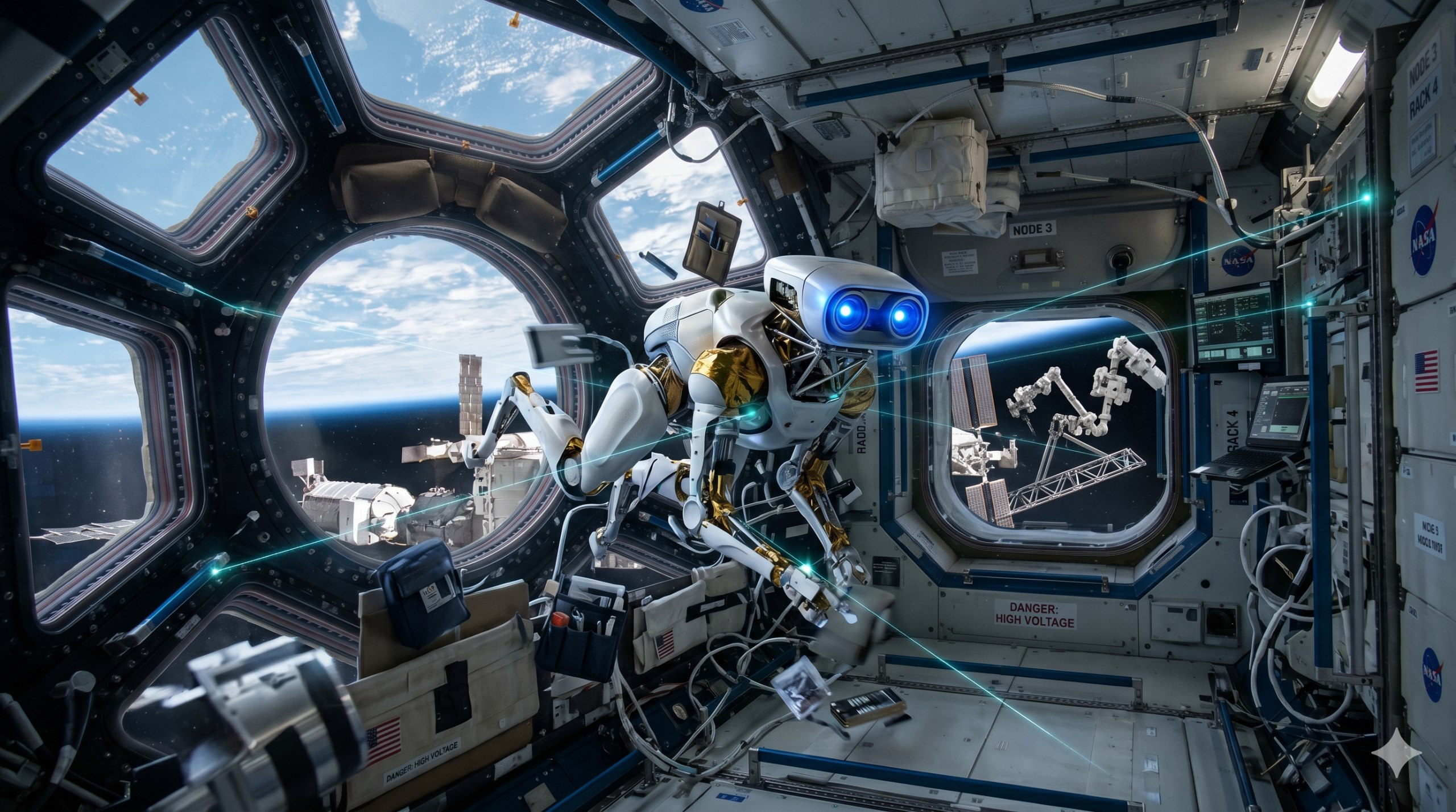
In June 2026, a seemingly low-key announcement stirred the aerospace community: AI is now helping to navigate free-flying robots aboard the International Space Station (ISS) — the first time AI-driven autonomous robot navigation has been demonstrated in orbit. At the same time, space robotics startup Icarus secured $6.1 million in seed funding, aiming to send robot workers into orbit. On the farther horizon, modular in-space assembly technology is paving the way for lunar bases and large space structures. The space robotics industry is undergoing a fundamental shift from "teleoperated tools" to "autonomous collaborative partners."
AI Navigation Breakthrough on the ISS
The "Intelligent Robot Autonomous Navigation System" (IRANS), developed by Stanford University and NASA, completed its first on-orbit test aboard the ISS in May 2026. Mounted on the Astrobee free-flying robot platform, the system leverages deep reinforcement learning and visual SLAM (Simultaneous Localization and Mapping) technology, enabling robots to autonomously navigate through multiple modules of the ISS without real-time ground operator control.
Previous space robots relied on pre-programmed trajectories or ground-based teleoperation — the latter limited by signal latency (Earth-Moon communication delay ~1.3 seconds, Mars delay 4-24 minutes). IRANS's key innovation is giving robots the ability to "make decisions in flight," including:
- Dynamic obstacle avoidance: Identify floating equipment, astronauts, and other robots within the module, and adjust flight paths in real time
- Adaptive grasping: When target objects are in uncertain positions (e.g., floating tools), use visual feedback to adjust grasping strategy on the fly
- Collaborative localization: Share visual feature points between multiple robots to build a more precise joint spatial map
NASA's test report shows that IRANS achieved a 97% success rate in autonomous navigation within ISS simulation environments, with average path planning time reduced by 85% compared to traditional methods.
Icarus: Sending Robot Workers Into Space
In the first half of 2026, space robotics startup Icarus completed a $6.1 million seed funding round, with investors including Initialized Capital and Space Capital. Icarus aims to develop a "universal space robot worker" — a modular robotic platform with multiple end effectors, capable of performing a wide range of tasks in orbit, from satellite refueling to on-orbit repair.
Icarus's technology roadmap consists of three phases:
Phase 1 (2026-2027): Deploy robotic assistants for the ISS interior, performing intra-module maintenance and experimental operations.
Phase 2 (2028-2029): Launch free-flying extravehicular robots capable of inspection and repair outside the ISS, eventually achieving autonomous satellite on-orbit servicing.
Phase 3 (2030 and beyond): Lunar surface robots to assist with base construction tasks under the Artemis program.
Icarus's founder stated that the goal is to reduce the cost of space robots by 10x, making on-orbit servicing a routine rather than an exception. This vision aligns with NASA's and ESA's long-term plans for space maintenance — just as ground maintenance is a vast service industry, space maintenance will become an important market as the orbital economy expands.
Modular In-Space Assembly: From Imagination to Engineering Reality
If the capabilities of individual robots are exciting, the prospect of a "robot fleet" collaborating to build large structures is even more revolutionary.
NASA's "On-orbit Servicing, Assembly, and Manufacturing" (OSAM) program achieved key progress in 2026. The OSAM-2 project (formerly "Space Infrastructure Constructor") successfully completed ground prototype testing — using two robotic arms working collaboratively, it autonomously assembled a 10-meter-long antenna structure from 70 standardized truss units. The entire assembly process required no human intervention, with robots using visual and force sensors to adjust the alignment of each joint in real time.
ESA's "Modular Space Structures" (MOSA) project takes a different approach — foldable structures inspired by origami. The MOSA platform uses shape-memory materials, allowing large structures to be compactly folded during launch and then "unfolded" by robots into predetermined three-dimensional shapes after reaching orbit. This technology is particularly suited for building large space telescope mirror arrays and space solar power stations.
The Role of Robotics in Lunar Base Construction
Both the U.S. Artemis program and China's International Lunar Research Station (ILRS) have identified robotics as a critical capability. Lunar base construction faces unique challenges: astronaut time is extraordinarily valuable (approximately $150,000 per hour), and the lunar dust environment poses health risks to humans. Robots become the ideal construction workforce.
Astronaut-robot collaboration is emerging as the mainstream model for lunar base construction. Under NASA's "Collaborative Autonomous Distributed Systems" (CADS) framework, a team of robots handles the transport and placement of building modules, while astronauts focus on tasks requiring human judgment (such as connecting and testing life support systems). In 2026 desert simulation missions, this collaborative model improved construction efficiency by approximately 3x.
Robotic excavation and road-building technologies are also advancing rapidly. Lunar excavator robots developed by Japan's JAXA and GITAI have achieved an excavation rate of 0.5 cubic meters per hour in simulated lunar regolith, and can maintain positioning accuracy within 10 cm of the worksite using visual odometry, without GPS signals (the Moon has no GNSS navigation).
Economic Dimensions: Market Size of Space Robotics
According to a joint report by BryceTech and the Space Foundation, the space robotics market is projected to grow from approximately $3.5 billion in 2025 to $12 billion by 2030, representing a compound annual growth rate (CAGR) of about 28%.
Key growth drivers include:
- Satellite life extension: On-orbit repair and refueling can extend satellite life by 3-5 years; repairing a single "disabled satellite" (approximately $20-50 million) costs far less than relaunching (approximately $100-300 million)
- Large space structures: Space solar power stations and large telescopes require orbital assembly capabilities
- Lunar infrastructure: Robot budget for Artemis lunar base construction is approximately $8 billion (2025-2035)
- Space debris removal: Multiple commercial debris removal contracts are forming, requiring capture and deorbit robots capable of autonomous on-orbit operations
Technical Challenges and Bottlenecks
The space robotics industry still faces several technical bottlenecks:
Computing resource limitations: Space-grade processors (such as the RTX 2000 series radiation-hardened chips) have performance far below terrestrial levels (roughly 3-5 years behind), limiting the complexity of on-board AI. Certification cycles for edge AI chips in space environments span 3-5 years.
Maneuverability: Current space robots (such as Astrobee) rely on compressed gas propulsion systems with limited total impulse (approximately tens of m/s in delta-v), constraining their operational radius and mission duration within large facilities.
Grasping and docking: Capturing uncooperative targets in microgravity (such as tumbling satellites) remains the most difficult challenge in robotic operations. Although vision-based relative navigation technology has made significant progress, reliable grasping of unmodified target satellites has not yet reached 100% success rates.
Outlook
The space robotics industry is in a critical window of transition from "capability demonstration" to "commercial service." Over the next 3-5 years, we may witness:
- The ISS becoming a testing ground and deployment base for AI robots
- The first commercial on-orbit servicing contract being signed (likely executed by Astroscale or Icarus)
- Lunar surface robots beginning to assist humans in establishing an outpost at the Moon's south pole
- The first on-orbit assembly demonstration of modular space structures
If the 20th century's space race was a rockets race, the 21st century's space economy will be a robotics capability race. Whoever can make robots work efficiently, reliably, and cost-effectively in orbit holds the key to space infrastructure.
Disclaimer: This article is for informational purposes only and does not constitute investment advice or a basis for business decisions. Data and time-sensitive information are accurate as of the publication date and may change with subsequent developments. Neither the author nor POC.HK assumes any liability for losses arising from the use of this information.