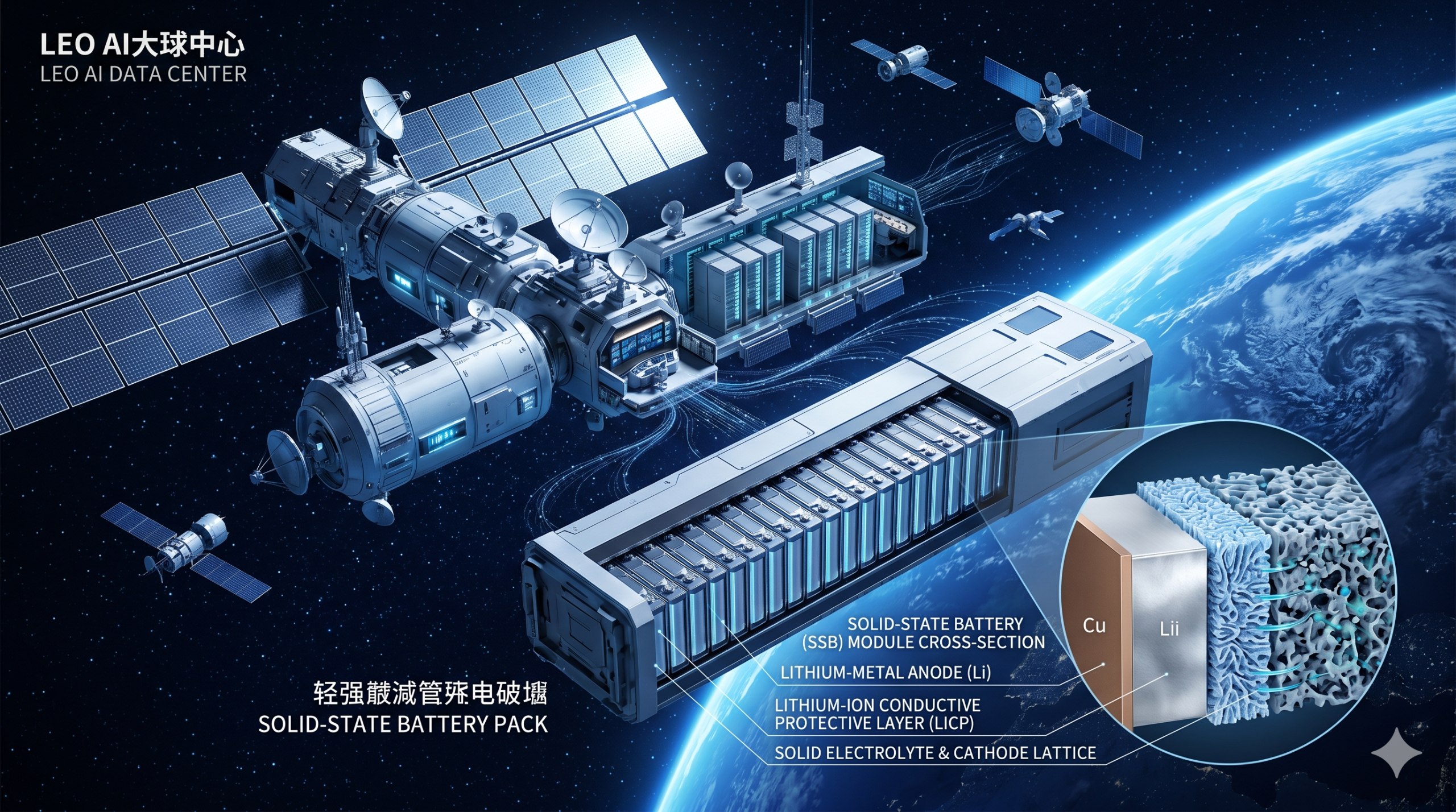
In June 2026, Texas-based advanced battery technology company Solidion Technology (NASDAQ: STI) announced a major breakthrough: the company holds over 30 patents for its lithium metal battery platform, specifically optimized for space applications, targeting markets including Low Earth Orbit (LEO) AI data centers, satellite constellations, crewed spacecraft, and future lunar infrastructure.
Following this announcement, Solidion's stock surged 88% in a single day, hitting a 52-week high. The company also announced a $35 million securities purchase agreement with an institutional investor to fund commercial-scale production.
Extreme Environmental Challenges for Space Batteries
Temperature variations in LEO can range from -150°C to +120°C. Traditional lithium-ion batteries see sharp performance degradation under such temperature fluctuations. Space batteries must also withstand vacuum outgassing, radiation damage, over 5,800 charge-discharge cycles per year, and mechanical shock during launch.
Solidion's Core Technology
Solidion's core technology focuses on lithium metal anode protection. Lithium metal batteries can achieve energy densities exceeding 380 Wh/kg — twice that of traditional lithium-ion batteries. However, they have long faced two major obstacles: lithium dendrite growth and electrolyte side reactions.
Solidion's lithium metal battery platform includes three technical pathways:
• Silicon-enriched all-solid-state lithium-ion batteries (40-60% energy density improvement, eliminating liquid electrolyte safety hazards) • Anode-free lithium metal batteries (20-30% cost reduction) • Lithium-sulfur batteries (theoretical 500+ Wh/kg)
The Gen-ECB Extreme Climate Battery series operates across a temperature range of -150°C to +120°C, employing specialized separator materials, phase-change material thermal management, and multi-layer radiation-resistant packaging.
Competitive Landscape
Solid-state electrolyte competitive landscape: Toyota plans to launch all-solid-state batteries in 2027-2028, QuantumScape is conducting mass production validation, and Samsung SDI and LG are also accelerating R&D. Solidion's differentiator is deeply coupling solid-state batteries with space applications — space customers prioritize reliability over price.
Space AI Data Centers: The Key Market
Solidion views space AI data centers as a key market. LEO AI data centers are not constrained by geopolitical boundaries and can provide global low-latency AI inference services.
Competitors include Voyager Space (space station energy storage), Redwire (flexible solar), Bloom Energy (fuel cells), and Elyse Energy (nuclear batteries).
Observatory Analysis
The space economy is shifting from launch capability-driven to infrastructure capability-driven. The space battery market is projected to grow from $420 million in 2025 to $4.7 billion by 2035 (CAGR 27%). However, space qualification cycles are 3-5 years long, and Solidion's Q1 2026 revenue was only $85,426.
Disclaimer: This article is for informational purposes only and does not constitute any investment advice or business decision basis. Data and timing information are based on the date of publication and may change with subsequent developments. The author and POC.HK assume no responsibility for any losses resulting from the use of this information.