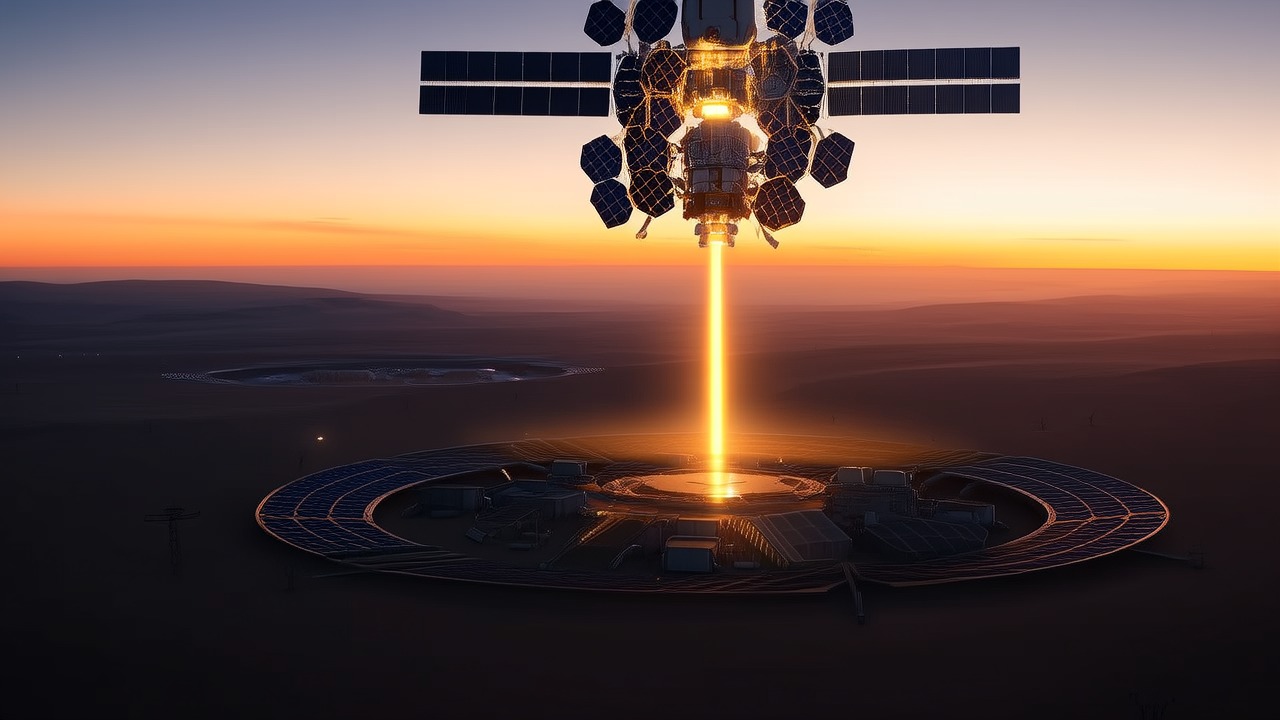
In 2026, space-based solar power (SBSP) is no longer merely a concept from science fiction. From a rooftop in Pasadena receiving wireless power from low Earth orbit to a receiving station in Yokohama, Japan, from China's "Zhuri" test facility in Chongqing to the European Space Agency's SOLARIS program, multiple technology pathways are advancing simultaneously, pushing this vision—once derided as "always 20 years away"—toward an unprecedented stage of tangible progress.
The catalyst for this inflection is not a single technology breakthrough but a systematic shift in cost structure. As SpaceX Starship drives launch costs toward $200 per kilogram, the most lethal economic barrier to SBSP—the enormous expense of putting solar panels into orbit—is collapsing rapidly. Meanwhile, photovoltaic mass-per-watt is improving, gallium nitride (GaN) amplifier efficiency is rising, and grid prices for clean firm power are climbing. As one program director at ESA's SOLARIS put it: "For the first time in the history of this field, every line in the cost model points the right direction at the same time."
The Global SBSP Landscape in 2026
Multiple active programs form a diverse global technology portfolio:
| Program / Lead | Country/Region | Architecture | 2026 Progress |
|---|---|---|---|
| SSPD-1 (Caltech) | United States | Microwave WPT | Measurable wireless power transmitted from LEO to ground |
| OHISAMA (JAXA) | Japan | Microwave transmission | 1 kW-class orbital-to-ground demonstration successful |
| SOLARIS (ESA) | Europe | Microwave + Laser | Multi-hundred-million-euro preparatory phase |
| Zhuri / Bishan (China) | China | Microwave WPT | 2 km ground test array under construction, 20.8% efficiency |
| HARRIER (Space Solar UK) | United Kingdom | 360° wireless power beaming | World's first omni-directional beam-steering test completed |
| Aetherflux | US (private) | LEO satellite constellation | Initial funding secured |
| Virtus Solis | US (private) | Modular space solar | Prototype design phase |
| Star Catcher Industries | US (private) | Space power relay | Business model validation underway |
Notably, these eight programs pursue significantly different technology approaches. Caltech's MAPLE uses lightweight flexible microwave arrays, while JAXA's OHISAMA focuses on high-efficiency directed beam transmission. China's Zhuri project takes a path of large-scale ground validation preceding orbital deployment. The UK's HARRIER is notable for its unique 360° beam-steering capability with no moving parts.
The Physics Advantage
A photovoltaic panel on the ground spends most of its life producing nothing. It is dark for half the day, dimmed by weather, attenuated by the atmosphere, and angled wrong for two-thirds of the daylight hours. The same panel placed in geostationary orbit sees the sun for 99% of the year—no clouds, no night, no atmospheric attenuation.
The capacity factor differential is decisive:
| Metric | Terrestrial Solar | Space Solar (GEO) |
|---|---|---|
| Annual sunlight | ~4,380 hours (50% theoretical) | ~8,672 hours (99%) |
| Atmospheric losses | 15-30% (weather-dependent) | 0% |
| Capacity factor | 20-25% | >95% |
| Solar spectrum | Limited by atmospheric absorption | Full spectrum |
| Power stability | Intermittent | Baseload |
Space solar power output is inherently baseload—like nuclear or hydro, it can supply stable power around the clock. This is exactly what decarbonized grids struggle to achieve. While terrestrial solar and wind have become extremely cheap, their intermittency means grids need massive energy storage to balance supply and demand. SBSP fundamentally avoids this problem.
Microwave Wireless Power Transmission: From Lab to Practicality
Wireless power transmission (WPT) is the most critical technology link in the SBSP value chain. Between 2025 and 2026, several landmark advances have occurred:
Caltech MAPLE's historic demonstration. In 2023, the SSPD-1 demonstrator successfully transmitted measurable wireless power from low Earth orbit to a rooftop receiver in Pasadena, California. Though the transmitted power was at the microwatt level, this was humanity's first demonstration of a complete solar-collection-to-microwave-conversion-to-ground-reception chain from orbit. The team has since iterated and improved the system.
China's Zhuri efficiency milestone. According to Xinhua, the Zhuri project achieved 20.8% overall wireless power transmission efficiency—approximately one-fifth of the original electrical energy successfully transmitted and converted back to usable power. While this figure is lower than NASA JPL's 1975 experiment achieving 54% efficiency, Zhuri's scale and system complexity far exceeded those early experiments, making its engineering significance greater.
Space Solar UK's HARRIER. The company completed testing of the world's first 360° wireless power transmission system with no moving parts. For solar power satellites that must simultaneously point at the sun (for collection) and Earth (for transmission), traditional designs require large rotating joints. HARRIER enables electronic beam steering in all directions with no moving parts, fundamentally improving system reliability.
Observatory Analysis: The Strategic Logic of SBSP
POC.HK believes the recent acceleration of space-based solar power should not be understood simply as "another clean energy technology." Its strategic logic is rooted in three dimensions:
Energy security. SBSP is fundamentally a technology that harvests energy from a global commons (space sunlight), independent of any nation's mineral resources or pipeline infrastructure. For energy-importing countries, this represents an ultimate path to energy independence.
Military dual-use. Microwave power transmission technology is itself a directed-energy technology. Its defense applications—unlimited drone endurance, instant power for remote bases, space-to-space wireless charging—may achieve commercialization before the civilian energy market.
Orbital economy infrastructure. Once deployed, SBSP satellites can transmit power not just to Earth but also to other space assets—satellites, space stations, lunar bases—making them core orbital economy infrastructure rather than isolated energy projects.
The most realistic current path: government and military-funded demonstration projects completing technology validation by 2027-2030, followed by private-sector construction of the first commercial SBSP station in the mid-2030s. This timeline sounds conservative, but relative to 50 years of stagnation, it represents unprecedented acceleration.
Disclaimer: This article is for informational purposes only and does not constitute investment advice or business decisions. Data and time-sensitive information are current as of the publication date and may change. Neither the author nor POC.HK assumes any liability for losses arising from the use of this information.