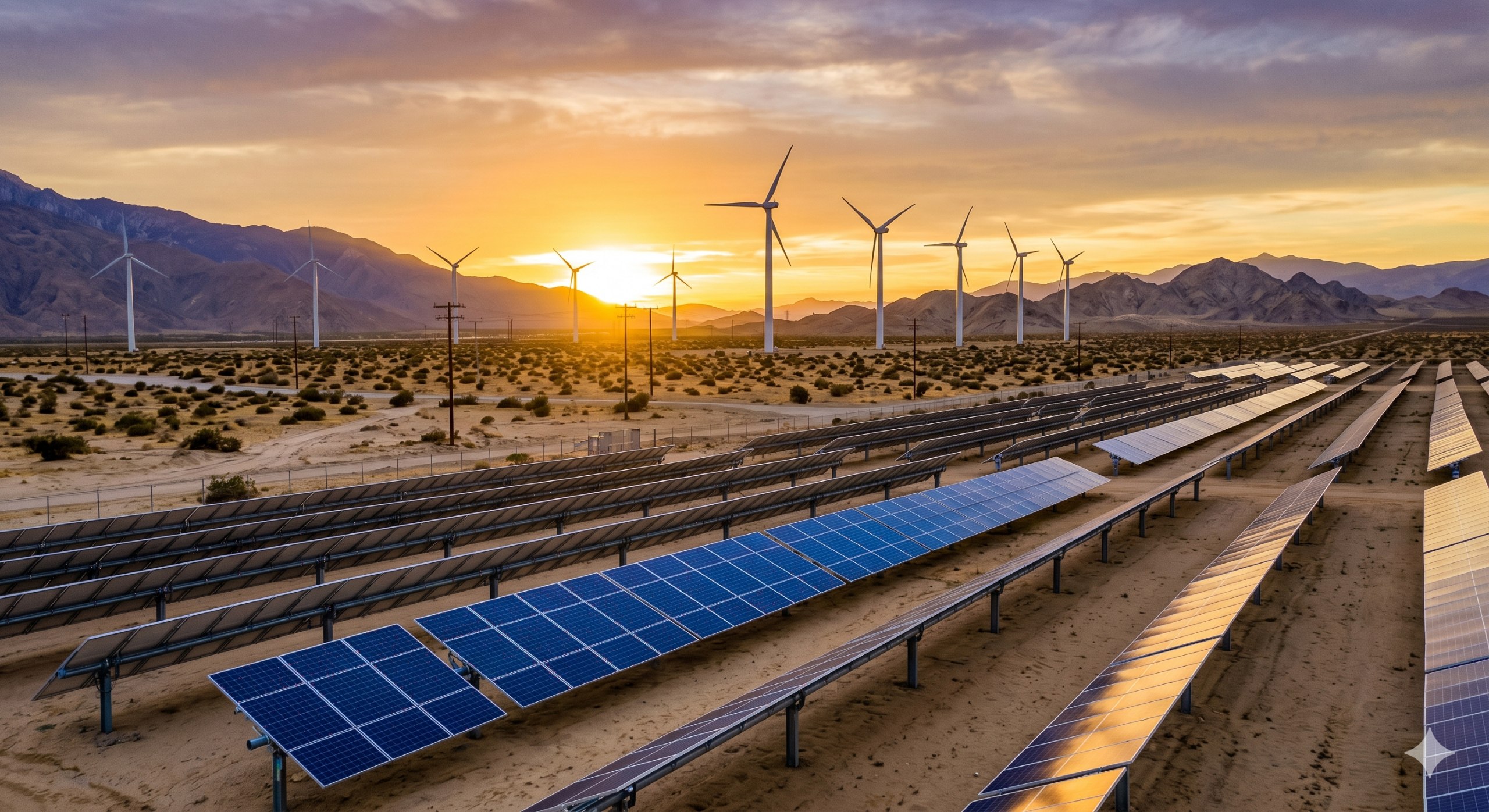
Economic Analysis of Solar-Wind Hybrid Power Stations: When Renewable Energy Loses Subsidies
Wind and solar energy exhibit natural temporal and seasonal complementarity: solar output peaks during the day, while wind tends to be stronger at night; solar energy is abundant in summer, while wind is more stable in winter. Solar-wind hybrid power stations — co-locating wind turbines and solar panels at the same site — seek to exploit this complementarity to improve overall generation stability and economics.
Quantifying Complementarity
To understand the value of solar-wind complementarity, we must first quantify the degree of "complementarity." Under typical meteorological conditions in northwest China, solar capacity factors are approximately 15-20%, while wind capacity factors range from 20-30%. When combined at the same site, the hybrid system's comprehensive capacity factor can rise to 30-40% — not simply additive, but because wind and solar output peaks at different times can mutually fill troughs.
Consider the Jiuquan solar-wind hybrid base in Gansu Province, with an installed capacity of 2 GW wind and 1 GW solar. Operational data shows that system output is most stable in spring and autumn, when both wind and sunlight are at moderate levels; summer afternoons see solar peaks followed by evening wind ramps; winter exhibits a pattern of "solar supplying during the day, wind supplementing around the clock." The coefficient of variation of the annual composite output curve decreases from 0.85 for solar alone to 0.55 for the hybrid system, indicating significantly reduced generation volatility.
Infrastructure Sharing Economics
The most direct economic benefit of solar-wind hybrid stations comes from infrastructure sharing.
Land utilization is the first area to benefit: the spacing between wind turbine towers is typically 300-500 meters, spaces that remain largely unused in pure wind farms. In a solar-wind hybrid configuration, these gaps can be filled with solar panels, increasing energy output per unit area by 50-100%. This advantage is particularly pronounced in regions with high land costs or scarce land resources.
Grid connection infrastructure sharing represents another significant saving. The step-up substations, transmission lines, and grid connection points for wind and solar farms typically account for 5-10% of total project investment. When wind and solar share the same infrastructure, this investment is spread across larger installed capacity, reducing per-unit grid connection costs by approximately 30-40%.
Operations and maintenance team resource sharing is also noteworthy. The O&M cycles of wind and solar farms exhibit seasonal complementarity: spring is the peak period for annual wind turbine maintenance, when solar generation is at moderate levels; autumn requires solar panel cleaning and inspection, while wind output gradually enters its peak season. A unified O&M team can achieve balanced annual workload distribution, improving O&M personnel utilization from 65% to over 85%.
The Hidden Value of Output Smoothing
Beyond infrastructure savings, the value of output smoothing is even more profound — but also more complex to quantify.
For power system operators, generation predictability and stability directly correlate with reserve capacity and dispatch costs. The output fluctuation amplitude of a solar-wind hybrid system is lower than that of standalone wind or solar, meaning grid operators need to reserve less backup capacity. Quantitative studies show that reserve capacity requirements for hybrid systems are 15-25% lower than for equivalent single-type renewable installations.
More critically, hybrid systems achieve higher output and utilization during high-price periods (typically evenings). In most electricity markets, evening prices are 1.5-2 times midday rates. Because hybrid systems include wind power, their evening output is typically higher than pure solar systems, thus achieving higher average electricity prices.
Post-Subsidy Economic Model
Wind and solar power in China have fully entered the grid parity era, with new projects no longer receiving national subsidies. Under subsidy-free conditions, the economic model for solar-wind hybrid projects must be strictly based on market electricity prices and ancillary service revenues.
Taking a typical 500 MW hybrid project (300 MW wind + 200 MW solar) under northwest China operating conditions:
- Annual generation: Wind approximately 630 GWh (capacity factor 24%), solar approximately 290 GWh (capacity factor 16.5%), totaling approximately 920 GWh
- Benchmark price: Assuming market-average grid price of 0.25 RMB/kWh in the Shaanxi-Gansu-Ningxia region
- Annual revenue: Approximately 230 million RMB
- Total investment: Wind approximately 1.8 billion RMB (6,000 RMB/kW), solar approximately 800 million RMB (4,000 RMB/kW), grid connection approximately 150 million RMB, totaling approximately 2.75 billion RMB
- Static payback period: Approximately 12 years
- Internal rate of return: Approximately 7-8%
This rate of return would be considered mid-to-low in the subsidy era, but in the grid parity era, it is commercially viable. If carbon trading revenues are included (based on 50 RMB per ton carbon allowance, annual emission reduction of approximately 800,000 tons, annual carbon revenue of approximately 40 million RMB), the IRR can increase to 9-10%.
Impact of Energy Storage Configuration
As renewable energy penetration continues to rise, more regions are requiring new wind-solar projects to configure a certain proportion of energy storage. Chinese provincial requirements typically range from 10-20% of installed capacity with 2-4 hours of storage duration.
Energy storage configuration significantly impacts the economics of solar-wind hybrid projects. At a 20%/4-hour storage ratio, total project investment increases by approximately 300-400 million RMB (based on 1.5 RMB/Wh storage system cost), reducing IRR by approximately 1.5-2 percentage points.
However, storage configuration is not purely a cost burden. Through peak shaving and ancillary services, storage systems can generate additional revenue streams: in electricity spot markets, the arbitrage space from daytime low-price charging and evening high-price discharging can reach 0.05-0.10 RMB/kWh; in frequency regulation markets, storage systems' response speed far exceeds conventional units, enabling higher frequency regulation service revenues.
From an optimization perspective, there is a "compound effect" between solar-wind hybrid systems and storage: complementarity already reduces output fluctuation amplitude, so the required storage capacity and cycle count are both lower than for equivalent single-type renewable installations — the annual equivalent cycles of the storage system can be reduced by approximately 20%, extending service life by 2-3 years.
International Comparative Perspectives
Different national market environments have varying impacts on the economics of solar-wind hybrid projects.
Europe: Solar-wind hybrid projects in Spain and Portugal benefit from higher market electricity prices (approximately €0.04-0.06/kWh) and mature ancillary service markets. The Iberian Peninsula's wind and solar resource complementarity is particularly favorable — summer solar output is high when wind is weaker, but strong winter winds precisely compensate for solar's seasonal shortfall. In Germany, with renewable energy share exceeding 50%, new projects can no longer obtain sufficient returns from the energy-only market and must rely on PPA premiums and ancillary service revenues.
India: India's situation is similar to China's — low land costs, abundant sunlight, but extreme price sensitivity. Indian solar-wind hybrid projects typically use higher wind-to-solar ratios (e.g., 60:40) to optimize seasonal output curves and match local high wind speed seasonal patterns. The Solar Energy Corporation of India (SECI) has awarded multiple hybrid projects through competitive bidding, with winning prices as low as 2.5-3.0 INR/kWh (approximately $0.03).
Middle East and North Africa: Hybrid projects in this region face entirely different challenges — solar resources are extremely abundant, but wind resources are relatively limited. The primary value of complementarity here lies not in generation increase, but in providing supplemental output during extreme high-temperature conditions when solar efficiency drops by approximately 10-15%.
Technology Selection Trade-offs
The technology choices for wind turbines and solar panels also affect the overall economics of solar-wind hybrid systems.
Wind turbine selection: Low-wind-speed turbines optimized for hybrid scenarios are emerging. Traditional turbines have rated wind speeds of about 11-13 m/s, while low-wind-speed turbines reduce the rated speed to 9-10 m/s, increasing annual generation by 15-20% at sites with average annual wind speeds of 6-7 m/s. Given that hybrid sites are typically chosen in low-wind-speed areas with superior solar resources (deserts, Gobi), low-wind-speed turbines offer particular economic value.
Solar panel direction: Bifacial panels offer unique advantages in hybrid scenarios. Installing bifacial panels in the gaps between wind turbines captures reflected and scattered light from the ground, increasing generation by 5-15%. The generation gains are particularly notable in sandy and snowy environments — sand albedo is approximately 0.3-0.4, and snow can reach 0.6-0.8.
Tracking system trade-offs: Horizontal single-axis tracking can increase solar generation by 15-25%, but costs rise by approximately 10-15% with higher maintenance complexity. In hybrid sites, tracking systems and wind turbine foundations create spatial conflicts that may reduce site utilization by 5-8%. After comprehensive evaluation, fixed-tilt configurations typically offer better economics in hybrid scenarios.
Conclusion
Solar-wind hybrid power stations remain commercially viable after subsidy phase-out, with their core economic logic resting on three levels: infrastructure sharing savings (approximately 20-30%), output smoothing price premiums (approximately 5-15%), and compound benefits from storage coordination. In northwest China and Belt and Road Initiative countries — regions with abundant complementary wind and solar resources — hybrid stations will become a mainstream model for future renewable energy project development.
From a broader perspective, the economics of solar-wind hybrid stations depend not only on technical parameters and engineering design, but also on electricity market pricing mechanisms and ancillary service valuation. When electricity markets truly reflect the differentiated value of energy across different time periods and reliability levels, the economic advantages of solar-wind complementarity will become even more pronounced.