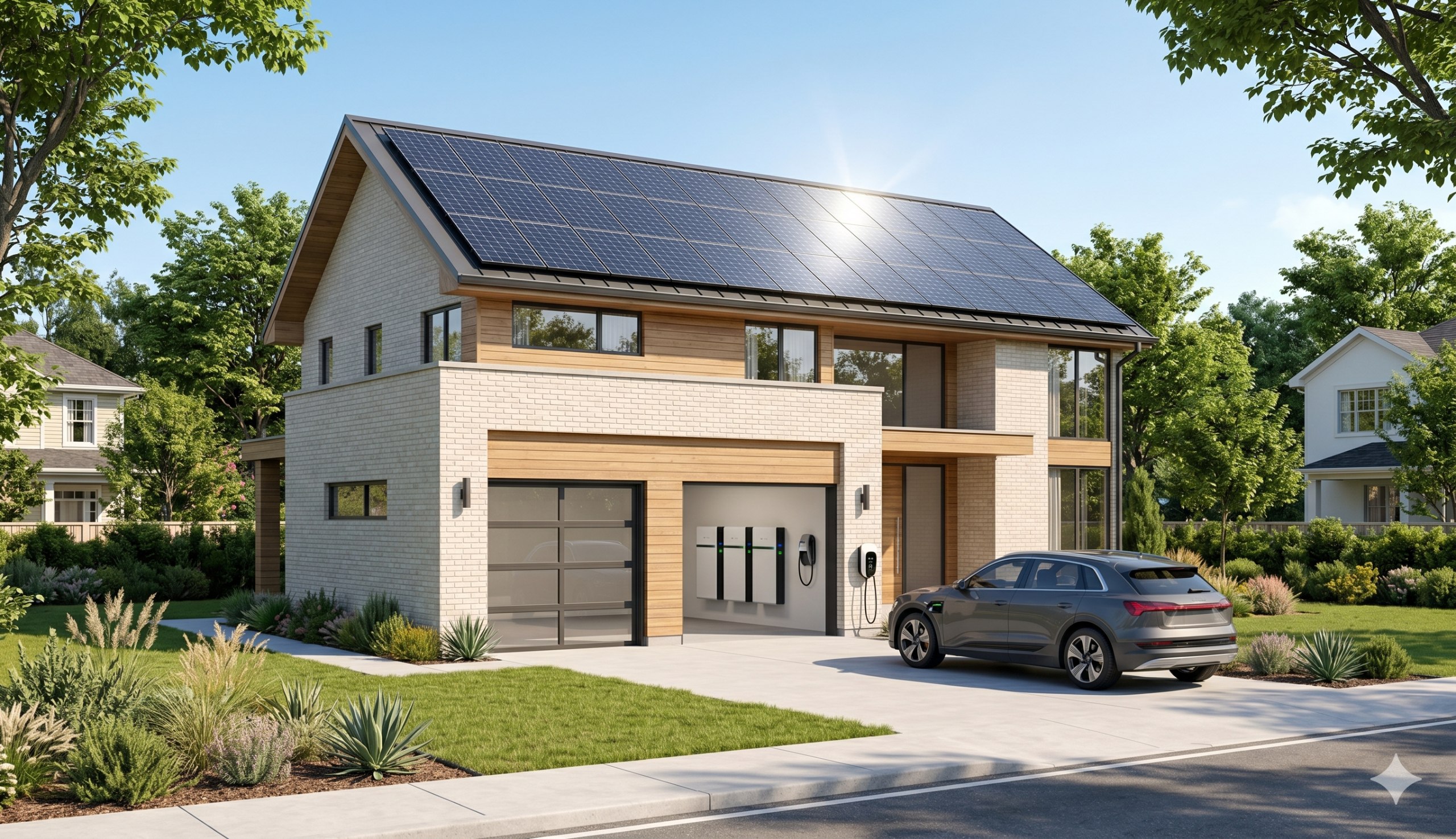
The Era of Residential Solar-Plus-Storage Grid Parity: A Turning Point for Energy Democratization
In 2025, residential solar-plus-storage systems achieved "grid parity" for the first time in multiple global markets — meaning the system's levelized cost of electricity (LCOE) fell below the average retail electricity price from the grid. This inflection point arrived 3-5 years earlier than most industry forecasts, driven by the compounding cost reductions across photovoltaic modules, lithium batteries, and power electronics.
Evolution of the Economic Model
Taking a typical Chinese household as an example: installing a 5 kW rooftop solar system paired with 10 kWh of storage costs approximately 40,000-50,000 RMB total. Based on annual generation of about 6,000 kWh and a self-consumption rate of 80%, annual electricity savings amount to approximately 4,500-5,500 RMB (based on tiered residential electricity pricing of 0.6-0.8 RMB/kWh). Adding peak-valley arbitrage through the storage system — charging at night when rates are low and discharging during daytime peak hours — annual returns can increase further to 6,000-7,000 RMB. The system payback period is approximately 6-8 years, with a total return exceeding 200% over the 25-year service life.
For German households, the economics are even more compelling: German residential electricity rates reach €0.30-0.40 per kWh, while the total cost of a 5 kW solar system plus 10 kWh storage is approximately €15,000-20,000. With a self-consumption rate of 70%, the payback period can shrink to 5-6 years. In 2024, over 80% of new German residential photovoltaic installations included storage systems.
Driving Factors
The direct driver behind the arrival of grid parity is the continued decline in system costs. Over the past five years, residential solar system costs have fallen by approximately 40%, while storage system costs have dropped by about 60%. But the deeper driving factor is the sustained increase in retail electricity prices — in Europe, residential electricity prices have risen an average of 8-10% annually over the past five years, closely linked to rising natural gas prices and carbon costs.
At the same time, the maturation of Virtual Power Plant (VPP) business models is improving the economics of residential storage. By aggregating thousands of home storage systems through third-party platforms to participate in electricity markets, residential users can discharge during peak demand hours to earn revenue, generating an additional approximately 1,000-2,000 RMB per year in service fees. Tesla's Autobidder platform and China's NIO Energy Cloud are already operating such aggregation services.
Far-Reaching Impact on the Energy System
The grid parity of residential solar-plus-storage is not merely a consumer value proposition — it represents an acceleration of the "decentralization" trend in the power system. When millions of households simultaneously become power generators and small-scale storage operators, the traditional "centralized generation, one-way distribution" model of the power system faces fundamental restructuring.
Grid operators must adapt to "bi-directional flow" power networks — electricity can flow from substations to users, and also back from home storage systems to the grid. This poses entirely new technical requirements for distribution network protection, control, and dispatching. But in the long term, large-scale distributed storage will provide the power grid with unprecedented flexibility resources, enabling high penetration of renewable energy integration.