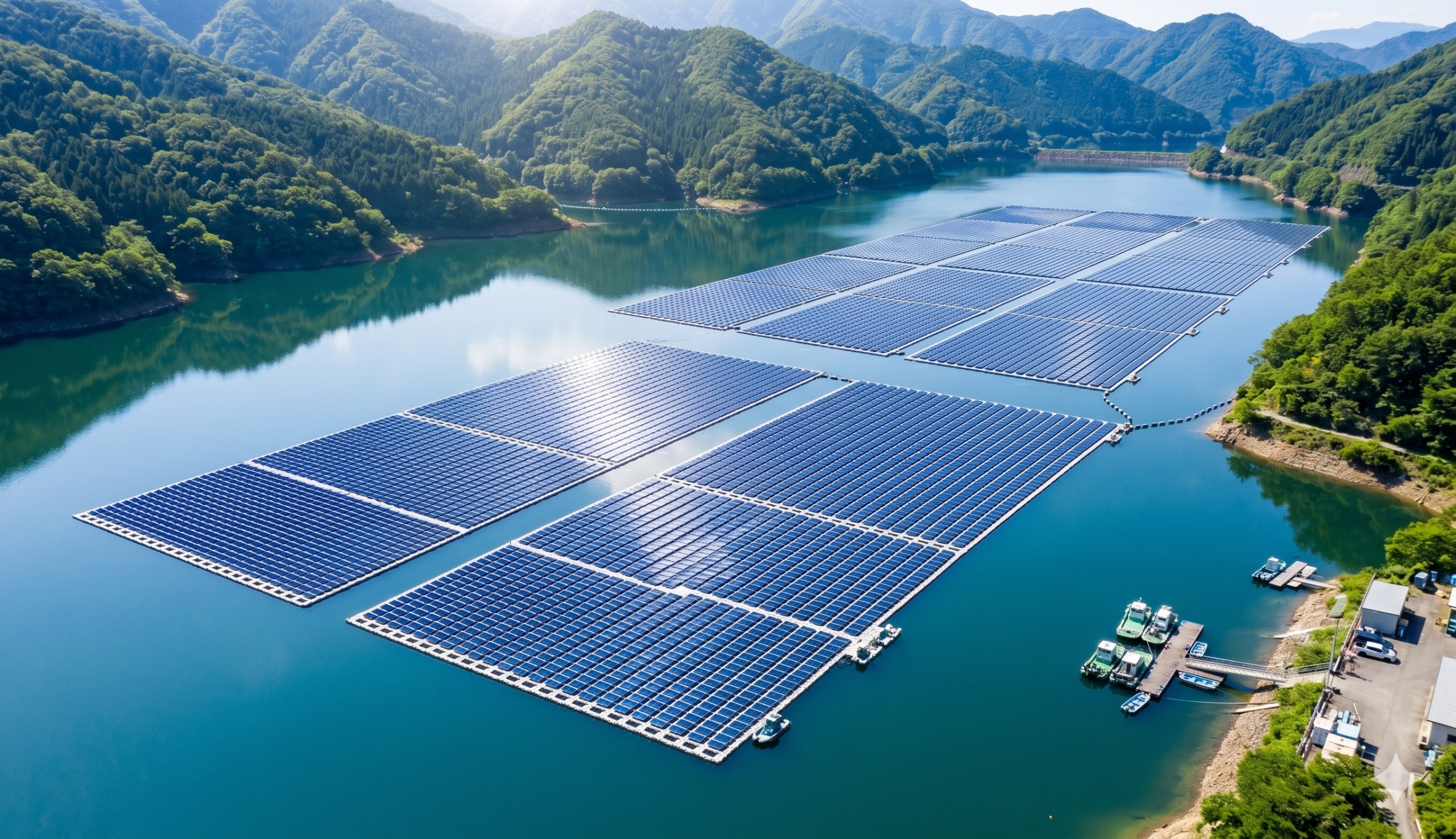
Floating Solar Farms: A New Blue Ocean for Clean Energy on Water
Floating solar photovoltaics (floatovoltaics) are rapidly emerging as one of the fastest-growing segments of the photovoltaic industry. Unlike traditional ground-mounted solar farms, floating solar installs photovoltaic modules on floating structures deployed on water bodies, not only saving land resources but also leveraging the cooling effect of water to improve power generation efficiency.
Evolution of Technical Approaches
First-generation floating solar systems used simple pontoon-and-support structures to fix standard photovoltaic modules on the water surface. As the market has developed, the industry has evolved to third-generation systems: using high-density polyethylene (HDPE) integrally molded floats with higher integration, longer service life (design life exceeding 25 years), and significantly improved wind and wave resistance.
The water surface cooling effect is a real and measurable technical advantage. Research shows that the average operating temperature of floating solar modules is approximately 5-10°C lower than ground-mounted installations, yielding a power generation gain of 10-15% in hot regions. While this figure may appear modest in engineering manuals, over a 25-year plant operating life it translates into tens of millions of yuan in additional revenue.
Global Market Landscape
Asia dominates the global floating solar market. China is the world's largest floating solar market, with large-scale development of water surfaces in coal mining subsidence areas in Shandong, Anhui, and Jiangsu provinces. The world's largest floating solar farm is located in Dezhou, Shandong, China — with an installed capacity of 320 MW, covering over 1,000 hectares of water surface.
Reservoirs and lakes in Southeast Asia are also becoming key deployment areas for floating solar. Indonesia plans to build a 2.2 GW floating solar project on the Batam Island reservoir; Singapore has deployed a 60 MW pilot project in the Johor Strait; and Taiwan's Zengwen Reservoir and Wushantou Reservoir are also advancing floating solar plans.
Dual Use of Reservoirs
The unique value of floating solar in reservoir scenarios lies in "dual use" — the same water surface simultaneously serves power generation and water resource management. The solar panel covering reduces evaporation losses (by 30-50% in arid regions), suppresses algae growth (reducing water treatment costs), while power generation revenue provides an additional income stream for reservoir operations.
For hydroelectric plant reservoir areas, the economic complementarity of floating solar is even more apparent: when hydropower capacity is insufficient during dry periods, floating solar can precisely supplement output; during wet periods when hydropower runs at full capacity, floating solar farms can leverage the reservoir's regulation capability to reduce curtailment rates.
Challenges and Limitations
Floating solar is not without drawbacks. Infrastructure costs are approximately 20-30% higher than ground-mounted photovoltaics, primarily from additional investment in floating systems, anchoring structures, and underwater cabling. Typhoons and extreme wave conditions pose structural safety threats — Typhoon Yagi in 2024 caused approximately 15% module damage to a floating solar farm in Hainan. Additionally, the ecological impact on water bodies — particularly the potential effects on dissolved oxygen levels and aquatic organisms — requires long-term monitoring and research.
Nevertheless, against the backdrop of increasingly constrained land resources and abundant reservoir and lake surfaces, floating solar will become an important component of photovoltaic capacity growth over the next decade. Cumulative global floating solar installations are projected to exceed 100 GW by 2030.
Offshore Floating Solar: The Next Wave
The next frontier for floating solar technology is the migration from inland waters to the ocean. Offshore floating solar faces far greater technical challenges than freshwater versions — wave heights of 5-10 meters, salt spray corrosion, marine biofouling, and more extreme wind loads. In 2025, Dutch company SolarDuck deployed the world's first commercial offshore floating solar array (5 MW) in the North Sea, using a triangular pyramidal float design that keeps panels above wave crests rather than the conventional surface-hugging approach.
Dutch test data shows offshore floating solar generates approximately 15% more electricity than inland versions — due to more pronounced ocean cooling effects and higher sea surface albedo. However, costs are 2-3 times higher than inland systems due to corrosion-resistant materials, stronger anchoring systems, and more complex installation engineering. SolarDuck expects to halve costs by 2030.
Offshore floating solar has a unique advantage: it can share infrastructure with offshore wind farms. Floating arrays can be installed in the idle sea space between turbines, using existing subsea cables and substations. In 2026, the Hollandse Kust Zuid wind farm piloted co-located solar (2 MW), demonstrating a 20% reduction in grid connection costs.
Floating Solar-Aquaculture Integration
Another rapidly growing direction is floating solar combined with aquaculture — known as "Aquavoltaics." Installing floating solar panels above fish or shrimp ponds allows the same water surface to serve both power generation and aquaculture. The shading effect of solar panels is actually beneficial for certain species (shrimp and specific fish), reducing the risk of excessive summer water temperatures while decreasing algal overgrowth.
Chinese pilot projects show shrimp survival rates improved by 12-18% after deploying floating solar over Fujian shrimp ponds (due to more stable water temperatures), with power generation revenue providing approximately 30% additional income for farmers. Thailand and Vietnam are promoting similar models in the Mekong Delta.
Environmental Impact Consensus
Scientific data on floating solar's impact on aquatic ecosystems is accumulating. A 2026 Nature Energy review analyzing ecological monitoring data from over 40 global floating solar projects reached these conclusions: for larger water bodies (>1 km²), coverage below 30% shows no statistically significant effect on dissolved oxygen; for small water bodies (<0.1 km²), coverage exceeding 20% can be expected to reduce dissolved oxygen by 5-10% and expand sediment hypoxic zones.
Studies also found that bird impacts are mostly positive — solar panels provide additional roosting platforms and nesting substrates. Best practice guidelines recommend preserving at least 30% open water area as ecological corridors with water quality and biodiversity monitoring during the first 3 years of operation. Floating solar is moving from an emerging technology to a mainstream pillar of global solar capacity.