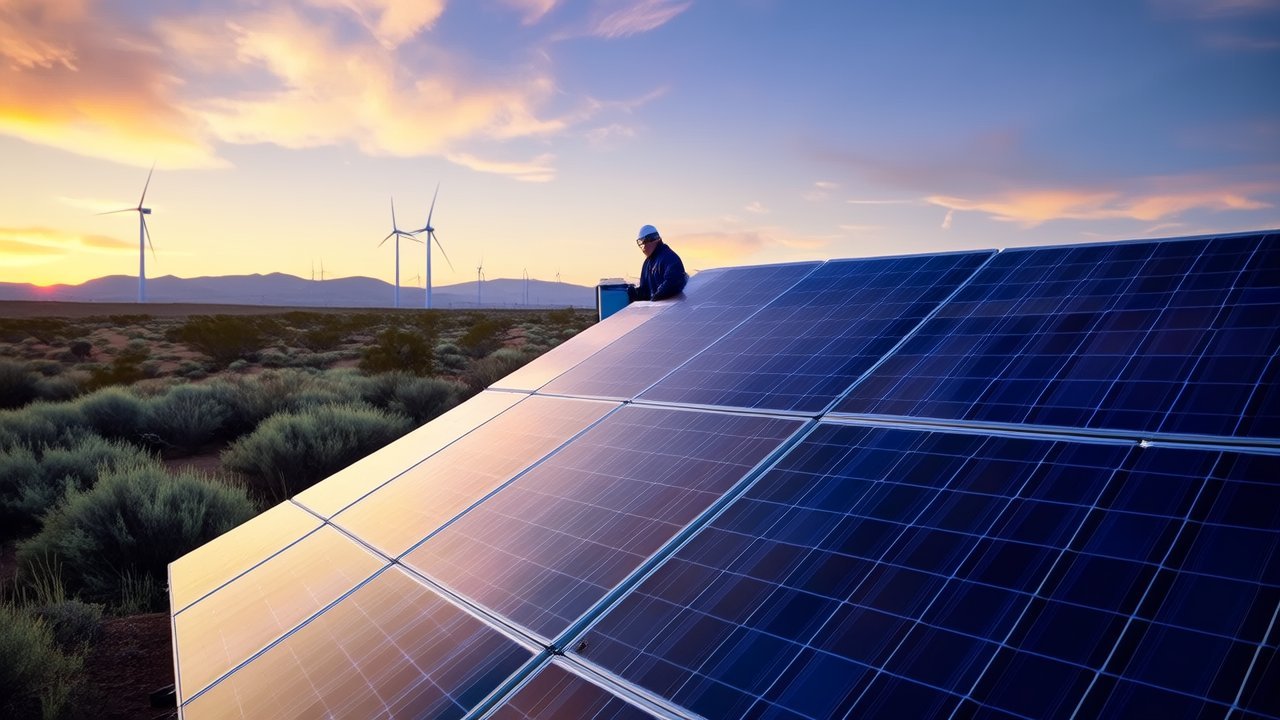
The global solar energy industry in mid-2026 stands at a confluence of multiple transitions. Perovskite-silicon tandem solar cells are moving from laboratory to production lines, back-contact (BC) cell technology is accelerating adoption among Chinese manufacturers, and global installed capacity is on track to surpass 2 terawatts (TW) this year. These changes collectively define a structural transformation: solar is evolving from the lowest-cost power source into a core component of grid infrastructure.
Perovskite solar cell commercialization is one of the most closely watched developments of 2026. Oxford PV has started the world's first commercial perovskite-silicon tandem solar panel production line in Brandenburg, Germany, with 200 MW annual capacity. Their tandem cells achieve 28.6% certified efficiency in testing, significantly exceeding the 24-26% commercial ceiling of conventional silicon cells. Multiple Chinese manufacturers — including Longi and Trina Solar — are building their own tandem pilot lines targeting GW-scale production by 2027-2028.
However, the bottleneck for perovskite commercialization is not efficiency but stability and scalable manufacturing. Perovskite materials' sensitivity to moisture, temperature, and UV radiation causes faster degradation than conventional silicon cells — a core challenge shared by all perovskite startups. Oxford PV claims 25-year module lifespan comparable to conventional silicon, but this data awaits independent long-term validation in real-world conditions.
In crystalline silicon, back-contact (BC) cell technology has become the dominant trend of 2026. Longi's HPBC 2.0 modules have achieved mass production with output power of 650-660W, peak 670W, and mass production efficiency of 24.8%. As of end-2025, Longi holds 46 GW of HPBC 2.0 cell capacity plus 11 GW through partnerships. This technology transfers both positive and negative electrodes to the cell's rear, eliminating front-grid shading losses while improving aesthetics — particularly valued in the rooftop distributed PV market.
Longi's 2025 performance reflects broader industry trends. The company shipped 86.58 GW of modules with annual revenue exceeding CNY 70 billion. Overseas markets showed particular strength — European module sales grew 18%, Latin America surged 54%, and Australia grew 76% to 1.3 GW. Notably, these gains occurred amid tightening US trade barriers, highlighting the importance of globalized manufacturing footprints.
Global installation trends for 2026: New solar PV installations are projected at 580-650 GW, pushing cumulative capacity past 2 TW. China remains the largest single market at 230-260 GW new additions, though growth decelerates from ~70% YoY to ~40%. India is the fastest-growing market at 35-40 GW new installations, targeting 500 GW renewable capacity by 2030.
The US market is constrained by tariff policy and IRA implementation uncertainty, with 45-55 GW expected new installations. A structural shift worth noting: corporate renewable PPA growth, driven by large tech companies — particularly AI data center operators — becoming the largest buyers of solar power.
Energy storage pairing ratios are a critical variable for grid integration. In 2026, solar-plus-storage ratios in major markets reach approximately: US 35%, Australia 40%, Germany 25%, China 15%. Battery pack prices have fallen below $80/kWh, making solar-plus-storage economic in an increasing number of regions.
Structural challenges persist. Manufacturing overcapacity is compressing margins — global solar module nameplate capacity exceeded 800 GW in 2025 against real demand of ~500 GW, implying ~60% capacity utilization. Module prices have declined from ~$0.12/W in late 2023 to ~$0.07/W in 2026, benefiting end users but forcing manufacturer consolidation.
Trade barriers remain uncertain. US tariff exemptions for Southeast Asian production have expired, and new anti-dumping duties are reshaping supply chains. Chinese manufacturers are building new capacity in the Middle East (Saudi Arabia, UAE) and the US — Longi's 5 GW Ohio module plant started production in 2025.
The most notable structural change is AI data centers replacing government subsidies as the primary solar demand driver. ChatGPT queries consume 10x more power than Google searches. Global AI data center electricity demand is projected to grow 3-5x between 2026-2030. Major tech companies (Microsoft, Google, Amazon, Meta) are already the world's largest renewable energy purchasers, with PPA contracts typically spanning 15-20 years — providing unprecedented revenue visibility for solar developers.
From the Observatory's perspective, value in the solar industry is shifting from manufacturing toward system integration and operations. Manufacturing gross margins have been compressed to single digits by overcapacity, while project development, storage operations, and VPP services maintain attractive margins. Perovskite manufacturing equipment suppliers — particularly coating and encapsulation equipment — may represent the next high-growth sub-sector.
The EU's Carbon Border Adjustment Mechanism (CBAM), fully implemented January 2026, is becoming a new demand driver. For energy-intensive manufacturing (steel, aluminum, cement, chemicals), solar plants are not just environmental choices but economic decisions to reduce CBAM costs.
Disclaimer: This article is for informational purposes only and does not constitute investment advice. Data and time-sensitive information are current as of the publication date and subject to change. Neither the author nor POC.HK assumes responsibility for any losses resulting from the use of this information.