Solar Energy 2026 Trends: Perovskite Commercialization, Floating Solar, and New Efficiency Records
The solar energy industry entered 2026 with momentum that few could have predicted a decade ago. Global installed solar capacity has surpassed 2.5 terawatts, and the pace of deployment continues to accelerate. But beyond the familiar narrative of falling costs and rising installations, three technological trends are reshaping the industry in profound ways: the long-awaited commercialization of perovskite solar cells, the rapid expansion of floating solar photovoltaics, and a string of efficiency records that are rewriting the limits of what solar panels can achieve.
Perovskite Commercialization: The Promise Becomes Real
For years, perovskites were the material of tomorrow — always promising, never quite delivered. That changed in 2025 and 2026 as multiple companies brought perovskite and perovskite-silicon tandem cells to commercial production.
Oxford PV made headlines in late 2025 when it began shipping its first commercial perovskite-silicon tandem panels from its factory in Brandenburg, Germany. The panels achieved a certified efficiency of 26.9% at the module level, far exceeding the 22-23% typical of conventional silicon panels. By early 2026, the company had scaled production to 100 megawatts of annual capacity and announced plans for a gigawatt-scale factory in the United States.
The significance goes beyond a single company. Perovskite-silicon tandems work by stacking a perovskite layer on top of a conventional silicon cell. The perovskite absorbs high-energy blue and green photons, while the silicon captures lower-energy red and infrared photons that pass through. This tandem architecture allows the cell to extract more energy from the full solar spectrum, pushing beyond the theoretical efficiency limit of single-junction silicon cells.
Longi Green Energy, the world's largest solar manufacturer, demonstrated a perovskite-silicon tandem cell with 33.9% efficiency in the laboratory in late 2025 — a record that stood for only months before being surpassed by a Chinese research group at 34.6%. While lab records do not translate directly to commercial products, they indicate a technology trajectory with substantial headroom.
The key remaining challenges are stability and manufacturing yield. Early perovskite cells degraded rapidly when exposed to heat, moisture, and UV light. Oxford PV claims its encapsulated tandem panels have passed accelerated aging tests equivalent to 25 years of outdoor exposure, but independent long-term field data is still accumulating. Manufacturers are also wrestling with the challenge of coating large-area substrates with uniform perovskite films — a problem that becomes harder as panel sizes increase.
Despite these hurdles, the industry consensus is that perovskite-silicon tandems will capture 10-15% of the global solar market by 2030, up from near zero today. The economics are compelling: a tandem panel that produces 30% more energy than a silicon panel of the same area, with only a 15-20% cost premium, delivers a lower levelized cost of electricity (LCOE) in almost any installation scenario.
Floating Solar: Power on the Water
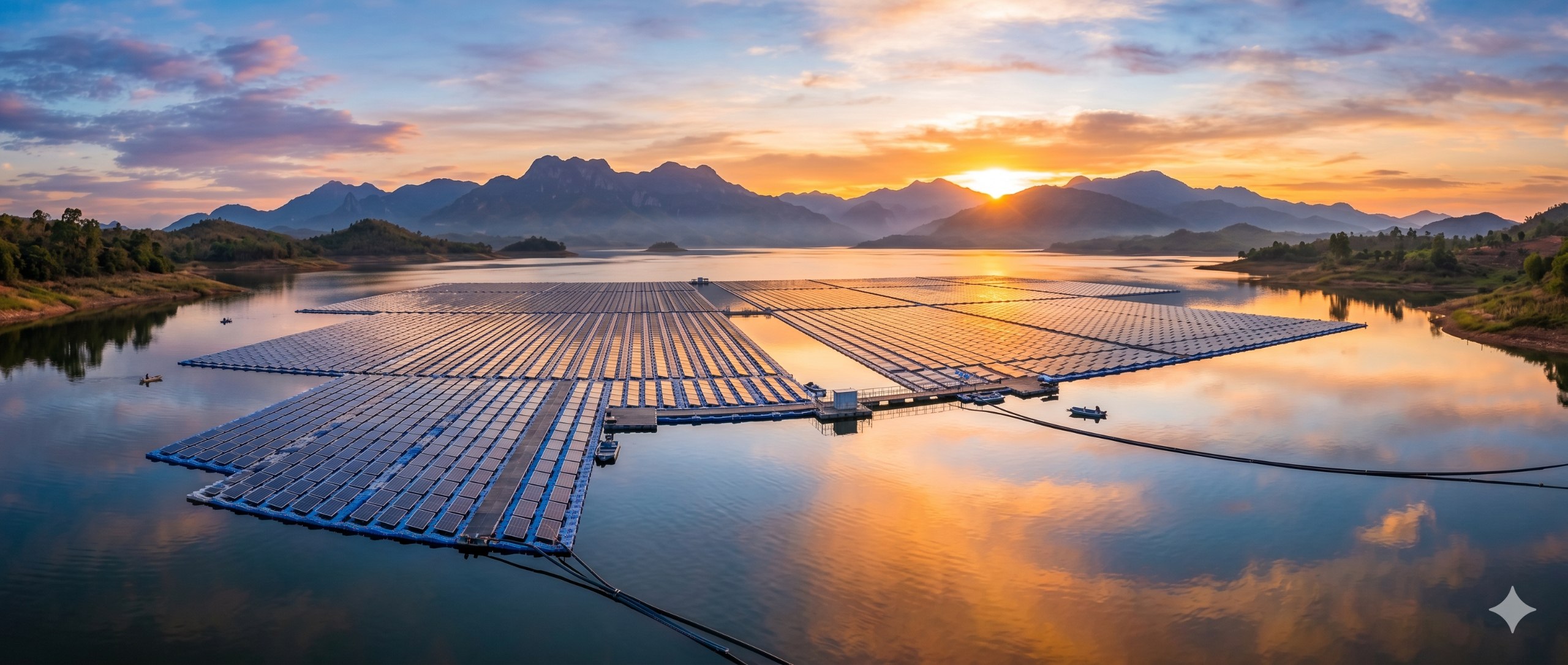
Floating solar photovoltaics (FPV) — solar panels mounted on buoyant platforms on lakes, reservoirs, and coastal waters — has emerged as one of the fastest-growing segments of the solar industry. Global FPV installations reached 12 gigawatts by the end of 2025, up from just 3 GW in 2022, and analysts project 30 GW by 2028.
The appeal is straightforward. Floating solar does not compete for land, which is increasingly scarce and expensive in densely populated regions. It reduces water evaporation from reservoirs — a critical benefit in drought-prone areas — and the cooling effect of water improves panel efficiency by 5-10% compared to land-based installations.
The technology has also matured rapidly. Early FPV systems used simple plastic floats that degraded in sunlight and were vulnerable to wave damage. Modern systems use high-density polyethylene (HDPE) floats with UV stabilizers, stainless steel mooring lines, and marine-grade electrical connectors. Some developers have introduced tracking systems that rotate panels to follow the sun, boosting energy yield by an additional 15-25%.
The largest floating solar installations now rival major land-based solar farms. The Dezhou Dingzhuang Floating Solar Farm in China's Shandong province, completed in 2024, has a capacity of 320 megawatts and covers an area equivalent to 450 soccer fields. In Southeast Asia, where land constraints are severe and abundant water bodies exist, floating solar has become the default choice for new utility-scale solar capacity.
A particularly innovative development is the pairing of floating solar with hydropower. Several dams in Brazil, India, and Laos have installed floating solar arrays on their reservoirs, sharing the existing transmission infrastructure and creating a hybrid renewable plant that can dispatch solar power during the day and hydro power at night. The synergy is powerful: the hydro plant can store water when the sun is shining and release it when solar output drops, effectively using the reservoir as a giant battery.
Offshore floating solar — panels deployed in coastal waters and oceans — is at an earlier stage but progressing rapidly. The main challenge is wave loading: the constant motion of ocean swells creates mechanical stress that standard FPV systems were not designed to handle. Companies like Ocean Sun (Norway) and Heliofloat (Netherlands) have developed flexible membrane-based platforms that conform to wave motion rather than resisting it, and pilot projects in the North Sea and Mediterranean have survived winter storms with minimal damage.
Efficiency Records: Pushing the Boundaries
The solar efficiency race in 2025-2026 has been remarkable not just for the numbers achieved but for the diversity of technologies setting records.
In the silicon realm, conventional single-junction crystalline silicon cells have long been approaching their theoretical Shockley-Queisser limit of about 29.4%. Longi achieved 27.3% for a heterojunction back-contact cell in 2025, widely seen as approaching the practical ceiling for silicon alone. Further gains will require tandem architectures.
Perovskite-silicon tandems, as noted, have reached 34.6% in the lab — but the real news is that these lab records are increasingly translating into production-relevant prototypes. LONGi's 33.9% record cell used processes compatible with their existing manufacturing lines, suggesting a path to volume production.
Perovskite-only (single junction) cells have also improved dramatically. UNIST in South Korea reported a certified 26.1% efficiency for a pure perovskite cell in early 2026 — a record for this class. While perovskite-only cells still trail silicon in durability, their extremely low material cost and simple fabrication process make them attractive for applications where weight and flexibility matter more than lifespan, such as building-integrated photovoltaics (BIPV) and portable electronics.
Cadmium telluride (CdTe) thin film, championed by First Solar, has also seen a resurgence. First Solar's Series 7 modules achieved 22.1% module efficiency in 2025, narrowing the gap with silicon and reinforcing CdTe's position as the leading thin-film technology for utility-scale deployment.
The Market Impact
These three trends — perovskite commercialization, floating solar expansion, and efficiency records — are converging to reshape the solar market in 2026.
Perovskite-silicon tandems will initially command a premium price for applications where space is limited: rooftops in dense urban areas, commercial buildings, and solar canopies over parking lots. As manufacturing scales, the cost premium will shrink, and tandems will begin competing for utility-scale projects by the late 2020s.
Floating solar is opening up vast new addressable markets. Countries like Indonesia, the Philippines, Vietnam, and Bangladesh — all with abundant water and severe land constraints — are now looking to FPV as their primary solar pathway. The World Bank's ESMAP program estimates the global technical potential for floating solar at 4,000 GW, far exceeding the current total installed solar capacity of all types.
Efficiency records, meanwhile, are driving down balance-of-system costs. Higher-efficiency panels mean fewer panels, less racking, less wiring, and less land per megawatt. These soft costs — everything except the panels themselves — now account for 60-70% of total system cost in many markets. Every percentage point of efficiency gain compounds across the entire system, reducing installation labor, permitting fees, and electrical infrastructure.
Challenges Ahead
The industry is not without headwinds. Trade tensions between the United States and China continue to create supply chain uncertainty. The Biden administration's solar tariff policies, extended through 2026, have pushed module prices higher in the US market, creating headwinds for deployment. European manufacturers, struggling to compete with Chinese imports, have called for stronger domestic content requirements.
Grid integration is another growing challenge. Solar's share of electricity generation has reached 15% globally and exceeds 30% in several markets (California, South Australia, parts of Germany) during peak daytime hours. At these penetration levels, the value of additional solar generation declines unless paired with storage, transmission expansion, or demand-side management. The rapid growth of battery energy storage — global installations hit 100 GWh in 2025 — is helping, but grid operators are still playing catch-up.
Looking Ahead
Solar energy in 2026 is a story of technology maturation meeting market urgency. Perovskites are finally crossing the chasm from laboratory to factory. Floating solar is turning unused water surfaces into power plants. And efficiency records are being set across multiple technologies, each pushing the envelope in its own way.
The clean energy transition is not a single technology story. It is a portfolio of innovations that reinforce each other. Solar — now the cheapest source of electricity in history in most of the world — continues to surprise with its capacity for reinvention.
Disclaimer: This article is for informational purposes only and does not constitute financial, technical, or investment advice. The views expressed are based on publicly available information as of the date of publication. Readers should conduct their own research and consult with qualified professionals before making any decisions based on this content.