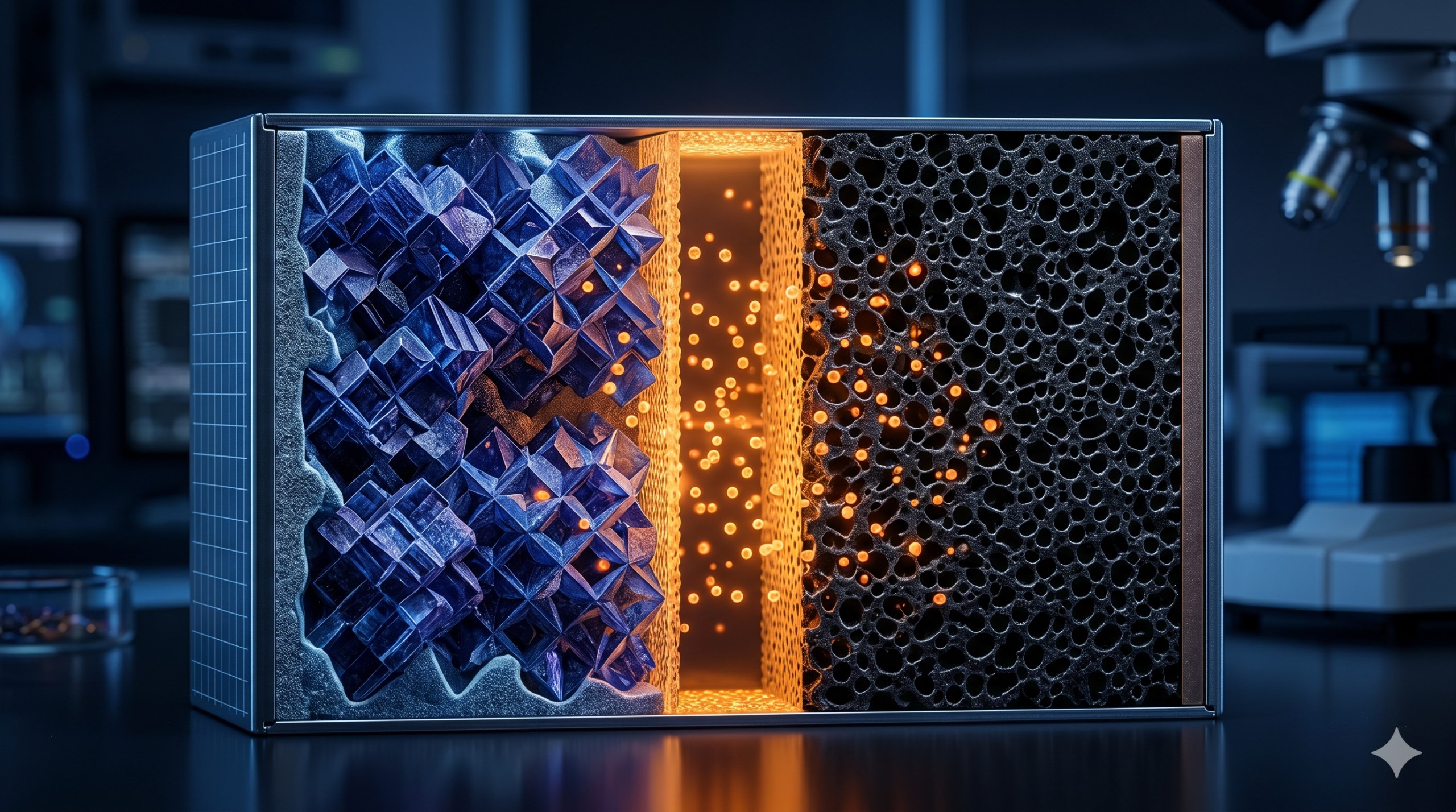
In 2026, the battery industry is undergoing a quiet revolution. While global attention remains focused on lithium-ion batteries, a cheaper, safer, and more resource-abundant alternative — sodium-ion batteries — is moving from the laboratory to mass production. China's CATL has begun large-scale sodium-ion battery production, and an MIT research team achieved a major energy density breakthrough in 2026. What does this mean for electric vehicles, energy storage stations, and the global energy transition?
How Sodium-Ion Batteries Work: Why Are They Cheaper?
The operating principle of sodium-ion batteries (SIBs) is highly similar to that of lithium-ion batteries (LIBs): during charging and discharging, sodium ions shuttle between the positive and negative electrodes (rocking-chair mechanism). However, the choice of sodium over lithium brings fundamental cost differences.
Resource Abundance: Sodium is the sixth most abundant element in the Earth's crust, widely distributed globally (primarily from salt and brine). In contrast, lithium resources are highly concentrated — Chile, Australia, and Argentina control approximately 75% of global lithium resources. Between 2024 and 2026, lithium prices experienced dramatic volatility (plummeting from $80,000 per ton to about $12,000, then rebounding to around $20,000). This instability has caused significant headaches for battery manufacturers. Sodium prices hover around $150-300 per ton, with virtually no price fluctuation risk.
Material Costs: Sodium-ion batteries can use aluminum foil as the anode current collector (lithium-ion batteries can only use copper foil), further reducing material costs. Comprehensive estimates suggest that sodium-ion battery material costs are approximately 30-40% lower than LFP (lithium iron phosphate) batteries and about 50-60% lower than NMC (nickel-manganese-cobalt) batteries.
MIT's Breakthrough: Energy Density Surpassing LFP
The long-standing Achilles' heel of sodium-ion batteries has been low energy density — early sodium-ion batteries achieved only 80-100 Wh/kg, far below LFP's 160-180 Wh/kg. This made them difficult to apply in electric vehicles.
In 2026, an MIT materials science team published a breakthrough study in Nature Energy: developing a novel layered oxide cathode material combined with a hard carbon anode, pushing sodium-ion battery energy density to 210 Wh/kg. This value already exceeds typical LFP battery levels and approaches the performance of entry-level NMC batteries.
The MIT team's key innovations include:
1. Novel Cathode Material: By introducing trace amounts of titanium and magnesium doping into NaNi0.5Mn0.5O2, lattice distortion during charge-discharge cycles was suppressed, extending cycle life from approximately 2000 cycles to over 5000 cycles.
2. Advanced Hard Carbon Anode: Hard carbon derived from biomass waste (such as coconut shells and almond shells), with microporous structure engineering, achieved a specific capacity of 450 mAh/g — approaching the performance of graphite anodes in lithium-ion batteries.
3. New Electrolyte Formulation: Developed a NaPF6-based dual-solvent electrolyte that remains stable across a wide temperature range of -20°C to 60°C, solving the previous poor low-temperature performance of sodium-ion batteries.
China's Mass Production Leadership
Although sodium-ion battery research originated in Europe and the United States, Chinese companies have established a clear lead in scaled production.
CATL (Contemporary Amperex Technology Co. Ltd.) commissioned its first 20 GWh sodium-ion battery production line at the end of 2025 and started a second production line in early 2026. CATL's first-generation sodium-ion battery product (energy density 145 Wh/kg) has been applied to Chinese energy storage projects and entry-level electric vehicles (such as A00-class microcars). Their second-generation product (target 175 Wh/kg) is planned for mass production by the end of 2026.
CATL's AB Battery Solution: An ingenious system design — mixing sodium-ion and lithium-ion batteries within a single battery pack. The BMS (Battery Management System) dynamically dispatches the two battery types based on real-time demand: sodium-ion batteries handle daily low-speed driving and energy storage backup, while lithium-ion batteries step in when high power output is needed. This hybrid approach maintains driving range while reducing battery pack costs by approximately 25%.
BYD began equipping the low-end version of its popular "Seagull" model with sodium-ion batteries in early 2026, achieving a range of 230 km (CLTC cycle) at a price as low as ¥68,800 RMB (approximately $9,500 USD), making it one of the most affordable electric vehicles currently available.
Enormous Potential in Energy Storage
If the electric vehicle market still has concerns about sodium-ion battery energy density, in the stationary energy storage field, the advantages of sodium-ion batteries are almost undisputed.
Power storage systems are far less sensitive to volume and weight than electric vehicles but are extremely sensitive to cost and safety. Sodium-ion batteries excel on both dimensions:
- Cost: The levelized cost of energy (LCOE) for sodium-ion storage systems has dropped to approximately $0.04-0.06/kWh/cycle, lower than LFP storage systems at $0.06-0.08/kWh/cycle.
- Safety: Sodium-ion batteries can be safely transported in a fully discharged state (no risk of lithium deposition), with a higher thermal runaway temperature (approximately 280°C vs. lithium-ion's 180°C), significantly reducing fire risk.
State Grid Corporation of China has deployed a total of 500 MWh of sodium-ion storage systems in three provincial demonstration projects. Preliminary operational data from these projects shows sodium-ion storage systems achieving cycle efficiency of 91-93%, slightly below lithium-ion systems' 94-96%, but the flat LCOE curve makes them competitive in daily single-cycle applications (solar-plus-storage).
Ecosystem Challenges and Unknowns
Despite a bright outlook, the industrialization of sodium-ion batteries still faces several challenges:
Supply Chain Maturity: Current global hard carbon anode production capacity is less than 20,000 tons/year, while lithium graphite anode capacity exceeds 2 million tons/year. Standardized production processes for hard carbon are not yet mature, and consistency issues between different production batches need to be resolved.
Recycling Systems: Sodium-ion battery recycling processes are still under development. Although the value of sodium itself is low for recycling (approximately $150/ton vs. lithium's $20,000/ton), metals like nickel and manganese in the cathode material have recycling value. A complete recycling industry chain may take 5-8 years to form.
Energy Density Ceiling: From an electrochemical standpoint, the ionic radius of sodium ions (1.02 Å) is larger than that of lithium ions (0.76 Å), meaning sodium-ion batteries have a theoretical energy density upper limit (approximately 250 Wh/kg). While this is not an issue for energy storage applications, in high-end applications like aviation electrification and long-haul electric trucks, sodium-ion batteries still cannot replace high-nickel NMC batteries.
Observatory Analysis
The rise of sodium-ion batteries should not be simplistically interpreted as the "lithium battery killer." A more accurate description is that the battery market is transitioning from a "single technology dominance" pattern to an era of "diversified technology coexistence."
During the 2025-2030 period, we expect the battery market to stratify as:
- High-end market (range >500 km): High-nickel NMC, solid-state batteries, lithium metal batteries
- Mid-range market (range 300-500 km): LFP, LMFP (lithium manganese iron phosphate)
- Low-end / Storage market: Sodium-ion batteries, flow batteries
The strategic significance of sodium-ion batteries lies not only in cost but in resource security. For future power grids that will require energy storage deployment on the scale of terawatt-hours, complete reliance on a geographically concentrated resource (lithium) presents a geopolitical risk. Sodium-ion batteries offer a de-risking technological pathway.
Disclaimer: This article is for informational purposes only and does not constitute investment advice or a basis for business decisions. Data and time-sensitive information are accurate as of the publication date and may change with subsequent developments. Neither the author nor POC.HK assumes any liability for losses arising from the use of this information.