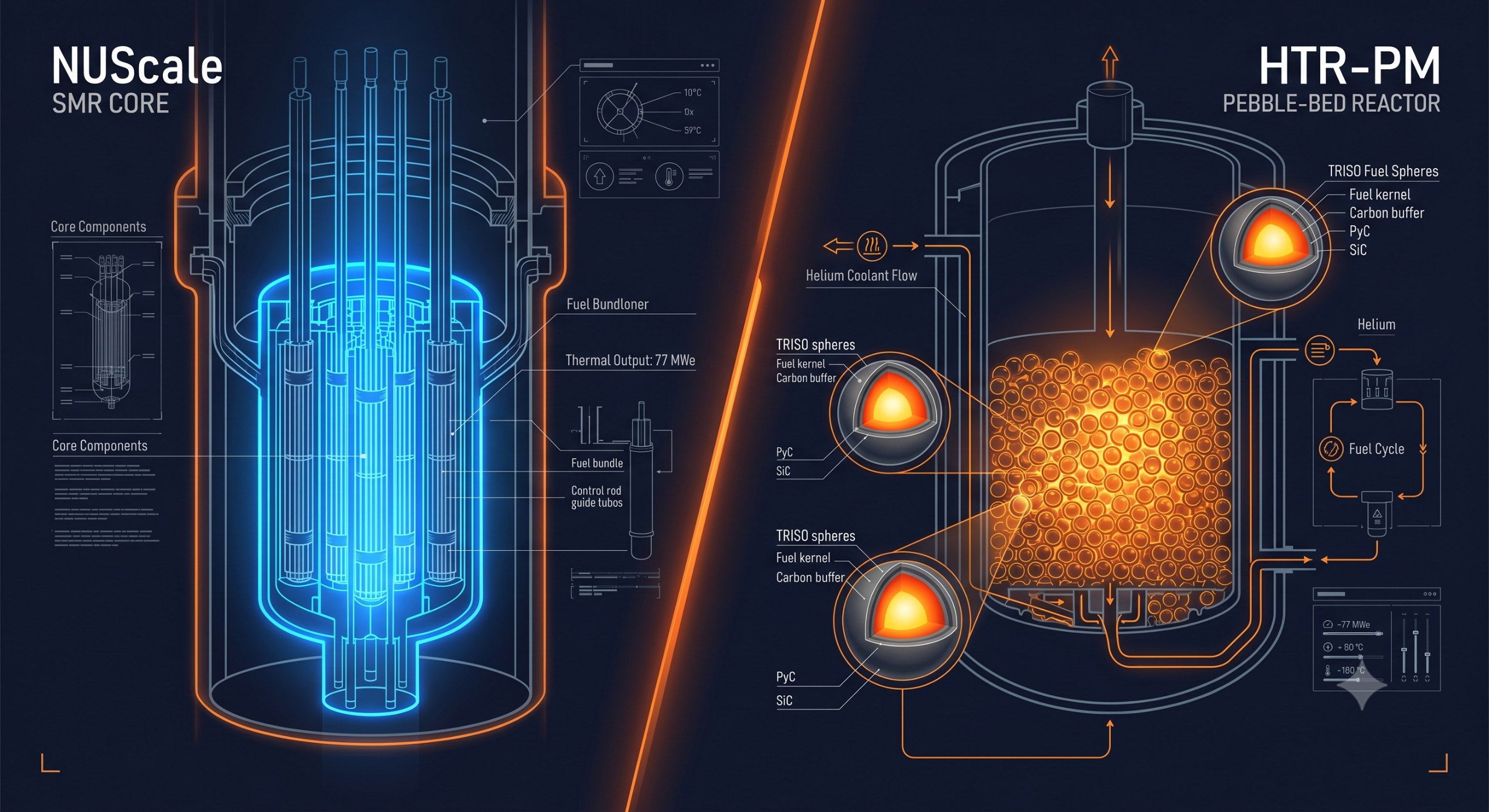
Small Modular Reactors Reach Dual Milestone: NuScale Receives Full NRC Certification, HTR-PM Achieves 100 Days Continuous Operation
Between June 2 and 3, 2026, the global Small Modular Reactor (SMR) sector witnessed two symbolic milestones. NuScale Power's VOYGR-6 design received full Standard Design Approval (SDA) from the US Nuclear Regulatory Commission (NRC), clearing the regulatory path for America's first commercial SMR plant. Simultaneously, China's Shidaowan HTR-PM (High-Temperature Gas-Cooled Reactor) demonstration plant achieved 100 days of continuous full-power operation, validating the engineering reliability of Generation IV nuclear technology. These events, occurring on opposite sides of the planet, point to the same trajectory: small nuclear reactors are transitioning from technical concepts to commercial reality.
NuScale VOYGR-6: A New Chapter in US Nuclear Regulation
After eight years of design review and millions of pages of documentation, NuScale's VOYGR-6 design received Standard Design Approval (SDA) from the NRC on June 2, 2026. This is the first SDA ever issued for an SMR design and the first approval of a new reactor design in the US since large PWR designs were certified in the 2010s.
Key specifications of VOYGR-6:
- Unit Power: 77 MWe
- Module Configuration: 6 power modules per plant, total 462 MWe
- Reactor Type: Integral Pressurized Water Reactor (iPWR)
- Cooling Method: Natural circulation cooling, no main pumps required
- Safety Features: Passive safety systems can maintain safe shutdown for 72 hours without power or operator intervention
- Footprint: Approximately 40 acres, far smaller than traditional nuclear plants
The significance of NRC certification extends beyond technical validation. With SDA secured, the planned VOYGR-6 plant at Idaho National Laboratory (INL) can directly reference this certification, dramatically simplifying the subsequent Construction Permit (CP) and Operating License (OL) approval processes.
NuScale has stated it is restarting commercial negotiations with Utah Associated Municipal Power Systems (UAMPS) for the Idaho project, and has signed a letter of intent with Romania NuScale for a six-module plant in Central and Eastern Europe. Analysts estimate the first commercial plant's target operation date at approximately 2030-2032.
HTR-PM: Long-Duration Operational Validation for Gen IV Nuclear
At Shidaowan in Shandong, China's HTR-PM demonstration plant reached 100 days of continuous full-power operation on June 3, 2026. This 200 MWth / approximately 65 MWe plant is the world's first grid-connected Generation IV nuclear reactor, continuously accumulating operational data since first criticality in 2023.
HTR-PM's technical characteristics differ fundamentally from NuScale's:
- Coolant: Helium (not water), with outlet temperatures reaching 750°C
- Fuel: TRISO particle fuel (Tri-structural ISOtropic), where each fuel particle is itself a miniature containment vessel
- Safety: Inherent safety -- under any accident scenario, the reactor automatically shuts down without external power or active safety systems
- Efficiency: High-temperature output enables not just electricity generation but industrial heat supply, desalination, and hydrogen production
The 100-day continuous full-power milestone is critical for engineering reliability validation. CNNC reports that HTR-PM achieved a 98.2% capacity factor during this period, well above the approximately 90% average availability of traditional PWRs. This has significant implications for demonstrating Generation IV reactor commercial viability.
HTR-PM's success has already spurred China's next commercial phase. CNNC has announced plans to build six HTR-PM600 units in Shandong (each 600 MWth / 210 MWe), targeting operation before 2030. Each HTR-PM600 comprises 6 reactor modules driving a single turbine, retaining the modular design philosophy.
SMR's Strategic Positioning: More Than "Smaller Nuclear Plants"
Traditional understanding of SMRs often remains within the "smaller, cheaper nuclear plants" framework. But these two milestones in 2026 reveal a deeper transformation: SMRs are redefining nuclear power's applications.
Diesel Replacement: For mining operations, remote communities, and industrial parks, SMRs can replace current diesel-dependent distributed energy. In Canada, three of four ongoing SMR projects target oil sands operations and remote indigenous communities for diesel replacement. Cost modeling shows a 300 MWe SMR's levelized cost of electricity (LCOE) over a 25-year lifetime at approximately $80-100/MWh, clearly competitive with diesel generation at $200-400/MWh.
Industrial Heat: HTR-PM's 750°C high-temperature output opens entirely new applications for nuclear energy in the industrial sector. Chemical processing, steel production, and hydrogen manufacturing require high-temperature heat sources currently provided primarily by fossil fuels. SMR high-temperature output can directly replace these industrial boilers, enabling industrial decarbonization.
Desalination: Interest in nuclear-powered desalination is growing in the Middle East and North Africa. SMRs' scale flexibility makes pairing reactors with desalination plants economically viable.
Grid Resilience: Unlike large nuclear plants (1,000+ MWe), SMRs can be deployed in regions with smaller grids or as distributed urban power sources. A single 77 MWe module failure would not cause widespread grid collapse.
Economic and Regulatory Challenges
Despite encouraging technical progress, SMR commercialization faces significant obstacles.
Scale Cost Paradox: SMRs were designed to reduce per-unit capital costs through modular production. However, first-of-a-kind construction costs remain high -- NuScale's Idaho project LCOE has been revised from an optimistic $55/MWh to approximately $89/MWh, while large PWRs (like AP1000) achieve approximately $70/MWh. Modular production requires sufficient volume to demonstrate cost advantages -- the "scale gap" is SMR commercialization's core challenge.
First-of-a-Kind Regulatory Cost: Each new design requires independent regulatory approval. NuScale took eight years to obtain certification -- for startups without large teams, this time and cost burden is enormous. GE-Hitachi's BWRX-300 is undergoing pre-licensing review by the Canadian Nuclear Safety Commission, expected to take 5-7 years. The industry is pushing for international regulatory harmonization to reduce redundant approval costs.
Supply Chain Readiness: SMRs require new supply chains -- particularly TRISO fuel and modular pressure vessel manufacturing capacity -- currently available in only a few countries.
Global SMR Landscape
| Design | Company | Type | Power | Status |
|---|---|---|---|---|
| VOYGR-6 | NuScale (US) | iPWR | 77 MWe | NRC Full Certification |
| BWRX-300 | GE-Hitachi | BWR | 300 MWe | Canadian Pre-licensing Review |
| HTR-PM | CNNC (China) | HTGR | 65 MWe | 100 Days Continuous Operation |
| SMR-160 | Holtec (US) | iPWR | 160 MWe | NRC Review |
| Natrium | TerraPower (US) | Sodium Fast | 345 MWe | Wyoming Construction |
| KARAT-100 | Rosatom (Russia) | iPWR | 100 MWe | Russian Review |
Outlook: SMR's 2030 Timeline
From the two milestones of 2026, SMR's 2030 timeline is becoming clearer: at least 4-5 SMR designs will receive regulatory approval globally, 3-4 commercial SMR plants will begin construction, and China's HTR-PM600 may approach commissioning.
SMRs will not replace large nuclear plants -- the two are complementary. Large plants serve grid baseload, while SMRs fill the gaps in distributed energy, industrial heat, and remote power supply. When nuclear applications expand from "electricity generation" to "heat, hydrogen, desalination," the SMR market may far exceed traditional nuclear power's imagined boundaries.