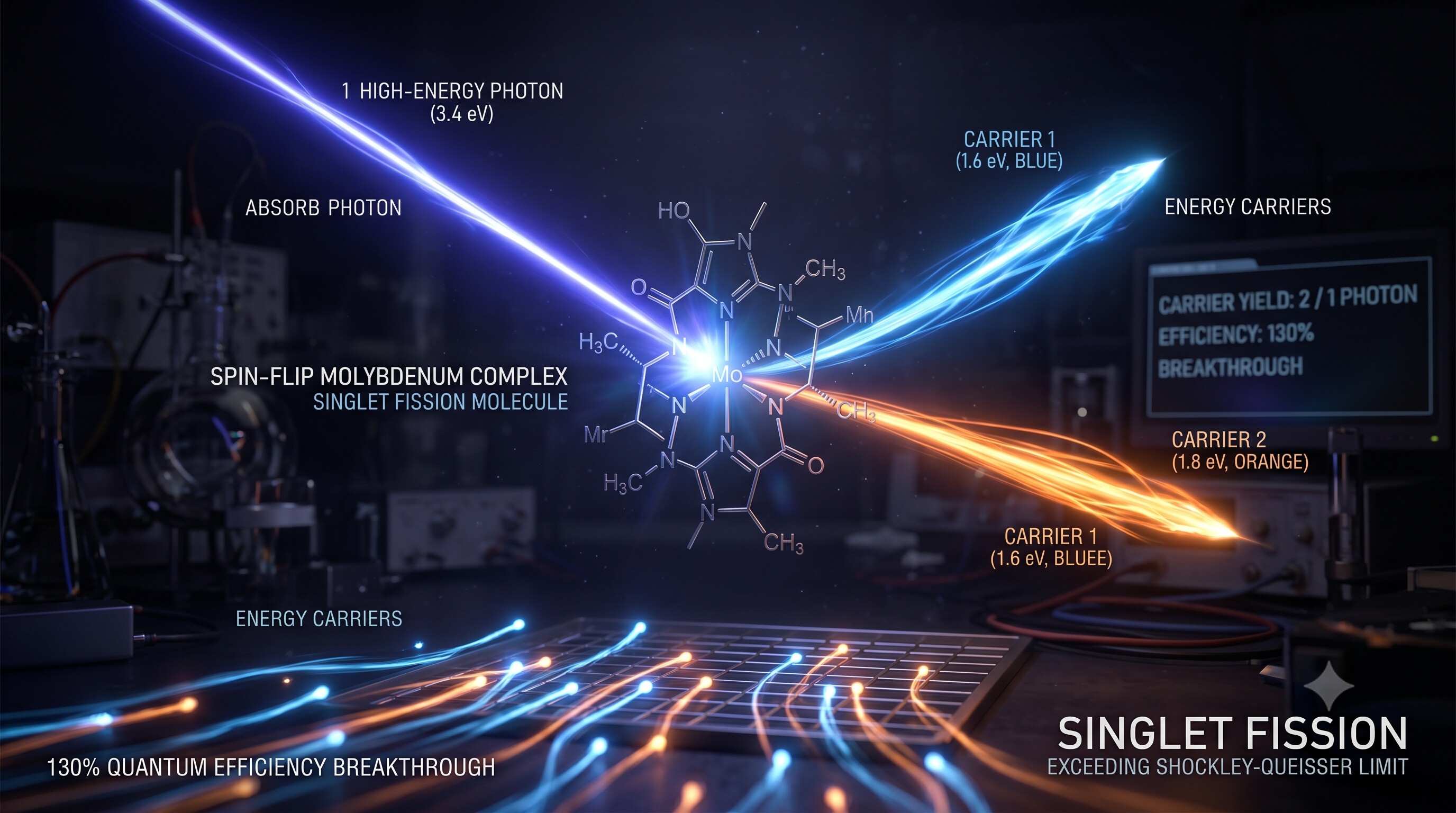
In March 2026, a joint research team from Kyushu University in Japan and Johannes Gutenberg University Mainz in Germany published a breakthrough in the Journal of the American Chemical Society (JACS) that could fundamentally reshape the solar energy landscape: using a "spin-flip" metal complex, they achieved approximately 130% energy conversion efficiency — meaning more energy carriers were produced than photons absorbed.
The Shockley-Queisser limit, long regarded as the theoretical ceiling for single-junction solar cells, sets a maximum efficiency of approximately 33.7% for conventional silicon photovoltaics. This new research changes the game from a different angle: rather than maximizing the utilization of each photon's energy, it engineers a mechanism where a single high-energy photon generates two energy carriers, fundamentally breaking the "one photon, one electron-hole pair" assumption.
Core Technology: Singlet Fission and Spin-Flip Emission
The breakthrough hinges on the combination of two physical processes: singlet fission (SF) and spin-flip emission.
Singlet fission has been described in academic circles as a "dream technology" for solar energy conversion. In conventional photoelectric conversion, a high-energy photon absorbed by a semiconductor generates one exciton (an electron-hole pair). In certain organic molecules, however, one high-energy exciton can "split" into two lower-energy excitons — this is singlet fission. The process converts excess energy that would otherwise be lost as heat into useful charge carriers.
The critical challenge has been that the two triplet-state excitons produced by singlet fission typically have energies below the bandgap of conventional solar cell materials like silicon, making them difficult to harvest directly. The team's key innovation was introducing a molybdenum-based metal complex — a "spin-flip emitter" — capable of extracting energy from these triplet excitons and converting it into usable near-infrared light emission.
The spin-flip emitter operates through the unique electronic configuration of the molybdenum ion. When triplet exciton energy transfers to the molybdenum center, it triggers a spin-state flip (triplet to singlet) accompanied by near-infrared light emission. The process is highly efficient because molybdenum's heavy atom effect enhances spin-orbit coupling, making the otherwise "forbidden" spin-flip transition feasible. This mechanism is conceptually similar to the heavy atom effect used in OLEDs, but applied to solar energy conversion for the first time.
What 130% Efficiency Actually Means
The 130% figure does not refer to power conversion efficiency (PCE) in the traditional sense, but to quantum efficiency — the number of energy carriers generated per absorbed photon. In this framework, 100% means one photon precisely produces one energy carrier, while 130% means each photon produces an average of 1.3 carriers.
This is revolutionary physics. In conventional solar materials, conservation of energy limits one photon to exciting at most one electron. Singlet fission breaks this constraint by redistributing the energy of one high-energy exciton across two lower-energy excitons, achieving exciton multiplication.
The team's system consists of three components:
- Tetracene derivatives: Absorb photons and generate two triplet excitons via singlet fission
- Molybdenum-based spin-flip complex: Acts as the energy acceptor, harvesting energy from triplet excitons and emitting near-infrared light
- Solution environment: Molecules dispersed in liquid, enabling energy transfer through diffusion
Experimental results demonstrated approximately 130% energy conversion efficiency, exceeding the 100% quantum yield threshold. Importantly, the spin-flip emitter's emission wavelength falls in the near-infrared region (approximately 750-900 nm), which closely matches silicon solar cells' optimal absorption band — providing spectral compatibility for future integration.
From Laboratory to Commercialization
Despite the excitement surrounding this discovery, a substantial technological gap remains between laboratory proof-of-concept and commercial solar panels.
The current experiments were conducted with molecular systems in solution, not solid-state solar cell devices. Integrating the singlet fission spin-flip mechanism into practical solar cells requires solving several key challenges:
- Solid-state integration: Depositing the organic molecular system as a solid thin film while maintaining singlet fission efficiency
- Charge extraction: Designing effective electrode structures to extract generated charges from the spin-flip emitter
- Stability: Addressing degradation of organic materials under prolonged light exposure
- Large-area fabrication: Scaling from laboratory dimensions to commercial production
At Technology Readiness Level (TRL) 2-3, this technology requires at least 10-15 years of sustained R&D before commercialization. For comparison, perovskite solar cells took 15 years of intensive research to reach their current TRL 6-7 (prototype demonstration).
The research team noted that near-term applications may be more relevant to LED and quantum technologies rather than direct solar cell deployment. The spin-flip emitter's unique photophysical properties could prove valuable in quantum computing and quantum communications. Additionally, singlet fission materials have potential applications in organic photodetectors and upconversion devices.
The Diversifying Future of Photovoltaics
The solar technology landscape of 2026 is becoming unprecedentedly diverse. In the same period, Oxford PV's perovskite-silicon tandem cells have reached 33.9% laboratory efficiency; long-term perovskite stability research is achieving breakthroughs; and building-integrated photovoltaics (BIPV) is transitioning from niche to mainstream.
Singlet fission offers a fundamentally different pathway to efficiency improvement compared to the perovskite tandem route. If successfully commercialized, it could be compatible with existing silicon solar cell manufacturing — potentially applied as a "top coating" layer on conventional silicon cells, capturing high-energy photons and converting them into lower-energy photons that silicon cells can utilize.
From an energy loss mechanism perspective, the primary efficiency loss in conventional silicon cells comes from "thermalization loss" — the excess energy of high-energy photons beyond silicon's bandgap being wasted as heat. Singlet fission directly converts this loss into useful charge carriers, fundamentally addressing one of photovoltaics' most persistent efficiency bottlenecks.
According to the International Energy Agency (IEA), global solar photovoltaic installed capacity surpassed 2,000 GW in 2025, making solar the largest source of new electricity capacity additions. Against this backdrop, even a 1-2 percentage point improvement in efficiency would have enormous implications for global carbon reduction. At current installed capacity, each 1% efficiency improvement is equivalent to approximately 20 GW of effective generating capacity — equal to the annual output of 20 nuclear power plants.
Observatory Analysis
The deeper significance of this research extends beyond the 130% efficiency figure itself — it demonstrates that the physical boundaries of solar energy conversion are far more flexible than previously imagined. The conventional Shockley-Queisser limit rests on the "one photon, one electron" assumption, which singlet fission fundamentally overturns.
From a competitive landscape perspective, at least a dozen leading research groups worldwide are actively exploring singlet fission applications, including the University of Cambridge, the University of Colorado Boulder, and the Chinese Academy of Sciences. The Kyushu team's result is milestone because it is the first to solve the longstanding "energy mismatch" problem — how to efficiently extract energy from triplet excitons.
From an investment and industry development perspective, this technology remains at a very early stage, with at least 10-15 years before commercialization. However, it represents an important diversification direction — offering a completely different efficiency improvement pathway alongside the perovskite tandem route. For investors and enterprises with long-term horizons in solar technology, this is a foundational breakthrough worth close monitoring.
Key milestones to watch over the next five years include: demonstration of solid-state devices, integration efficiency with silicon cells, and the pace of material stability improvements. If these critical milestones can be achieved between 2028-2030, singlet fission solar technology could enter commercialization after 2035, becoming the next-generation photovoltaic technology after perovskites.
Disclaimer: The information contained in this article is for reference only and does not constitute investment advice or business decision-making basis. Data and time-sensitive information are accurate as of the publication date and may change with subsequent developments. Neither the author nor POC.HK assumes any responsibility for losses resulting from the use of this information.