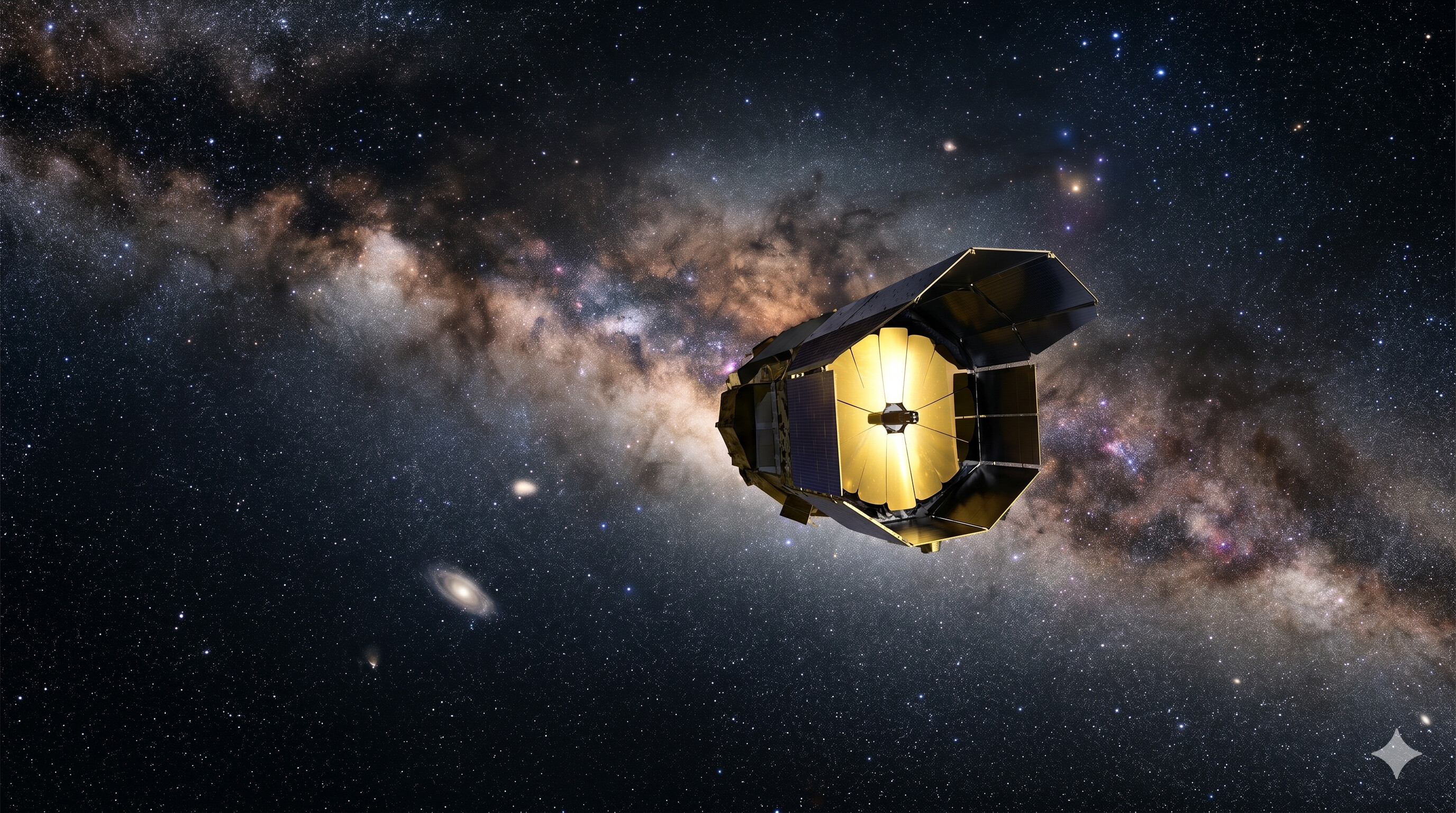
In June 2026, NASA announced that the launch date for the Nancy Grace Roman Space Telescope has been set for August 30, 2026 — approximately eight months ahead of the previously committed "no later than May 2027" timeline. This schedule adjustment not only reflects significant improvements in NASA's management of large space telescope projects following the lessons learned from the James Webb Space Telescope (JWST) delays, but also means that the astronomical community will welcome a new observation platform with a field of view 100 times larger than Hubble's in less than three months.
Roman's Design Niche: Hubble's Vision, Webb's Infrared Capabilities
The Roman Space Telescope is designed to occupy a unique observational niche between Hubble and JWST. Hubble features a 2.4-metre primary mirror covering near-ultraviolet to near-infrared wavelengths (0.1–2.5 micrometres), with a narrow field of view (WFPC3 at approximately 2.6 arcminutes), making it ideal for detailed observations of individual targets. JWST has a 6.5-metre primary mirror covering near-infrared to mid-infrared (0.6–28 micrometres), with an even narrower field of view (NIRCam at approximately 2.2 arcminutes), focused on the deepest and most distant cosmic observations.
Roman's 2.4-metre primary mirror is identical to Hubble's (in fact, it is a spare mirror originally built for the Hubble programme), but it is equipped with an array of 18 Hubble-class detectors, giving it a total field of view of 0.28 square degrees — roughly 100 times that of Hubble's WFPC3. This allows Roman to cover an area 1.4 times the size of the full Moon in a single exposure. Its infrared observation capabilities (0.48–2.3 micrometres) complement JWST, covering wide-area survey requirements beyond JWST's observation programme.
Roman's core scientific instruments include:
Wide Field Instrument (WFI): An array of 18 4K×4K H4RG-10 detectors covering the 0.48–2.3 micrometre band, totalling 288 megapixels. The WFI will lead Roman's core survey missions.
Coronagraph Instrument (CGI): A technology-demonstration stellar coronagraph designed for direct imaging of exoplanets. The CGI can block starlight (to a contrast of 10^-9), enabling a planet-to-star signal ratio of 10^-8 in visible light.
Roman will operate at the Sun-Earth L2 Lagrange point, sharing an observation location with JWST. The design mission lifetime is 5 years, but it carries enough propellant to support more than 10 years of operation.
Three Flagship Survey Missions
During its 5-year primary mission, Roman will execute three flagship survey programmes, each unprecedented in scale within astronomy:
High Latitude Wide Area Survey (HLWAS): Roman's largest single survey programme, covering approximately 2,000 square degrees of sky (about 5% of the full sky), with each observation point reaching sufficient depth to detect Type Ia supernovae at redshift z>1. HLWAS aims to produce statistical constraints on the dark energy equation of state, reducing current uncertainties by an order of magnitude. The survey is expected to yield data on billions of galaxies — more than the total number of galaxies ever observed by all astronomical telescopes to date.
Galactic Disk Time-Domain Survey (GDTS): Focused on high-cadence observations of the Galactic disk, imaging the same region every 15 minutes for several months. This survey will generate an unprecedented catalogue of microlensing events, used to measure the number and mass distribution of free-floating planets in the Milky Way. It is expected to discover more than 2,600 exoplanets, including a large number of Earth-mass rogue planets.
Supernova Survey: Building on HLWAS, Roman will conduct a dedicated search and follow-up programme for Type Ia supernovae. By measuring the light curves of thousands of Type Ia supernovae across a redshift range of 0.1–1.7, Roman can construct a detailed map of the Universe's expansion history over the past 10 billion years.
These three surveys will begin within the first six months of Roman's launch, and the science team expects to release the first scientific results within six months of the first year's data delivery.
The Engineering Significance of an Eight-Month Acceleration
Moving Roman's launch from May 2027 to August 2026 is extremely rare in large space telescope projects. Typical NASA flagship missions tend to be delayed, not accelerated. Several factors explain why Roman achieved this schedule optimisation:
First, Roman leveraged existing hardware — the 2.4-metre primary mirror is a spare from the Hubble programme, already optically finished. Compared to JWST, which required designing and building a segmented primary mirror from scratch, this saved years of development time.
Second, Roman's design extensively uses mature, space-verified technologies (a low-risk design strategy). Unlike JWST's development of 11 new technologies, Roman's key subsystems (detectors, electronics, cryogenic systems) had already reached high technology readiness levels (TRL 6 or above) before launch.
Third, NASA restructured the programme in 2025, changing Roman's launch window from a "no later than" constraint of May 2027 to a "target" of August 2026. This adjustment was made possible by smooth progress in integration and testing at Northrop Grumman, as well as confirmation of the Falcon 9 launch vehicle's capabilities from SpaceX.
Competitive Landscape and International Collaboration
Roman will create synergies with several ongoing and upcoming astronomical projects. The European Space Agency's (ESA) Euclid mission, launched in 2023, is also dedicated to dark energy research, but Roman's infrared capabilities, higher angular resolution, and faster survey speed provide complementary strengths. Euclid covers visible and near-infrared wavelengths with a larger field of view but lower resolution; Roman provides Hubble-quality wide-field imaging in the infrared.
The Vera C. Rubin Observatory (LSST) also began science operations in 2025. LSST covers the entire southern sky in visible light, but Roman's infrared capabilities and space-grade image quality (unaffected by atmospheric turbulence) give it unique advantages in measuring distant supernovae and galaxy shapes.
Roman's science team includes collaborators from NASA's Goddard Space Flight Center, Caltech/IPAC, the Space Telescope Science Institute (STScI), and numerous universities. More than 1,000 scientists will participate in Roman data analysis and scientific research.
Observatory Analysis
The accelerated launch of the Roman Space Telescope marks a milestone in NASA's maturity in managing large-scale science projects. Having learned from JWST's delays and cost overruns, NASA adopted a pragmatic engineering management strategy for Roman — maximising the use of mature technology, fully leveraging existing hardware, and rigorously controlling scope changes. This "manufacturing first, exploration second" approach has yielded significant results in large space telescope programmes.
From a scientific output perspective, Roman's contributions may be as profound as JWST's, but in a different direction. JWST focuses on the deepest and most distant Universe — the formation of early galaxies, spectroscopic analysis of exoplanet atmospheres. Roman focuses on the broadest and most populous Universe — statistical measurements of dark energy, exoplanet censuses, and large-scale time-domain astronomy surveys. The two form a perfect complement.
Roman's total investment is approximately USD 3.5 billion (including launch costs), making it a highly efficient scientific investment relative to its scientific return. Based on the billions of galaxies Roman will observe during its 5-year primary mission, the observation cost per galaxy is less than USD 1 — a remarkable efficiency in the hundreds-of-millions-to-billions space telescope domain.
For the Asian astronomical community, Roman's open data policy is particularly significant. All of Roman's survey data will be made publicly available immediately after processing, with no proprietary period. This means that research institutions in Taiwan, Japan, and South Korea can access Roman data alongside their American counterparts, participating in cutting-edge research on dark energy, exoplanets, and time-domain astronomy.
Disclaimer: This article is for informational purposes only and does not constitute investment advice. Data and timestamps are accurate as of the publication date and may change with subsequent developments. Neither the author nor POC.HK assumes any liability for losses arising from the use of this information.