Robots Replacing Human Jobs: The Employment Restructuring of the Fourth Industrial Revolution
Every technological revolution has been accompanied by fears of mass unemployment. In the 18th century, Luddites smashed textile machines; in the 20th century, automation panic spawned extensive academic discussion about "technological unemployment." Now, the dual onslaught of generative AI and humanoid robots is triggering a new wave of occupational anxiety. But is this time truly different? Or is history merely repeating itself in a spiraling ascent?
Observatory Analysis
Historical Evidence: Automation Did Not Eliminate Jobs, But Changed Them
Data from the past 30 years provides a powerful reference. The International Federation of Robotics (IFR) shows that global industrial robot density grew from 66 per 10,000 manufacturing workers in 2015 to approximately 162 in 2025 — a 145% increase. Yet global manufacturing employment did not collapse — it went from approximately 460 million in 2015 to approximately 470 million in 2025, remaining broadly stable.
However, these averages mask critical structural changes. In automotive manufacturing, for example, production hours per vehicle dropped from approximately 30 hours in 2010 to approximately 18 hours in 2025, but positions related to engineering design, software development, and system integration increased by over 40%. In other words, jobs did not disappear, but their content completely changed — the boundaries of "blue-collar" work are blurring, with more and more manufacturing workers needing programming fundamentals and data analysis skills.
A 2024 McKinsey Global Institute report indicates that by 2030, approximately 400 million jobs worldwide may be affected by automation technologies, but the positions actually fully replaced may account for only 5-10%. A much larger change will be the redefinition of work content — it is projected that in over 60% of occupations, more than 30% of work tasks will be automated.
The Goal of Automation Is Not Unemployment, But Productivity
Understanding the economic logic of automation requires a productivity perspective. Nordhaus (2023) research indicates that industrial automation has contributed approximately 0.5-0.8 percentage points of annual productivity growth in developed economies over the past 50 years. Each wave of automation follows the same pattern: first replacing the most repetitive, dangerous, and least judgment-intensive jobs; then creating new, higher-value positions; and finally driving overall economic expansion, indirectly increasing total employment.
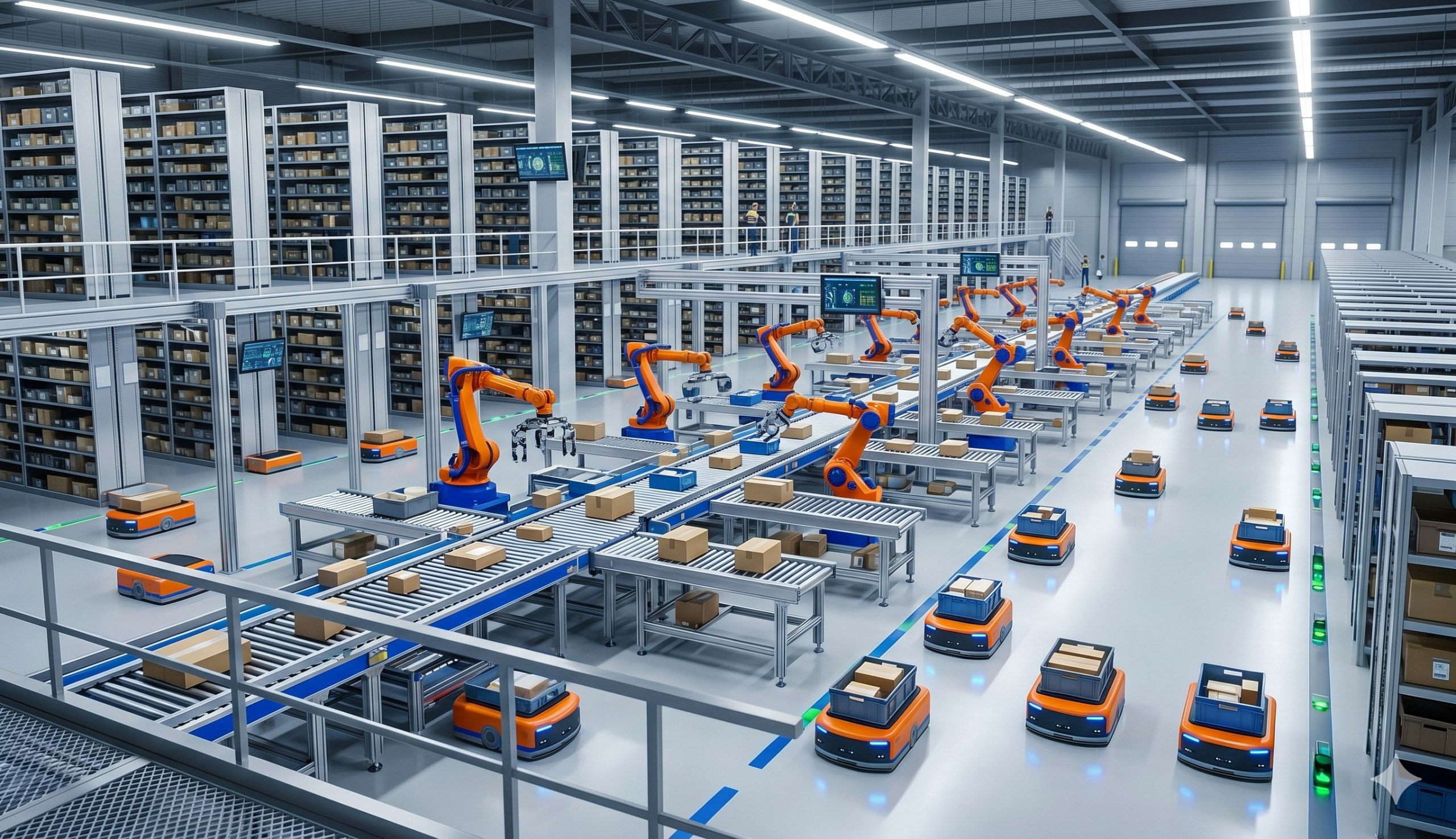
This pattern has been validated in the robotics domain. Since Amazon warehouses introduced Kiva handling robots in 2012, the number of robots has grown from 1,000 to over 750,000 in 2025. Employment data from the same period shows: Amazon warehouse employee headcount grew from approximately 50,000 to approximately 950,000 (including seasonal workers), with new job categories such as robot maintenance technicians, automation systems engineers, and operations data analysts emerging. Robots did not replace employment — they replaced inefficient work patterns. They enabled Amazon to provide faster delivery at lower costs, driving exponential order growth and ultimately creating more jobs.
The Special Risk of 2026: The Synergistic Effect of Generative AI + Humanoid Robots
When discussing robots replacing jobs in the past, there was often an implicit safety assumption — robots could replace manual labor, but creative, judgment-based, and communicative higher cognitive work was still safe. The emergence of generative AI has shattered this assumption.
Between 2024 and 2026, we have witnessed for the first time the combined effects of two technological trends:
-
AI Embodiment: The semantic understanding capabilities of LLMs/VLMs are being embedded into robot control systems (such as Google RT-2, Figure AI's Helix model), enabling robots not only to execute pre-programmed actions but also to understand contextual semantics and adapt to new instructions in real-time. This means non-standardized tasks that traditional robots could not handle (such as "take the documents on that desk to the second meeting room") are becoming automatable.
-
End-to-End Training Paradigm: Both Tesla Optimus and Figure 02 use imitation learning to directly learn skills from human operation data, rather than manually writing motion planning programs. This dramatically lowers the deployment barrier — robot training time for a production line has shortened from months to days.
The synergistic effect of these two technologies means that white-collar jobs previously considered "safe" are now exposed to automation risk. Customer service, translation, junior programming, basic data analysis, legal document review — cognitive tasks that were still considered difficult to automate in 2022 are rapidly being replaced by AI in the GPT-5 era. Meanwhile, automation of blue-collar work is extending from structured environments (factories) to semi-structured environments (warehouses, retail, construction sites).
The Most Vulnerable Job Categories
Based on the classic research framework of Oxford's Frey & Osborne (2013), combined with the latest technological capabilities of 2025-2026, here are the characteristics of high-risk positions:
- High repetition + Low judgment: Assembly line operators, quality inspectors, data entry clerks
- Remotely replaceable + Language-focused: Junior customer service, translators, basic accounting
- No regulatory moat: Compared to doctors (requiring medical licenses) or lawyers (requiring bar qualifications), these positions lack legal protection
- Non-dexterous operation: handling, sorting, packaging work will be largely replaced by next-generation humanoid robots within 3-5 years
International Differences in Policy Responses
Countries' response strategies to automation impacts vary enormously. The EU passed the AI Liability Directive in 2024, requiring companies to conduct "human employment impact assessments" when introducing automation systems, and to provide retraining for affected workers. Germany has further implemented a combined "short-time work allowance + skills upgrading" policy — automation-related off-the-job training is subsidized by the government covering 67% of wages.
At the US federal level, there is no unified automation response policy, but some states have begun exploring the concept of a robot tax — imposing additional taxes on companies that use robots to replace human workers, funding unemployment relief and vocational training. San Francisco passed a local bill in 2025 requiring companies that lay off more than 10% of workers where layoffs are clearly linked to automation to pay an "automation transition tax" equivalent to 30% of laid-off employees' annual salary.
China's strategy is entirely different. The State Council's 2025 "Humanoid Robot Industry Development Action Plan" explicitly designates humanoid robots as a national strategic industry, with policy focus on accelerating industrialization rather than employment protection. Fiscal subsidies in Beijing and Shanghai are directed toward robot procurement and deployment, not workforce retraining — the underlying logic is that China faces population aging and labor shortages, making automation a necessity rather than a threat.
Looking Ahead
Short term (2026-2028): Impact largely confined to specific industries
Over the next two years, the substantive impact of automation on employment will concentrate in manufacturing and logistics. The IFR predicts that by 2028, the global industrial robot installed base will reach 1 million units, with approximately 300,000-400,000 new units added, directly affecting approximately 800,000 to 1.2 million jobs. But this wave will primarily impact non-skilled operators, sorters, and basic quality inspectors — overall demand for these positions will decline by 15-25%.
Retail cashiers and food service order-takers also face rapid replacement. Chipotle, one of the largest US restaurant chains, has deployed automated ordering robots in 150 stores, planning to reach 80% of locations by 2027. Amazon Go's "just walk out" technology is expanding to large supermarkets, already covering over 500 traditional retail stores in the US alone.
A key signal is that this wave arrives faster but is shallower. The combination of generative AI and robots makes deployment barriers extremely low, but also means the jobs being replaced are primarily the simplest task components — human workers still have irreplaceable roles in checking, maintenance, and exception handling.
Medium term (2028-2032): The critical window for structural adjustment
When annual humanoid robot production exceeds 100,000 units, costs will approach the annual wage level of human workers (approximately $30,000-50,000). At that point, a "decision threshold" will be reached — for businesses where hiring costs exceed robot leasing costs, the economic incentive for large-scale replacement will reach a tipping point.
But historical experience shows that labor markets are not simple substitution relationships. The "So-so automation" framework proposed by MIT economists Acemoglu and Restrepo (2019) points out that truly disruptive automation is not high-productivity replacement, but "low-efficiency automation" — where robots complete work without significantly improving productivity, leading to simultaneous damage to corporate profits and wages. The key to avoiding so-so automation is that robot deployment must be accompanied by compensatory creation of human work — new positions, new skill demands, new industrial opportunities.
Long-term outlook (2033+): Reconstructing the social contract of human-machine collaboration
Ultimately, the social impact of robots replacing jobs depends on the design of distribution systems. If productivity gains concentrate among a small number of capital holders, society will face unprecedented inequality risks. Conversely, if automation dividends can be redistributed through tax transfers, Universal Basic Income (UBI), or mechanisms like "robot taxes + retraining funds," human society may enter an unprecedented era of abundance — freeing people from repetitive labor toward creative, caring, and exploratory work.
This is not just an economic issue, but a political choice. The impacts we see in 2026 are only the tip of the iceberg. The real challenge lies not in technology, but in whether we are prepared to answer a fundamental question: when robots can do most of the work, what will define human value?
POC.HK Future Technology Observatory — Independent Technology Watch Report