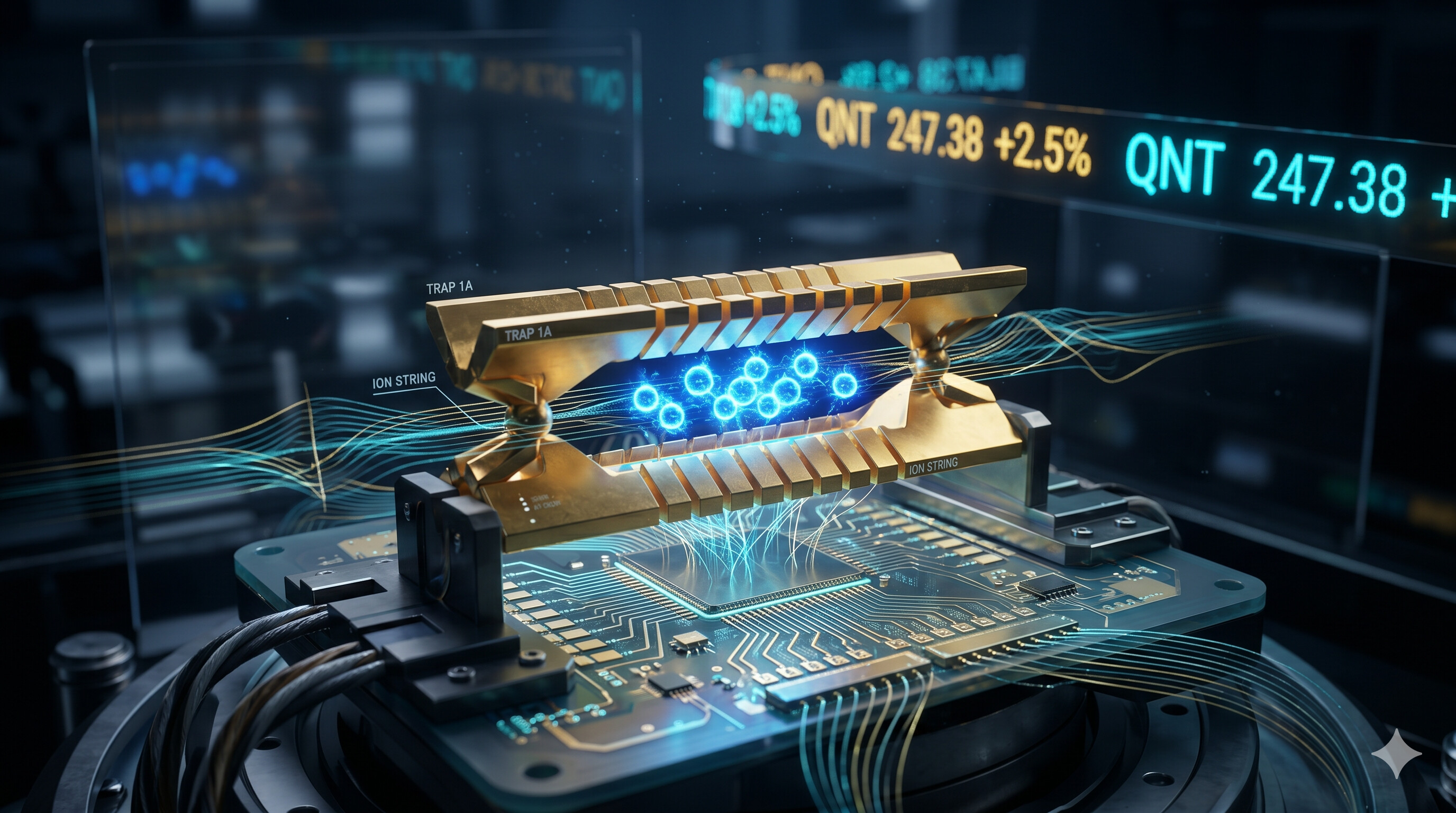
On 4 June 2026, Quantinuum began trading on Nasdaq under the ticker QNT, pricing at the upper end of its range to raise $1.68 billion and reaching a market capitalisation of $15.7 billion on its debut day. This is by far the largest initial public offering in the quantum computing industry to date, and the second pure-play quantum computing company to go public following IonQ's listing in 2024. Quantinuum founder Illyas Khan became a billionaire as a result of the IPO, with his stake valued at $2.2 billion.
Quantinuum's Background: Honeywell's Quantum Strategy
Quantinuum was formed in 2021 through the merger of Honeywell's Quantum Solutions division and British quantum software company Cambridge Quantum. Honeywell retained a majority stake, which meant that from its inception Quantinuum enjoyed a level of resource backing that typical quantum startups could only dream of — Honeywell not only provided financial support but also contributed deep industrial expertise in precision manufacturing, control systems, and cryogenic engineering.
Quantinuum's core technology pathway is trapped-ion quantum computing. Unlike the superconducting qubit approach (adopted by Google, IBM, and Rigetti), trapped-ion technology uses electromagnetic fields to trap charged ions and exploits their internal energy levels as qubits. The advantages of this approach are significant: trapped-ion qubits offer extremely high fidelity (single-qubit gate fidelity >99.99%, two-qubit gate >99.8%), all qubits are identical (with near-zero manufacturing variation), and they operate in room-temperature vacuum environments without requiring dilution refrigerators.
Quantinuum's latest H2 processor features 56 trapped-ion qubits and has demonstrated industry-leading Quantum Volume in standardised benchmarks — its 2Q+1 performance metric consistently surpasses competitors. The H2 is the first trapped-ion processor to integrate radio-frequency (RF) control and optical readout on the same chip, an integrated architecture that paves the way for system scaling.
Business Model: From Hardware to Full Stack
Quantinuum's commercial strategy differs from pure hardware companies such as IonQ, adopting instead a full-stack vertically integrated model. Its product lines include:
Hardware as a Service (HaaS): Access to H1 and H2 processors via cloud APIs, with customers paying per quantum compute time. This model lowers the upfront cost barrier for customers.
Quantum Cybersecurity (Quantum Origin): A cryptographic security key service using quantum random number generators. Quantum Origin was one of Quantinuum's earliest products to generate commercial revenue, with primary customers in financial services and government.
Quantum Chemistry and Materials Simulation (InQuanto): A quantum chemistry software platform targeting the pharmaceutical and materials science industries. InQuanto allows users to apply quantum computing to molecular simulation without requiring deep knowledge of quantum physics. It has already signed trial agreements with several pharmaceutical companies, including Switzerland-based Novartis.
Quantum Computing Software Stack (TKET): Quantinuum open-sourced its quantum compiler framework TKET, one of the most widely adopted intermediate representations and optimisation tools in the quantum computing industry. TKET enables developers to migrate workloads across different quantum hardware backends, similar to how PyTorch provides an abstraction layer across GPUs in the AI domain.
On the financial side, Quantinuum achieved $79.3 million in bookings revenue in 2025, but only $1.3 million in the first quarter of 2026. This volatility reflects a quantum computing market that remains in its early adoption phase — annualised subscription models have not yet taken hold, and customer spending tends to be project-based rather than recurring. However, Q1 bookings typically precede large annual contracts, with Q2 through Q4 being the peak period for revenue recognition.
Market Positioning and Competitive Landscape
Quantinuum's IPO provides an important public market reference point for the quantum computing industry. At a $15.7 billion market cap, Quantinuum trades at roughly 198 times its 2025 bookings revenue. By comparison, IonQ currently has a market capitalisation of approximately $3.5 billion, while D-Wave Systems sits at around $1.5 billion. Quantinuum's premium reflects market enthusiasm for its trapped-ion technology roadmap, Honeywell's endorsement, and its full-stack business model.
In terms of technology pathway comparisons:
Superconducting approach (Google, IBM, Rigetti): Highest qubit counts (IBM Condor has reached 1,121 qubits), but two-qubit gate fidelity typically falls between 99.5% and 99.9%, and extreme low-temperature operation (~15 mK) is required. The superconducting approach is currently better suited for large-scale quantum error correction engineering.
Trapped-ion approach (Quantinuum, IonQ): Fewer qubits (H2 has 56), but higher fidelity, identical qubits, and room-temperature operation. Trapped-ion systems have an advantage in implementing logical qubits — Quantinuum has announced error correction on 12 logical qubits, the leading logical qubit count in the industry.
Neutral-atom approach (QuEra, Atom Computing): Greatest qubit scaling potential (already reaching hundreds of qubits), but fidelity and coherence times are still improving. Neutral atoms are seen as the most promising pathway for eventually achieving million-qubit machines.
The Commercialisation Phase of Quantum Computing
Quantinuum's IPO arrives at a pivotal moment as quantum computing transitions from the NISQ (Noisy Intermediate-Scale Quantum) era toward the fault-tolerant era. All quantum computers today remain in the NISQ phase; universal fault-tolerant quantum computing has not yet been realised. Industry consensus holds that 5-10 more years of engineering improvements are needed before the first practical fault-tolerant quantum computer emerges.
This raises a fundamental question: how can a quantum computing company support a $15.7 billion valuation before achieving commercial scale? The answer lies in its strategic positioning. Quantinuum is not merely a quantum hardware company — it is a quantum infrastructure company. Products like Quantum Origin and TKET can run on classical computers, providing transitional revenue streams while quantum computing matures.
Moreover, market expectations for quantum computing depend not only on current performance but also on humanity's urgent need for new computing paradigms as Moore's Law slows. As AI model sizes grow exponentially, the power consumption and cost of classical computing are rising sharply. Quantum computing's theoretical exponential acceleration on certain problems — such as molecular simulation, optimisation, and cryptography — makes it the most promising computing paradigm for the post-Moore era.
Observatory Analysis
Quantinuum's IPO is more than a single company going public — it marks a milestone in the quantum computing industry's shift from venture capital valuation to public market pricing. Public market investors' acceptance of quantum computing will directly affect the entire industry's fundraising environment and talent attraction.
Looking at venture capital flows, quantum computing startups received approximately $8 billion in global venture investment between 2023 and 2025, but over 60% was concentrated among a handful of leading companies. Quantinuum's successful listing will provide exit channels for more second-tier and regional quantum startups, thereby activating capital circulation across the entire ecosystem.
Risk factors worth monitoring include: when quantum computing will generate sustainable recurring revenue from real commercial applications; the physical limitations of scaling trapped-ion qubit counts (each ion requires an individual laser control system, and optical system complexity grows superlinearly with qubit count); and technological competition from superconducting and neutral-atom approaches.
For investors, Quantinuum offers one of the most mature technology stacks in quantum computing, while its Honeywell backing reduces technology risk. However, the $15.7 billion valuation implies that the market has already priced in a highly optimistic technology development trajectory — investors will need patience to wait 5-10 years before truly seeing the commercial value of quantum computing materialise.
Disclaimer: This article is for informational purposes only and does not constitute investment advice. Data and timestamps are accurate as of the publication date and may change with subsequent developments. Neither the author nor POC.HK assumes any liability for losses arising from the use of this information.