Oxford PV Begins Commercial Perovskite Panel Production
Oxford PV has achieved a milestone the solar industry has been awaiting for years: the first commercial production line for perovskite-silicon tandem solar panels. The company's factory in Brandenburg, Germany, is now shipping panels to customers, marking the beginning of the commercialization era for this long-promised technology.
"We have moved beyond the laboratory and beyond the pilot line," said David Ward, CEO of Oxford PV. "These are real products, shipping to real customers, generating real electricity."
The Technology
Perovskite-silicon tandem cells work by layering a perovskite material on top of a conventional silicon solar cell. The perovskite layer absorbs high-energy blue and green photons from sunlight, while the silicon cell underneath captures the lower-energy red and infrared photons that pass through. This tandem approach breaks the efficiency ceiling of single-junction silicon cells, extracting more energy from the same amount of sunlight.
Oxford PV's commercial panels achieve a certified module efficiency of 26.9% — significantly higher than the 21-23% typical of standard silicon panels. In real-world conditions, the company claims the panels will deliver 25-30% more energy per square meter over the course of a year compared to the best conventional panels.
The Production Line
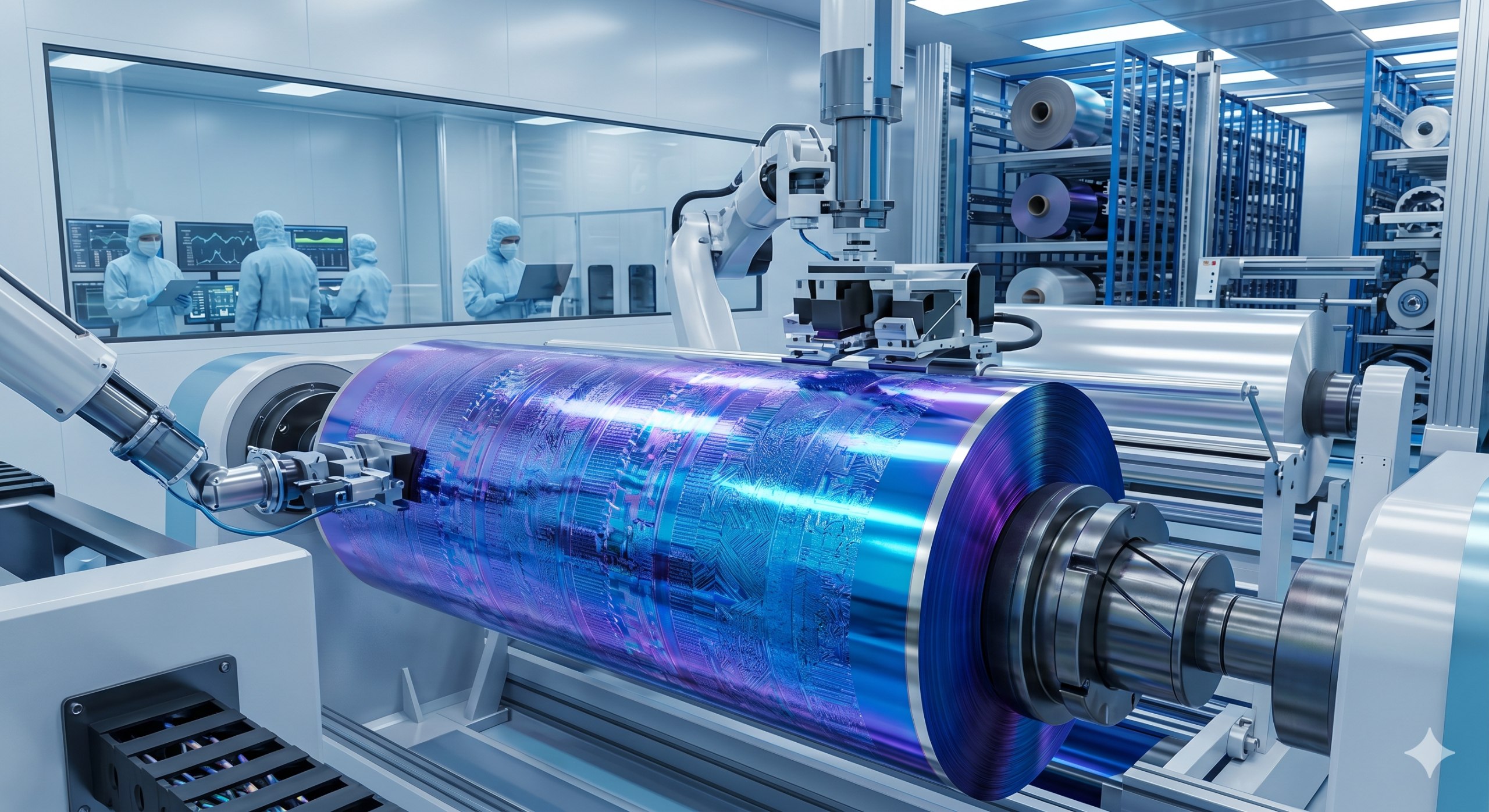
The Brandenburg factory has an initial annual capacity of 100 megawatts. The production line integrates perovskite deposition into Oxford PV's existing silicon cell manufacturing process, adding only a handful of steps. The perovskite layer is applied using a proprietary coating technique that the company spent over a decade perfecting.
Key to making the production line work was solving the stability problem that has plagued perovskites since their discovery. Early perovskite cells degraded within hours when exposed to moisture and heat. Oxford PV's encapsulation technology seals the perovskite layer against environmental ingress, and the company says its panels have passed accelerated aging tests equivalent to 25 years of outdoor exposure.
The product carries a 25-year linear power warranty, matching the industry standard for premium silicon panels — a strong signal that Oxford PV is confident in its durability.
Customer Response
Initial customers include commercial rooftop installers, utility-scale developers, and several European research institutions. The panels command a premium over standard silicon — roughly 15-20% higher per-watt pricing — but the higher energy density means fewer panels are needed for a given power output, reducing balance-of-system costs for racking, wiring, and installation labor.
For rooftop installations where space is limited, the economics are particularly compelling. A building that could fit a 10-kilowatt system with standard panels can now fit a 13-kilowatt equivalent with Oxford PV's tandems, without increasing the roof area.
Scaling Plans
Oxford PV has announced plans for a second factory in the United States, expected to begin construction in 2027 with a capacity of 1 gigawatt per year. The company has secured significant investment from both European and American clean energy funds.
The broader industry is watching closely. If Oxford PV's commercial ramp succeeds, it will validate the entire perovskite tandem roadmap and trigger a wave of investment from larger manufacturers. Longi, JinkoSolar, and First Solar have all announced perovskite tandem development programs, but none have yet reached commercial production.
The Road Ahead
Perovskite-silicon tandems are not expected to replace conventional silicon panels overnight. Manufacturing scale needs to grow by orders of magnitude, costs need to fall further, and field performance data over multiple years needs to accumulate. But the Brandenburg factory is a decisive step. The technology that was always five years away has finally arrived.
Yield Ramp and Stability Breakthroughs
The Brandenburg production line has been ramping from pilot production in 2025 to commercial volume in 2026, targeting 125 MW annual capacity. The critical challenge has been yield — improving from 45% in early 2025 to 72% by mid-2026, with a target of 85% by 2027 (still below the 95%+ standard of mainstream crystalline silicon production). Yield loss comes from three primary sources: pinhole defects in the perovskite film (approximately 40% of defects), charge transport layer delamination (30%), and ion bombardment damage to the underlying perovskite during electrode deposition (20%).
On stability, a 2026 KAUST team published a new interfacial passivation technique using 2D/3D perovskite heterojunctions as interface modification layers. Unencapsulated perovskite cells maintained 90% of initial efficiency for over 1,000 hours in 85°C/85%RH accelerated aging tests — equivalent to approximately 5-7 years of outdoor use. When combined with advanced encapsulation (glass-glass with desiccant), tandem module accelerated-aging predicted lifetime has reached 25-30 years, comparable to crystalline silicon standards.
Competitive Landscape
Oxford PV's technology originated from Professor Henry Snaith's research group at Oxford University's Physics Department. Snaith's team first demonstrated solid-state perovskite solar cells in 2012, sparking the global perovskite photovoltaic research boom. The company was spun out of Oxford in 2010 and has raised approximately $250 million from investors including German chemical giant Merck, UK clean technology funds, and the European Innovation Council.
Key competitors include: China's Hangzhou FibreCrystal Optoelectronics (perovskite single-junction modules at approximately 20% efficiency, over 200 MW annual capacity — cost advantage from China's manufacturing scale); Korea's Hanwha Q Cells (perovskite tandem modules at 26.5% efficiency, targeting 2028 production); and US-based First Solar (thin-film route, evaluating perovskite as a complement to its CdTe technology). Additionally, Chinese solar giants Longi and JinkoSolar have established internal perovskite R&D teams.
Perovskite solar's commercial share of the global solar market is projected to reach 10-15% by 2030. Oxford PV's first-mover advantage will depend on its ability to scale to GW-level capacity within 2-3 years, continuously improve yield, and compete with Chinese manufacturers on price. The era of tandem photovoltaics has begun — not as a laboratory demonstration, but as a shipped product. The Brandenburg factory represents more than a corporate milestone; it is the point at which perovskite solar transitioned from perpetual promise to commercial reality. The solar industry will look back at Brandenburg the way it looks back at the first silicon solar cell — as the moment a laboratory curiosity became an industrial product with the power to change global energy markets. Oxford PV has opened the door. What comes through it will reshape solar energy for decades.