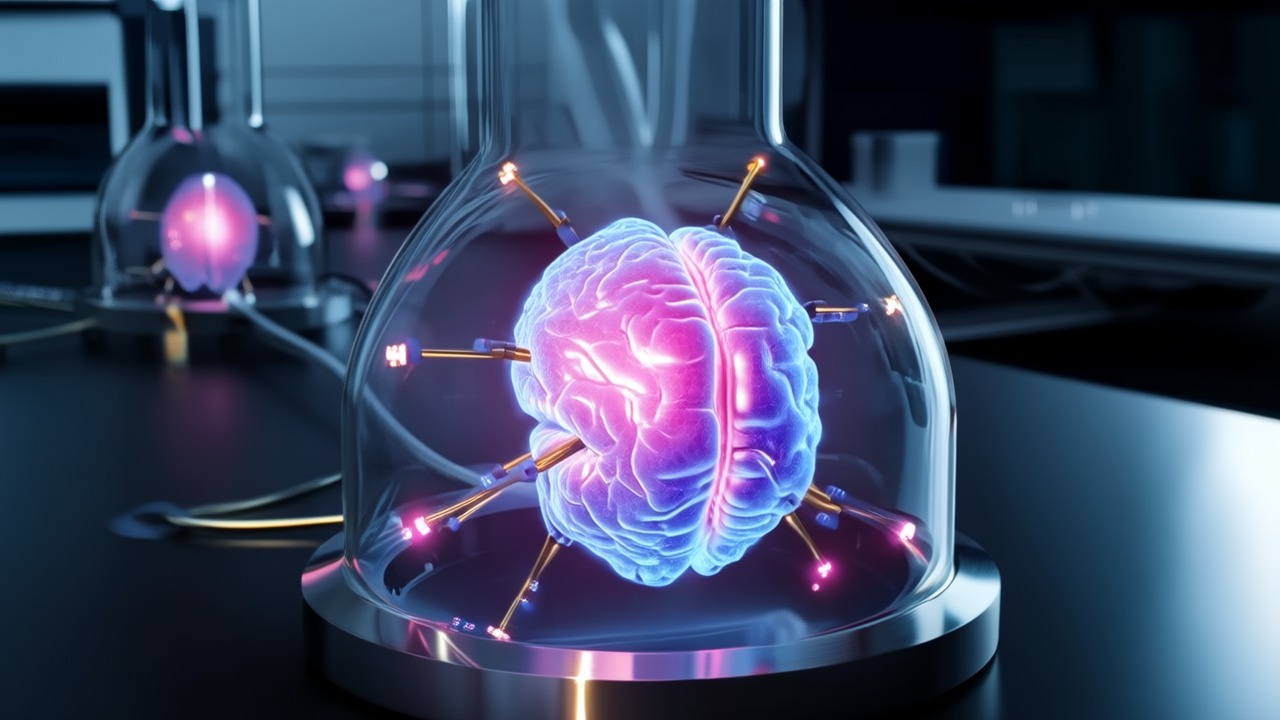
In a Lausanne laboratory, sixteen pinhead-sized blobs of living human brain tissue float inside microfluidic chambers, bathed in nutrients, threaded with electrodes, and quietly learning. They are not metaphors for neural networks — they are neural networks, made of real neurons grown from human induced pluripotent stem cells (iPSCs), possessing active synapses and synaptic connections.
This is organoid intelligence (OI) — the convergence of biological neural tissue and silicon-based microelectrode arrays into a fundamentally new computing paradigm. In 2026, OI has graduated from a curiosity in biology papers into an early but rapidly maturing computing paradigm. Called "wetware computing," this approach presents a radical alternative to the escalating energy crisis of GPU farms.
Why Build Biological Computers?
The human brain operates on approximately 20 watts of power. A silicon-based supercomputer matching the human brain's processing capacity requires at least 10 megawatts — an energy efficiency gap of six orders of magnitude. This gap is not merely an engineering inconvenience; at some level, it is a physical impossibility. Transistors are approaching fundamental limits, Moore's Law is slowing, and AI training compute demands are driving datacenter power consumption to unsustainable levels.
This is organoid intelligence's entry point. OI's core argument: neurons are computational units optimized by 500 million years of evolution. They do not require artificial transistors to simulate. Instead, we can let real neurons serve as the computational core — as they do in the human brain — replacing transistor-based electronic switching with organic molecular ion channels.
From DishBrain to Neuroplatform
Organoid intelligence's pivotal breakthrough came in 2022. Melbourne-based Cortical Labs demonstrated its DishBrain system — a planar culture of approximately 800,000 mouse neurons — learning to play the video game Pong. The neurons were not "told" the rules. They received electrical feedback through microelectrode arrays: predictable, organized signals when they hit the ball, and chaotic, random signals when they missed. The neural network adjusted its connection weights through synaptic plasticity — the same mechanism biological brains use to learn any skill.
Between 2024 and 2026, two major leaps occurred. First was the transition from planar cultures to 3D organoids. These millimeter-scale cortical spheroids, differentiated from iPSCs, structurally resemble real brain tissue more closely. They contain multiple cell types (neurons, astrocytes, oligodendrocytes, microglia) and spontaneously organize into layered cortical structures, with electrical activity patterns resembling premature infant EEG signals.
Second was a revolutionary leap in interface density. Modern high-density microelectrode arrays — MaxWell Biosystems' 24-well plates with 4,000 recording sites per well, and 3Brain's CMOS chips with 26,000 recording sites per well — enable researchers to simultaneously record and stimulate thousands of individual neurons within a single organoid at single-cell resolution.
The most significant platform is FinalSpark's Neuroplatform — the world's first remotely accessible wetware computing cloud. It connects 16 organoids continuously to microelectrode arrays, providing 24/7 remote experimental access to researchers in 14 countries worldwide. Researchers use standard Python code to record organoid electrical activity, deliver electrical stimulation, and send dopaminergic signals as reward or punishment — essentially "programming" real biological neural networks.
What Can OI Do?
By 2026, organoid intelligence has demonstrated potential beyond pure silicon-based approaches in several application directions.
Pattern recognition and nonlinear prediction: Indiana University's Brainoware system integrated brain organoids with electronic hardware, achieving 78% accuracy in speech recognition. More significantly, on nonlinear equation prediction tasks, Brainoware required 90% less training time than silicon-based systems. This efficiency stems from biological neurons' intrinsic computational capability — each neuron is a highly nonlinear information processing unit that does not require thousands of transistors to simulate.
Drug screening and disease modeling: Organoid intelligence's true near-term value may lie not as a general-purpose computer, but as a biological computing platform for drug screening. Traditional drug toxicity testing relies on animal models or 2D cell cultures that poorly predict human responses. Organoids — reflecting real human brain tissue's cellular diversity and structural complexity — provide drug response data closer to the in vivo environment than traditional methods. FinalSpark's Neuroplatform is already used by multiple universities (including University of Bristol's robotics lab and Technical University of Munich) for neural activity research, at a subscription cost of $1,000 per month — far below the cost of establishing and maintaining a biological neuroscience laboratory.
Biorobotic control: University of Bristol researchers used Neuroplatform to test bio-inspired robotic perception algorithms directly on biological organoids. Perception algorithms developed in standard Python interacted with organoids through electrode arrays, and organoid output signals were translated into robot movement commands — forming a genuine biological-machine hybrid control loop.
The Ethical Challenge: Are Organoids Conscious?
Organoid intelligence faces a unique challenge — not just technical, but ethical. When a millimeter-scale brain organoid's electrical activity pattern begins to resemble a premature infant's EEG, ethical questions become unavoidable: Does this structure have sentience? Can it feel pain? What moral status does it hold?
The Baltimore Declaration, published in 2025, represents the first international consensus document attempting to provide an ethical framework for OI research. It proposes three key principles: first, researchers should apply a precautionary principle regarding organoid complexity and potential sentience — never assume they lack sentience, but periodically assess neural activity patterns and set ethical boundaries. Second, OI research outcomes should serve societal benefit, avoiding military or surveillance applications. Third, public dialogue mechanisms are needed, allowing society to participate in decisions about how to treat biological computing systems that may possess rudimentary sentience.
These are not distant theoretical questions. In 2024, Johns Hopkins' Professor Thomas Hartung — OI's leading advocate and concept originator — noted that current millimeter-scale organoid neural activity remains far below any threshold considered "consciousness." But as organoid scale and structural complexity increase, this threshold may be approached by the end of this decade.
POC.HK Observatory Analysis
Organoid intelligence represents one of the most radical shifts in computing paradigms: abandoning silicon-based simulation in favor of direct computation using biological materials. Structurally, this is not merely another AI accelerator technology — it is a different answer to the fundamental question of "what constitutes computation."
We should maintain clear-eyed assessment of OI's technological maturity. 2026-era OI systems remain far from general-purpose computers. Organoid lifespans are limited (currently approximately 6 to 12 months), culture conditions are demanding, input/output bandwidth is constrained by electrode density (though dramatically improved), and organoid-to-organoid variability far exceeds chip-to-chip variation. OI will almost certainly not replace GPUs within the next 5 years — indeed, OI systems themselves still depend on silicon computers for data processing and control.
But OI's structural advantages — energy efficiency, intrinsic nonlinear processing capability, adaptivity, and biocompatibility — give it unique competitiveness in specific domains: neuropharmacological screening, bio-hybrid control, and ultra-low-power edge computing. An industry signal worth tracking: whether any major pharmaceutical company begins integrating OI platforms into its drug discovery pipeline as a standard tool. Such commercial validation would mark OI's key milestone in transitioning beyond academic circles.
From an investment perspective, the OI startup ecosystem remains very early. FinalSpark (Switzerland) is the only company offering a commercialized remote OI platform. Cortical Labs (Australia) focuses on disease modeling and drug screening. Koniku (USA) integrates neurons with silicon chips for olfactory sensors. These companies remain at seed to Series A stages, with extremely low valuations.
Organoid intelligence's greatest uncertainty lies not in technology but in ethics. If OI systems genuinely approach the threshold of rudimentary consciousness, they will face intense public and regulatory scrutiny — potentially constraining development direction earlier than any technical bottleneck. Researchers and companies that establish ethical frameworks now (as the Baltimore Declaration attempts) will gain a long-term trust advantage in this domain.
Disclaimer: The information contained in this article is for reference purposes only and does not constitute investment advice or business decision-making basis. Data and time-sensitive information are current as of the publication date and may change with subsequent developments. Neither the author nor POC.HK assumes any responsibility for losses resulting from the use of this information.