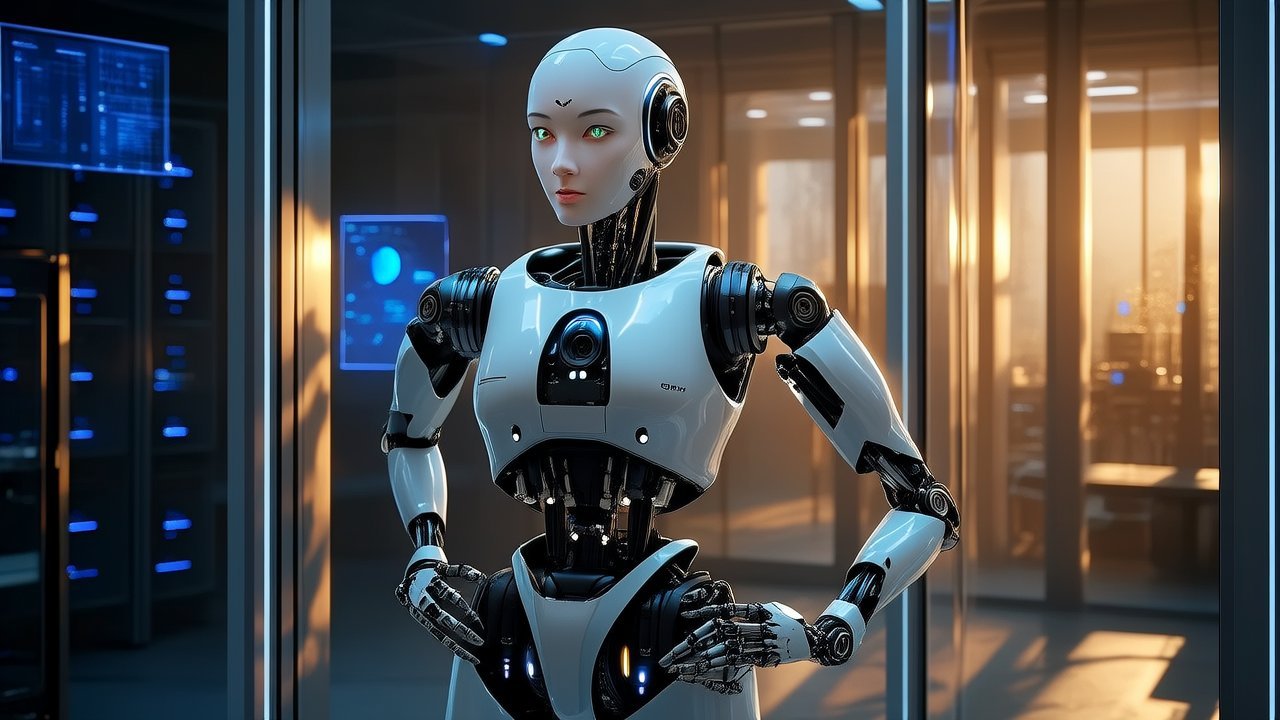
On June 1, 2026, NVIDIA CEO Jensen Huang took the stage at GTC Taipei to announce the Isaac GR00T Reference Humanoid Robot — the industry's first open, fully integrated humanoid robot reference design. The announcement represents a watershed moment for the humanoid robotics industry, analogous to what the Android Open Source Project did for smartphones: providing a standardised hardware and software platform that any research institution or company can adopt, modify, and build upon.
The reference robot bundles a Unitree H2 Plus humanoid chassis with Sharpa Wave tactile five-finger hands, powered by a NVIDIA Jetson AGX Thor T5000 compute module delivering 2,070 FP4 teraflops of Blackwell-architecture AI compute. But the hardware is only half the story. NVIDIA has open-sourced the entire software stack — Isaac Teleop for data collection, the GR00T N1.6 vision-language-action foundation model for reasoning and control, Isaac Sim and Isaac Lab for simulation-based training, and Isaac ROS for deployment middleware.
The Android Moment for Humanoid Robotics
The humanoid robotics industry has been fragmented, with every developer essentially starting from scratch — building their own hardware, writing their own control software, training their own models, and stitching together incompatible tools. The GR00T reference platform changes this by providing a complete, standardised foundation that researchers can use out of the box.
Five leading institutions have already committed to the platform: the Stanford Robotics Center, ETH Zurich's Robotic Systems Lab, the Allen Institute for AI (Ai2), UC San Diego's Advanced Robotics and Controls Laboratory, and NVIDIA Research itself. These institutions will receive the first units, with broader shipments expected from October 2026.
The impact of this standardisation cannot be overstated. A university lab that previously spent years integrating hardware from one vendor, simulation software from a second, and training infrastructure from a third can now deploy a single system that includes everything. This removes what is perhaps the single largest barrier to progress in academic humanoid robotics: the overhead of building and maintaining the underlying platform rather than advancing the science.
The GR00T N1.6 Foundation Model
At the core of the reference platform is the GR00T N1.6 vision-language-action model, which integrates visual observations from egocentric camera streams, robot state data, and natural language instructions into a unified policy representation. The model uses world models from NVIDIA Cosmos Reason to decompose high-level instructions into stepwise action plans grounded in scene understanding.
GR00T N1.6 introduces several key enhancements over previous versions. A 2x larger diffusion transformer with 32 layers produces smoother, less jittery movements that adapt to changing positions. A variant of Cosmos-Reason-2B VLM with native resolution support enables the robot to “see” clearly without distortion and reason better about its environment. The model was trained on thousands of hours of new teleoperation data spanning humanoids, mobile manipulators, and bimanual arms, enabling better generalisation across different robot embodiments.
This architecture enables what NVIDIA calls “generalist humanoid capabilities” — the ability to perform locomotion and dexterous manipulation through end-to-end learned representations, rather than hand-coded control pipelines. The sim-to-real workflow combines whole-body reinforcement learning in Isaac Lab, synthetic data-trained navigation with COMPASS, and CUDA-accelerated visual SLAM for environment-aware behaviour.
The Sharpa Wave Tactile Hand
One of the most technically significant components of the reference platform is the Sharpa Wave five-finger dexterous hand from Singapore-based Sharpa. Unlike traditional robotic grippers that rely on vision-only perception, the Sharpa Wave incorporates tactile sensing directly into the fingertips, enabling the robot to perceive contact forces, surface textures, and object compliance.
This is a critical capability for general-purpose manipulation. Without tactile feedback, a robot cannot distinguish between grasping a rigid object and crushing a fragile one, cannot feel when a tool is properly seated in its hand, and cannot perform precision tasks like threading a needle or inserting a connector. The integration of tactile sensing into an open reference platform makes this capability accessible to researchers who previously would have needed to develop it in-house.
Observatory Analysis
The GR00T reference platform represents a fundamental strategic shift for NVIDIA. The company is not building humanoid robots itself — it is building the platform on which the humanoid robotics industry will be built. This is the same playbook NVIDIA executed in AI: provide the computing hardware, the software stack, and the development tools, then let the ecosystem build applications on top.
The timing is significant. Humanoid robotics is at a critical inflection point where multiple companies — Tesla, Figure AI, Boston Dynamics, 1X Technologies, Agility Robotics — are moving from research demonstrations to limited commercial deployments. The industry needs a standardised development platform to accelerate progress, much as the early smartphone industry needed Android to escape the fragmentation of proprietary operating systems.
The open-source aspect is particularly important. By open-sourcing the entire software stack, NVIDIA ensures that the GR00T platform becomes the default research standard for academic humanoid robotics. Once the best research and the most talented graduates are trained on NVIDIA's platform, the ecosystem lock-in becomes self-reinforcing — precisely the dynamic that made CUDA the dominant computing platform for AI.
However, risks remain. The Unitree H2 Plus chassis is a Chinese-made robot, which may create export control and geopolitical complications for defence or government-funded research. And the platform's reliance on NVIDIA's proprietary Jetson AGX Thor compute module creates a hardware dependency that some researchers may wish to avoid. But for the majority of the academic research community, the benefits of an integrated, open, standardised platform will far outweigh these concerns.
The Platform Battle: NVIDIA vs Vertical Integration
The GR00T reference platform signals that humanoid robotics has entered the "platform wars" phase. Tesla's Optimus pursues a vertically integrated strategy — proprietary hardware, in-house factory deployment, proprietary AI models — resembling Apple's model. NVIDIA's GR00T mirrors the Android open-platform strategy, attracting the entire research community to develop on its standardised infrastructure.
The broader implications extend to which development model will dominate. If NVIDIA's open approach succeeds, the barrier to entry for humanoid robotics development will drop dramatically, enabling more participants to focus on application-layer innovation. But if vertical integration proves superior in reliability, cost, and safety at commercial scale, closed ecosystems may ultimately dominate production deployments.
A wildcard is Google DeepMind's recent robotics push. With the hiring of former Boston Dynamics CTO Aaron Saunders and expanded robotics research in Europe, Google could introduce a robotics platform deeply integrated with its Gemini models. Such a move would give NVIDIA genuine platform competition in humanoid robotics — a dynamic the company has largely avoided in AI training.
Disclaimer: The information contained in this article is for reference purposes only and does not constitute investment advice or any form of commercial decision-making basis. Data and time-sensitive information are accurate as of the date of publication and may change with subsequent developments. The author and POC.HK assume no responsibility for any losses arising from the use of the information herein.