Jensen Huang's Seoul Diplomacy: How NVIDIA Transformed South Korea from Chip Supplier to Physical AI Strategic Partner
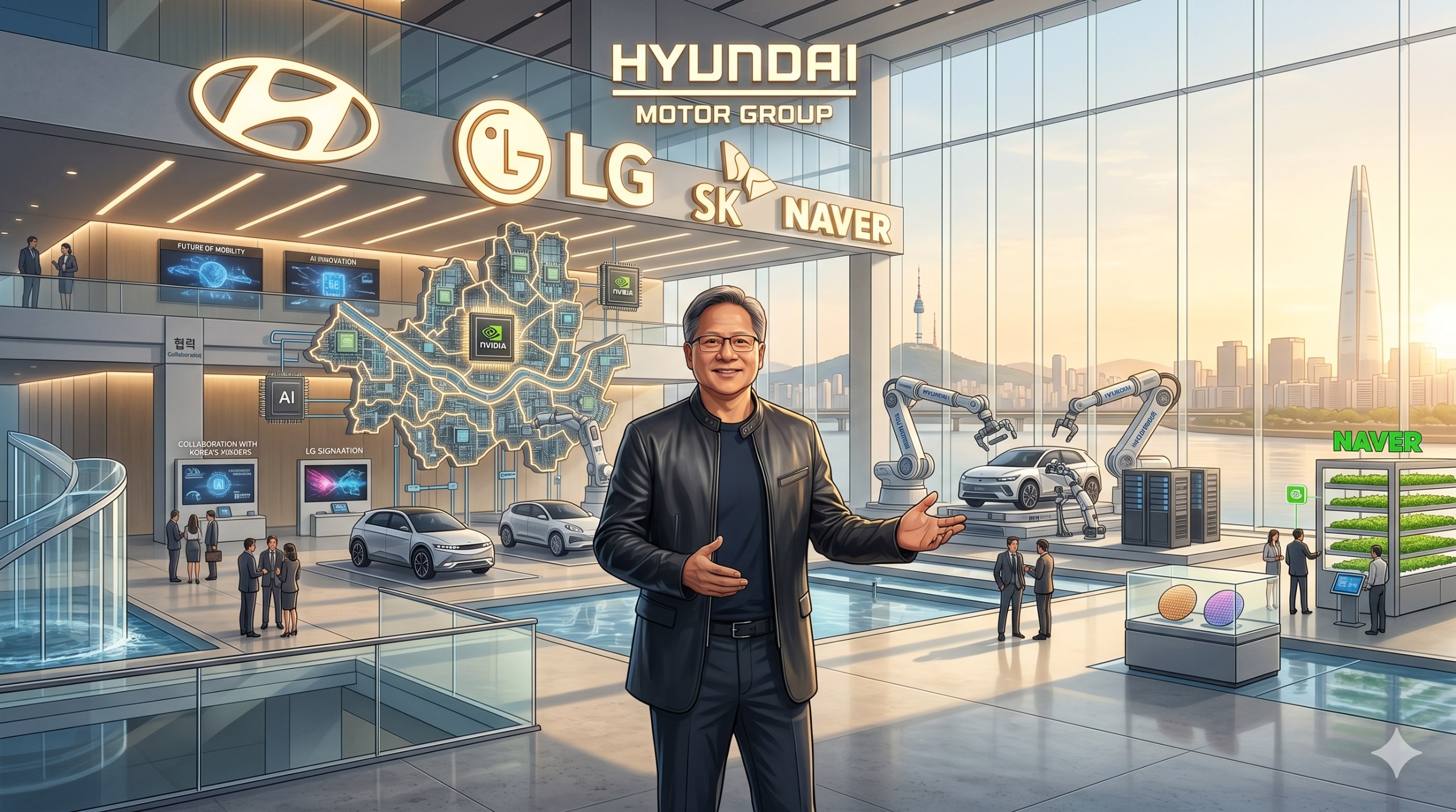
In June 2026, NVIDIA founder and CEO Jensen Huang embarked on a four-day "Seoul Diplomacy" tour, holding intensive meetings with the leaders of South Korea's five major conglomerates — Hyundai Motor Group, LG Group, SK Group, Naver, and Doosan Group. This was far more than a routine business visit; it was a critical maneuver in NVIDIA's global AI supply chain restructuring: elevating South Korea from a mere memory chip supplier to a strategic partner in the era of Physical AI.
"This is Hyundai's era," Huang told reporters after meeting with Hyundai Motor Group Executive Chair Chung Eui-sun at the company's headquarters. The remark was both a recognition of Hyundai's AI布局 and an indication of NVIDIA's new strategic direction for the Physical AI ecosystem — moving from the data center into the physical world.
South Korea's Supply Chain Upgrade: From HBM to Physical AI Partner
Huang's first stop in Seoul was SK Group. On June 7, NVIDIA and SK Group's SK Hynix announced a multi-year technology collaboration agreement, locking in the next-generation product roadmap for High Bandwidth Memory (HBM). HBM is a critical component in AI accelerators today, playing a core role in NVIDIA's Blackwell and upcoming Rubin architectures.
But this trip extended far beyond memory chips. NVIDIA also announced a partnership with Naver — Naver will build a gigawatt-scale AI factory based on NVIDIA platforms, marking the South Korean internet giant's formal entry into the hyperscale AI infrastructure space.
Analysts noted that the relationship between NVIDIA and South Korean enterprises is undergoing a qualitative transformation. Over the past five years, South Korea has primarily served as NVIDIA's HBM supply base — SK Hynix and Samsung Electronics supplied critical high-bandwidth memory for NVIDIA's AI chips. However, starting from late 2025, as AI transitions from the virtual world (training and inference) into the physical world (robotics, autonomous driving, smart factories), NVIDIA needs partners with manufacturing and system integration capabilities — and the vertical integration advantages of South Korea's industrial system align perfectly with this need.
Hyundai Motor: From Building Cars to Building AI Factories
The Hyundai Motor Group partnership was the most eye-catching part of this Seoul trip. Hyundai Motor Group Executive Chair Chung Eui-sun met with Huang to discuss broad collaboration integrating Physical AI into deep technology domains. The cooperation spans three layers: Autonomous Mobility, Robotics, and AI Factories. This signals that Hyundai is no longer just a traditional automaker but is transforming into a comprehensive AI enterprise, backed by NVIDIA's AI infrastructure.
"I am incredibly excited to partner with Hyundai across every area of AI — from mobility to robotics to AI factories," Huang said after the meeting. Hyundai Motor Group owns Boston Dynamics and operates multiple autonomous driving and smart factory projects. The key to this upgraded partnership is that Hyundai is not just a user of NVIDIA platforms but will become a co-builder of the Physical AI ecosystem.
LG Group: Humanoid Robots and AI Data Centers
During his visit to LG Group, Huang met with LG Chairman Koo Kwang-mo, announcing cooperation in humanoid robots and AI data centers. "We are working with LG on motor technology and mechanical systems, with the goal of integrating humanoid robots and the future of robotics," Huang said. LG is building a dedicated AI data factory to support the global robotics ecosystem. Through NVIDIA's Omniverse and Isaac Sim platforms, LG can generate synthetic training data at scale, dramatically shortening robot development cycles.
Doosan Group: AI Factory Ecosystem
Doosan Group announced deepened collaboration with NVIDIA in the AI factory ecosystem, providing energy, cooling, and power management solutions for AI infrastructure. As AI data center energy consumption surges — NVIDIA's Rubin GPU has a single-card power draw of 1500W — data center energy infrastructure is becoming a global bottleneck.
South Korea's "Physical AI National Strategy"
Huang's Seoul itinerary drew the attention of the South Korean government. The government is actively promoting a "Physical AI National Strategy," aiming to make South Korea a global leader in Physical AI by 2030. South Korea's chaebol groups possess a complete vertical supply chain spanning semiconductors, displays, motors, and finished product manufacturing, offering unique advantages in the Physical AI era.
NVIDIA's South Korea strategy essentially builds a "Physical AI Supply Chain Alliance": SK Hynix provides HBM memory, Hyundai provides mobility platforms and robot hardware, LG provides motors and mechanical systems, Naver provides hyperscale AI computing power, and Doosan provides AI factory energy infrastructure.
Future Outlook: From Silicon to System — The AI Ecosystem
Observatory Analysis
The deeper significance of Huang's Seoul trip is this: NVIDIA is transforming from a chip company into an organizer of the AI infrastructure ecosystem. NVIDIA's strategic重心 is shifting from "AI computing power" to "the integration of AI with the physical world." In the coming years, robotics, autonomous driving, smart manufacturing, and energy infrastructure will receive greater injections of NVIDIA ecosystem resources. Looking ahead: NVIDIA will announce more national-level AI cooperation agreements within the next 12 months; Physical AI will become the next AI investment hotspot following large language models; and countries with complete vertical supply chains (South Korea, Japan, Taiwan) will gain strategic advantages in the Physical AI era.
Disclaimer: This article is for informational purposes only and does not constitute any investment advice or basis for business decisions. Data and timing information is current as of the publication date and may change as subsequent developments occur. The author and POC.HK accept no liability for any loss arising from the use of the information contained herein.