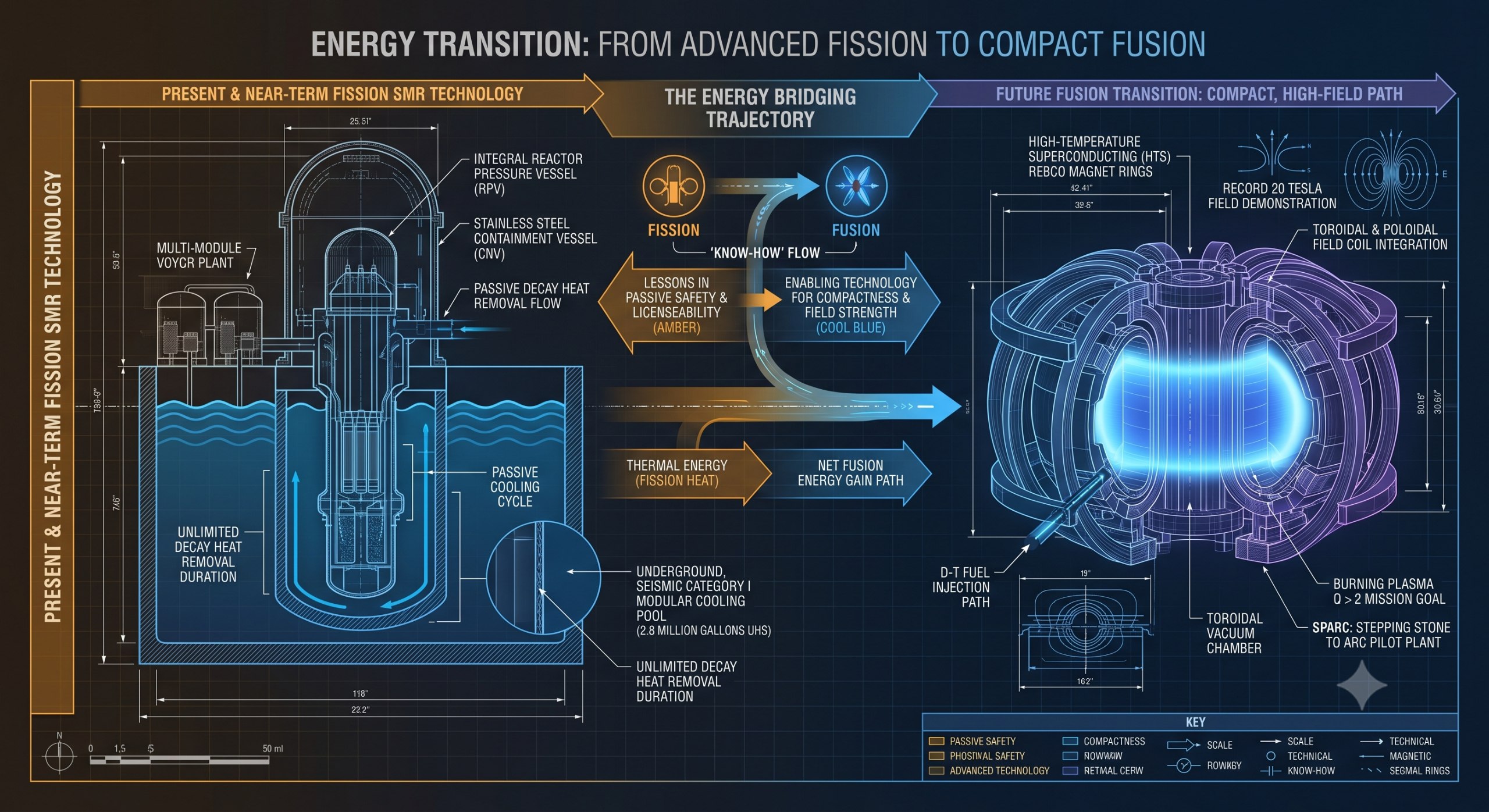
The New Nuclear Age: A Comparative Analysis of SMR and Fusion Commercialization Pathways
The first week of June 2026 witnessed two historic moments for the global nuclear energy industry: NuScale's SMR design received full NRC certification while China's HTR-PM achieved 100 days of continuous operation; simultaneously, Commonwealth Fusion Systems' SPARC device set a Q=11 record in private fusion. These events are not isolated -- they collectively point toward an emerging energy landscape: nuclear power is undergoing its most profound technological restructuring since the first commercialization of nuclear energy in the 1950s.
This report systematically analyzes the development status and future pathways of SMRs and fusion from four dimensions: technology pathways, business models, regulatory approaches, and market scale.
Chapter 1: Historical Context of Nuclear Technology Development
To understand the significance of nuclear energy in 2026, it must be placed within a longer historical perspective.
The Three Eras of Nuclear Power
First Generation (1950-1980): Military Conversion and Scaling Nuclear power transitioned from military technology for nuclear submarines and weapons to civilian electricity generation. The design philosophy emphasized scale -- bigger is more economical. US PWRs and BWRs became mainstream, with France and Japan fully embracing nuclear energy. By the 1980s, global nuclear capacity exceeded 200 GW.
Second Generation (1980-2010): Safety Reflection and Stagnation Three major accidents -- Three Mile Island (1979), Chernobyl (1986), and Fukushima (2011) -- profoundly changed nuclear energy's trajectory. Safety regulation tightened dramatically, new plant construction costs skyrocketed, and public acceptance declined. No new nuclear plants were approved in the US after 1979. Nuclear's share of global electricity fell from 17% in the 1990s to 10% in the 2010s.
Third Generation (2010-2025): Lessons from AP1000/EPR Westinghouse AP1000 and Areva EPR represented Generation III technology, with 60-year design life, passive safety systems, and severe accident prevention measures. But AP1000's construction cost at the US Vogtle project ballooned from $14 billion to over $30 billion, with 7-year delays. European EPR projects (Finland Olkiluoto, France Flamanville) faced similar massive overruns. The lesson of Gen III: the capital costs and execution risk of large nuclear plants have made them commercially uncompetitive.
Fourth Generation (2026-): SMRs and New Technology Pathways It is against the backdrop of Gen III's commercial failures that SMRs and fusion have found their historic opportunity.
Chapter 2: SMR Technology Landscape
Definition and Core Logic
A Small Modular Reactor (SMR) is not a single technology but a design philosophy: reducing reactor power to one-tenth to one-third of traditional large plants, manufacturing them in factories to standardized designs, then transporting to sites for installation.
The core business logic of SMRs:
- Economies of Scale vs Learning Curves: Traditional nuclear relies on unit size to reduce per-unit costs (economies of scale); SMRs rely on batch production to reduce costs (learning curves)
- Capital Risk Management: Large nuclear requires >$10 billion upfront investment; SMRs cost $1-3 billion per unit, significantly reducing single-project risk
- Flexible Deployment: Modules can be added incrementally based on demand, avoiding one-time overcapacity
- New Applications: Industrial heat supply, desalination, hydrogen production -- areas large nuclear cannot economically address
SMR Technology Pathway Comparison
Current global SMR development features multiple parallel technology pathways:
Light Water SMRs (iPWR / BWR)
These SMRs are based on the most mature PWR or BWR technology, with the lowest regulatory risk but limited innovation.
| Design | Company | Power | Cooling | Safety Features | Status |
|---|---|---|---|---|---|
| VOYGR-6 | NuScale (US) | 77 MWe | Natural circ. PWR | 72hr passive safety | NRC Certified |
| BWRX-300 | GE-Hitachi | 300 MWe | Natural circ. BWR | Passive isolation cooling | Canada Review |
| SMR-160 | Holtec (US) | 160 MWe | PWR | Underground containment | NRC Review |
| KARAT-100 | Rosatom (Russia) | 100 MWe | PWR | Passive heat rejection | Russia Review |
Generation IV SMRs
Using non-light-water cooling technologies for higher temperatures, greater efficiency, or better fuel cycles.
| Design | Company | Type | Power | Coolant | Outlet Temp | Status |
|---|---|---|---|---|---|---|
| HTR-PM | CNNC (China) | HTGR | 65 MWe | Helium | 750°C | 100 days operation |
| Natrium | TerraPower (US) | Sodium Fast | 345 MWe | Liquid Sodium | 500°C | Wyoming construction |
| Hermes | Kairos Power (US) | Fluoride Salt | 35 MWth | Fluoride Salt | 650°C | Construction |
| ARC-100 | ARC Clean Energy (Canada) | Sodium Fast | 100 MWe | Liquid Sodium | 510°C | Canada Review |
| Moltex SSR | Moltex Energy (UK) | Molten Salt | 300 MWe | Molten Salt | 600°C | UK Review |
Microreactors
Ultra-small reactors under 20 MWe, targeting diesel replacement in remote areas.
- BWXT Advanced Nuclear Reactor: 5 MWe, TRISO fuel, 20-year design life without refueling
- Westinghouse eVinci: 5 MWe, heat pipe cooling, solid core, highly portable
- Oklo Aurora: 1.5 MWe, sodium fast reactor, can use nuclear waste as fuel
SMR Economic Analysis
SMR commercial viability ultimately depends on economics. Below are LCOE estimates based on public data:
First-of-a-Kind LCOE Estimates
| Design | LCOE (First) | LCOE (Nth) | Large Nuclear Comparison |
|---|---|---|---|
| NuScale VOYGR-6 | $89/MWh | $55-65/MWh | AP1000: $70/MWh |
| BWRX-300 | $75/MWh | $45-55/MWh | Gas: $40-60/MWh |
| HTR-PM | -- | $55-70/MWh (est.) | Coal: $50-80/MWh |
| Natrium | $80/MWh | $50-60/MWh | Solar: $25-50/MWh |
Key observations:
- Nth-of-a-kind SMR LCOE estimates are based on assumptions -- no SMR has been validated in mass production
- The largest cost uncertainty comes from factory manufacturing costs and site installation efficiency
- When considering non-power applications like industrial heat, SMR's comprehensive economics may outperform large nuclear
Chapter 3: Fusion Breakthrough and Reality
CFS SPARC: What Q=11 Means
On June 1, CFS announced SPARC produced 120 MW of fusion power in 5 seconds with approximately 11 MW input, achieving Q≈11. This is humanity's first Q>1 achievement in a private fusion device, with a power output-to-input ratio far exceeding any previous fusion device record (JET's 1997 record was Q≈0.67). SPARC's result marks fusion science's transition from "approaching breakeven" to "significant net gain."
But Q=11's practical meaning must be understood:
- Pulsed vs Continuous: A 5-second pulse versus the 24/7 continuous operation required by the grid represents an enormous gulf
- Q_engineering vs Q_scientific: Q=11 only calculates plasma energy gain, excluding auxiliary system energy consumption (magnets, cooling, etc.) -- true engineering Q (Q_engineering) is typically much lower than scientific Q
- Device to Power Plant: SPARC is an experimental device; its commercial successor ARC must solve thermal management, tritium breeding, continuous operation, and maintenance engineering challenges, likely requiring 10-15 years
Global Fusion Pathway Comparison
| Company/Route | Technology | Temp (M deg C) | Plasma Time | Est. Q>1 | Est. Commercial |
|---|---|---|---|---|---|
| CFS SPARC (HTS Tokamak) | Magnetic | 150-200 | 5-10 sec (pulse) | 2026-27 | ~2040 |
| Helion Polaris (FRC) | Magneto-inertial | 180 | milliseconds | 2027-28 | ~2035 |
| TAE Copernicus (FRC) | Magnetic | TBD | TBD | 2029 | ~2035-40 |
| General Fusion (MTF) | Hybrid | TBD | milliseconds | 2028-29 | ~2035 |
| Zap Energy (Z-Pinch) | Inertial/Electrostatic | TBD | microseconds | 2030 | ~2040 |
| ITER (International) | Magnetic | 200 | 400 sec | 2035-39 | ~2050+ |
Fusion Commercialization's Real Timeline
Fusion commercialization must cross three chasms:
Chasm 1: Scientific Feasibility (Q>1) CFS has already crossed this threshold. Helion expects to do so by 2027. This is the easiest hurdle -- after proving scientific feasibility, fusion transitions from a "physics problem" to an "engineering problem."
Chasm 2: Engineering Feasibility (Continuous Operation + Maintenance) This is the underestimated challenge. Transitioning from 5-second pulses to months of continuous operation requires solving:
- Plasma-wall interactions -- high-energy particles erode reactor walls during extended operation
- Tritium breeding -- D-T cycle requires tritium production within the reactor; lithium blanket technology has not been validated under fusion conditions
- Remote maintenance -- fusion reactors become radioactive after operation, requiring fully robotic maintenance
- Thermal management -- thermal load differences from pulsed to steady-state are enormous
This phase may require 10-15 years (2035-2040).
Chasm 3: Commercial Viability (Economics) Even when technically feasible, fusion must compete with solar+storage, wind, SMRs, and natural gas on cost. Construction costs, O&M costs, and capacity factors will determine fusion's commercial fate. With solar costs continuing to decline, fusion's economic window is narrowing.
Optimistic estimate: 2035 first experimental fusion plant grid connection Conservative estimate: 2045-2050 first commercial fusion plant
Chapter 4: SMR vs Fusion -- Comparative Analysis
Timeline Comparison
| Dimension | SMR | Fusion |
|---|---|---|
| First commercial connection | 2030-2032 | 2040-2050 |
| Technology readiness | TRL 7-8 | TRL 3-5 |
| Regulatory framework | Existing (expanding) | Non-existent (must build) |
| Supply chain | Partially exists | Nearly non-existent |
| Unit cost (est.) | $55-89/MWh | $100-200+/MWh |
| Applications | Power + Heat + Hydrogen | Primarily power |
| Investment return period | 10-15 years | 20-30 years |
Complementary, Not Competitive
SMRs and fusion are not competitors -- they serve different timescales and applications.
SMRs fill the 2030-2050 gap: Before fusion commercializes, SMRs provide an immediately deployable low-carbon baseload path. SMRs' core competitor is not fusion but natural gas (peaking) and solar+storage.
Fusion targets the post-2040 long-term market: If successful, fusion can provide truly "unlimited clean electricity." But until then, SMRs are needed to maintain nuclear power's presence and industrial chain in the energy mix.
Shared challenges: Both face public acceptance issues, nuclear regulatory frameworks, and supply chain development. More importantly, both must convince investors to accept 10-20 year capital return periods -- in an era of VC chasing 5-7 year exits, this is itself the greatest challenge.
Chapter 5: Market Scale and Investment Landscape
SMR Market Projections
| Source | 2030 Projection | 2035 Projection | 2040 Projection |
|---|---|---|---|
| IAEA | 1-3 GWe | 10-30 GWe | 50-100 GWe |
| NuScale (company) | 3-5 GWe | 30-50 GWe | 100-200 GWe |
| Allied Market Research | $8.5B market | $35B market | $85B market |
Under conservative estimates, SMRs will not exceed 10% of global nuclear capacity before 2040, but will dominate in remote area and industrial applications.
Fusion Investment Trends
Global private fusion company cumulative funding has grown from $2 billion in 2021 to over $8 billion in 2026:
| Year | Annual Funding | Cumulative | Active Companies |
|---|---|---|---|
| 2021 | $0.85B | $2.0B | 25 |
| 2022 | $1.2B | $3.2B | 30 |
| 2023 | $1.5B | $4.7B | 35 |
| 2024 | $1.8B | $6.5B | 38 |
| 2025 | $1.0B | $7.5B | 40 |
| 2026 Q1 | $0.5B | $8.0B | 42 |
Fusion investment's uniqueness lies in attracting both traditional energy companies and tech giants: Microsoft (investing in Helion), Google (TAE), Chevron and Equinor (Zap Energy) -- these investors have 10-20 year return expectations, demonstrating long-term confidence in the technology.
SMR Project Financing Case Studies
SMR project financing models are evolving. Representative cases:
Idaho NuScale Project (expected 2030-2032)
- Initial plan: 12 modules, 924 MWe; reduced to 6 modules, 462 MWe
- Financing: UAMPS member power purchase agreements + DOE cost sharing + private investment
- Challenge: Initial LCOE revised from $55/MWh to $89/MWh, some UAMPS members withdrew
Romania NuScale Project
- Plan: 6 modules, 462 MWe, target 2032
- Financing: US Exim Bank providing $5 billion financing indication
- Strategic significance: Eastern Europe's first commercial SMR, replacing retiring coal plants
Wyoming Natrium Project (TerraPower)
- Plan: 345 MWe sodium fast reactor + molten salt storage (peak 500 MWe)
- Financing: DOE ARDP program providing $2 billion cost share + Bill Gates' personal investment
- Distinction: Integrated storage enabling load-following during high renewable generation
Shidaowan Expansion (China HTR-PM600)
- Plan: 6 units, 210 MWe each
- Financing: National special funding + CNNC self-owned funds
- Advantage: Demonstration project has validated technology, expansion financing risk significantly reduced
Chapter 6: Regulatory Framework -- SMR's Known Path vs Fusion's Unknown Territory
Regulation is one of the most fundamental differences between SMRs and fusion. SMRs can leverage existing nuclear regulatory frameworks for approval, while fusion must build an entirely new regulatory system from scratch.
SMR Regulation: Extending Existing Frameworks
SMR's regulatory pathway is relatively clear. Using NuScale VOYGR-6 as example, the entire NRC approval process took 8 years:
-
Design Certification: Comprehensive safety review of reactor design -- the approval VOYGR-6 received in June 2026. NRC reviewed millions of pages covering accident analysis, safety system design, probabilistic risk assessment (PRA), human factors engineering, and all other aspects.
-
Construction Permit (CP): After design certification, site-specific construction permit review focuses on site characteristics and construction plans.
-
Operating License (OL): After construction, OL review confirms the plant is built to design and meets safe operation requirements.
Design certification's strategic significance lies in its transferability -- once a design is certified, any site planning to use that design can reference the certification, dramatically simplifying subsequent approvals. This is the modularity concept applied at the regulatory level.
SMR regulatory progress in other countries:
-
Canada: CNSC conducting pre-licensing reviews for BWRX-300 and ARC-100. Canada uses Vendor Design Review (VDR) process, similar to NRC design certification but allowing more iterative interaction.
-
UK: ONR conducting Generic Design Assessment (GDA) for SMR designs. Rolls-Royce's 470 MWe SMR design has entered GDA Phase 3.
-
Russia: Russia has approved Rosatom's RITM-200N design, a land-based SMR derived from nuclear icebreaker reactors.
-
China: "Demonstration first" model -- HTR-PM constructed and operated as a national major science and technology project, with safety assessment under NNSA supervision.
Fusion Regulation: Starting from Zero
Fusion's regulatory challenges are far greater than SMRs. The core question: should fusion devices be classified as nuclear facilities (subject to existing nuclear regulation) or particle accelerators/industrial equipment?
The US Decoupling Path
The US was the first to take a clear position. In 2024, the NRC issued its determination on fusion device regulatory classification: fusion devices are not subject to 10 CFR Part 50 (nuclear plant regulations) but follow a Part 30 (byproduct materials) framework. This means fusion devices are treated as particle accelerators rather than nuclear reactors -- dramatically reducing the regulatory burden.
The logic behind this decision: fusion devices have no core meltdown risk (plasma automatically extinguishes when confinement is lost), produce no long-lived high-level nuclear waste (D-T cycle neutron activation products have much shorter half-lives than fission products), and require no large-scale emergency planning zones (EPZ).
But the decoupling path has drawbacks:
- Incomplete regulatory framework -- existing Part 30 rules are not designed for hundred-megawatt-scale fusion devices
- States may implement different regulatory classifications for fusion devices
- If fusion devices use D-T fuel, tritium management still requires separate regulatory approval
The UK Regulatory Sandbox
The UK adopted a different path: establishing a fusion regulatory sandbox, allowing fusion startups to build demonstration devices in a "controlled flexibility" regulatory environment. General Fusion's demonstration device at UKAEA Culham is the first project under this sandbox framework.
The sandbox advantage is flexibility -- regulators can iteratively develop requirements with developers. The disadvantage is difficulty scaling -- each project may require separate regulatory arrangements, hindering standardized deployment.
China's Guidance Framework
China's Atomic Energy Authority (CAEA) published regulatory guidelines for fusion research facilities, classifying fusion devices as "research facilities" rather than nuclear power facilities. The guidelines set safety requirements for plasma operating parameters, radiation protection, and tritium management, but are significantly more lenient than fission facility requirements.
Need for International Coordination
Fusion regulatory fragmentation is a major industry obstacle. A fusion company wanting global deployment may face five different regulatory frameworks across the US, UK, China, EU, and Japan. The industry is pushing the IAEA to establish unified fusion safety standards, but this process may take 5-10 years -- synchronized with ITER's engineering progress.
Chapter 7: Supply Chain and Manufacturing -- The Underestimated Bottleneck
SMR and fusion commercialization ultimately depend on supply chain development. The two face different challenges.
SMR Supply Chain Challenges
Modular Manufacturing Capacity: SMR's business logic depends on factory mass production rather than on-site construction. But the problem: there is currently no factory in the world with mass production experience for SMR modules.
- NuScale's planned VOYGR modules require heavy manufacturing facilities; modules are approximately 5m diameter, 20m length, weighing ~600 tons
- Only a few factories globally (Japan IHI, Korea Doosan, US BWXT) can produce such nuclear-grade pressure vessels
- Achieving batch production scale requires new dedicated SMR manufacturing facilities -- themselves requiring billions in investment
TRISO Fuel Supply: HTR-PM, BWRX-300, and BWXT microreactors all use TRISO fuel particles. Only the US (BWXT, Framatome) and China (CNNC North) currently have TRISO fuel mass production capability. Supporting large-scale SMR deployment would require 100x+ TRISO fuel production capacity expansion.
Nuclear-Grade Castings/Forgings: Miniaturizing large nuclear plants has not eliminated the need for nuclear-grade castings and forgings -- SMR pressure vessels, steam generators, and main pumps still require nuclear-qualified suppliers. Only a few companies globally (Japan JSW, Korea Doosan, China Yizheng) have these manufacturing capabilities.
Fusion Supply Chain Challenges
Fusion's supply chain requirements are completely different from SMRs -- and currently nearly non-existent.
HTS Tape: CFS's SPARC and ARC depend on high-temperature superconducting (HTS) tape. SPARC used approximately 10,000 km of HTS tape. Current global HTS tape annual production capacity is only about 2,000-3,000 km -- meaning one SPARC's HTS requirement consumes 3-5 years of global production. For commercial fusion, HTS tape production capacity needs 100-1,000x expansion.
Tritium Supply: D-T cycle requires tritium as fuel. Global tritium supply is extremely limited (primarily from Canadian CANDU reactor byproducts), totaling approximately 20-30 kg. A 500 MWe D-T fusion plant would need approximately 50 kg of tritium per year -- 5x current global annual production. This means fusion plants must achieve self-sustaining tritium production (lithium blanket breeding), and the initial startup tritium requirement is itself a major challenge.
Plasma-Facing Components: Fusion reactor first walls and diverters must withstand extreme heat fluxes (10-20 MW/m2) and neutron irradiation. No commercial supplier can currently produce these components -- they remain in laboratory R&D.
Robotic Maintenance Systems: After operation, fusion reactors become radioactive, requiring fully remote robotic maintenance. This level of full-robotic maintenance has no industrial precedent.
Chapter 8: Geopolitical Dimensions
Nuclear technology has never been merely an energy issue -- it has always been central to geopolitics. SMR and fusion development will reshape the global nuclear map.
SMR Export Market Competition
The SMR export market is becoming a new arena for great power competition. The US, Russia, China, South Korea, and France are all actively promoting their respective SMR designs.
-
US: NuScale + GE-Hitachi combination targeting markets in Eastern Europe (Poland, Romania, Czech Republic), Middle East (Saudi Arabia, UAE), and Southeast Asia (Indonesia, Philippines). The US Export-Import Bank has established a $5 billion dedicated SMR export financing facility.
-
Russia: Rosatom's RITM-200N has first-mover advantage -- Russia has built multiple overseas nuclear plants (Turkey Akkuyu, Bangladesh Rooppur, Egypt El Dabaa), establishing a complete export financing and construction model. Rosatom plans to promote RITM-200N in African and South Asian markets.
-
China: CNNC is advancing "Hualong One" SMR adaptation, targeting Belt and Road countries. HTR-PM's inherent safety features appeal to developing countries with weaker regulatory capacity.
-
South Korea: Korea's APR-1400 is positioned as "high-quality, on-time delivery" in global markets. Korea is developing the SMART 100 MWe SMR.
Fusion Geopolitics
Fusion's geopolitical impact is less immediately apparent than SMRs but may prove more profound long-term.
-
IP and Technology Sovereignty: Most fusion technology IP is concentrated in the US, UK, and China. If fusion commercializes successfully, the first countries to master the technology will gain significant economic and strategic advantages.
-
Energy Independence: Fusion uses deuterium and lithium as fuel -- deuterium in seawater can power humanity for billions of years. For countries currently dependent on fossil fuel imports, fusion represents ultimate energy independence.
-
Non-Proliferation: While fusion devices have no nuclear proliferation risk (nuclear weapons use fissile material), D-T cycle tritium requires strict controls -- tritium can also be used in nuclear weapon boosters.
Chapter 9: Country Case Studies
United States: Private Capital-Driven Dual Track
The US has adopted private capital-led, government-supported models for both SMRs and fusion. For SMRs, DOE's SMR demonstration program and Advanced Reactor Demonstration Program (ARDP) provided cost-sharing for NuScale, TerraPower, and Kairos Power. For fusion, DOE's Fusion Energy Program supported multiple fusion startups through the Milestone-Based Fusion Development program.
US advantages: strong venture capital ecosystem, world-class research universities (MIT, Princeton), open and predictable regulatory framework. Disadvantages: federal policy volatility, long-standing nuclear waste stalemate, aging high-skill nuclear engineering workforce.
China: State-Led Vertical Integration
China's nuclear energy approach is the most consistent -- national strategy, long-term funding, and vertical integration. For SMRs, HTR-PM is a national science and technology major project, with CNNC's HTR-PM600 plan approved by the State Council. For fusion, China is an active ITER participant while building its own CFETR (China Fusion Engineering Test Reactor), targeting Q>5.
China's advantages: centralized decision-making, abundant funding (immune to market cycles), supply chain integration (state-owned enterprises control all nuclear fuel cycle stages). Disadvantages: technology still behind the US (HTS magnets, plasma control), international collaboration restricted (US export controls).
France/EU: Continuation of Nuclear Tradition
France has long had the highest nuclear density (nuclear providing 70%+ of electricity). EDF is developing Nuward, a 170 MWe PWR-based SMR. The EU has included SMRs in the REPowerEU plan's key technology portfolio and established an SMR regulatory coordination mechanism.
France's advantages: mature nuclear industrial system, experienced regulator (ASN), relatively high public acceptance of nuclear. Disadvantages: bureaucratic inefficiency, EPR project cost overruns continuing to affect investor confidence.
Japan: Nuclear Restart and SMR Hybrid Path
After Fukushima, Japan's nuclear restart has been slow -- of 33 available reactors, only about 10 have resumed operation. Japan is exploring SMRs as a "Nuclear Restart 2.0" technology option. The government's Clean Energy Strategy explicitly supports SMR R&D, targeting first domestic SMR deployment in the 2030s.
Japan's deep expertise in nuclear materials, precision manufacturing, and robotics gives it supply chain advantages, but public acceptance and site availability remain severe challenges.
Chapter 10: Talent and Labor Market
The nuclear industry is experiencing a talent crisis -- possibly the most underestimated factor constraining SMR and fusion commercialization.
Aging Workforce
US NRC data shows the US nuclear industry workforce median age is 50, with approximately 40% of nuclear engineers reaching retirement age within 5 years. Europe and Russia face similar situations -- the industry faces collective knowledge loss.
Talent Supply-Demand Gap
SMR and large-scale renewable energy construction are creating rapidly increasing demand for nuclear engineers. IAEA estimates:
- By 2035, the global nuclear industry needs approximately 200,000 new skilled workers
- Current global annual nuclear engineering graduates total about 12,000 -- the supply-demand gap continues to widen
Fusion Talent Emergence
While fission faces workforce aging, fusion is attracting a new generation of scientists and engineers -- because fusion is seen as "clean, innovative frontier" rather than "traditional heavy industry." Fusion engineer salaries have risen 25% in 18 months, with job vacancies up 40%.
HTS magnet engineers and plasma control software developers are the two most in-demand roles -- reflecting the industry's transition from a "physics problem" to an "engineering problem."
Global Nuclear Education Status
Major global nuclear engineering education institutions' distribution correlates strongly with SMR/fusion R&D geography:
-
US: MIT Nuclear Science and Engineering, UC Berkeley Nuclear Engineering, University of Michigan Nuclear Engineering -- approximately 600 graduates annually. MIT launched a fusion engineering specialization in 2024, with 30 inaugural students.
-
China: Tsinghua Institute of Nuclear and New Energy Technology, Xi'an Jiaotong University, USTC -- approximately 1,500 graduates annually. Chinese universities are rapidly expanding fusion engineering course offerings.
-
Europe: France INSTN, UK Manchester Dalton Nuclear Institute, Sweden KTH -- approximately 800 graduates annually. UKAEA's fusion doctoral training center trains about 50 fusion PhDs annually.
-
Japan: University of Tokyo and Kyoto University nuclear engineering departments -- approximately 300 graduates annually, but severely affected by aging.
Startup Ecosystem
Notably, fusion is developing a unique startup ecosystem -- university laboratory spin-offs are becoming the core driving force for the industry.
CFS spun off from MIT's Plasma Science and Fusion Center (PSFC), Helion from MSNW, TAE from Triangle Universities Nuclear Laboratory. This "lab-to-startup" technology transfer model is accelerating fusion's commercialization -- researchers no longer need to wait through long government project cycles and can pursue their technical visions directly in the private sector.
Chapter 11: Safety Analysis -- SMR vs Fusion Risk Profiles
Public concern about nuclear safety is a significant constraint on industry development. SMRs and fusion have fundamentally different safety characteristics.
SMR Safety Philosophy
SMR safety design is based on the "passive safety" principle -- in accident scenarios, the reactor can safely shut down without power or operator intervention.
Using NuScale VOYGR-6 as example:
- Reactor installed in underground containment, surrounded by cooling water pool
- Natural circulation cooling -- no main pumps needed to remove decay heat
- Containment immersed in water pool -- even with complete loss of coolant, the pool provides indefinite cooling
- 72-hour passive cooling capability -- after which only pool water replenishment is needed
HTR-PM's safety features are even more fundamental:
- TRISO fuel particles are themselves miniature containment vessels -- even with complete loss of cooling, TRISO particles maintain structural integrity at temperatures up to 1,600°C
- Helium coolant is chemically inert -- no hydrogen explosion risk (key factor in Fukushima)
- Negative temperature reactivity coefficient -- temperature increase automatically reduces reactivity, causing the reactor to self-shutdown
SMR's inherent safety design dramatically reduces accident consequences compared to large nuclear plants -- emergency planning zones (EPZ) can be reduced from traditional 10-mile radius to site boundary. This enables SMR deployment closer to population centers.
Fusion Safety Characteristics
Fusion device safety features fundamentally differ from fission reactors:
No Core Meltdown Risk: This is fusion safety's core advantage. After fission reactor shutdown, fission products in the core continue producing decay heat -- if cooling fails, core temperature rises until meltdown. In fusion devices, once plasma loses magnetic confinement (e.g., magnet failure), plasma immediately expands and extinguishes in milliseconds -- fusion reactions naturally terminate, with no "meltdown" concept.
No Long-Lived High-Level Waste: D-T cycle fusion produces neutron activation products (primarily from reactor structural material activation) with half-lives typically decades to centuries, far shorter than fission waste's tens of thousands of years. This means fusion plant decommissioning waste management requirements are dramatically reduced.
No Nuclear Proliferation Risk: Fusion devices use no enriched uranium or plutonium, eliminating nuclear weapons material proliferation risk.
But fusion is not completely risk-free:
Tritium Leak Risk: Tritium used in D-T cycle is radioactive (half-life 12.3 years), absorbable through breathing and skin. While tritium's radiological risk is far lower than fission products (like Cs-137 or I-131), large-scale leakage would still require evacuation and environmental cleanup.
Structural Material Activation: High-energy neutrons (14.1 MeV) activate reactor structural materials, producing short-lived radioactive isotopes. This means radiation protection measures are still needed during fusion plant operation and decommissioning.
Energy Storage Risk: Fusion device magnet systems (especially HTS magnets) store enormous electromagnetic energy -- if a magnet quenches, energy releases in milliseconds, potentially causing mechanical damage to surrounding equipment.
Public Acceptance Comparison
While fusion's safety characteristics are clearly superior to fission, public acceptance of nuclear energy is strongly influenced by cultural and historical factors.
In the US, support for new nuclear plants has recovered from 43% post-Fukushima to 57% in 2026. SMR public support is 64%, higher than large nuclear's 51%. Fusion, not yet in the public eye, has no systematic polling data.
In Europe, Germany and Austria remain opposed to nuclear, but public opinion in France, Finland, and Poland is shifting toward support for new builds.
In China, nuclear's public acceptance is generally high (approximately 70% support), though "NIMBY" effects around large nuclear plant siting persist.
Fusion may face a unique public acceptance challenge: because fusion is promoted as "nearly unlimited clean energy," the public may develop unrealistic expectations about commercialization timelines. When fusion is still not grid-connected in the 2030s, "fusion fatigue" may set in -- loss of public trust and declining investment willingness.
Final Conclusion: The Decade Window
June 2026 marks the formal beginning of a new nuclear era. SMRs received the first US regulatory certification, proving their technical feasibility; fusion achieved Q>1 net energy gain, proving its scientific feasibility. These two advances occurring in the same week are not coincidence -- they collectively reflect the technology renaissance of nuclear energy after three decades of stagnation.
The coming decade (2026-2036) will be decisive:
- SMRs must prove their economics -- whether factory mass production can deliver promised learning-curve cost reductions
- Fusion must cross the engineering chasm -- from Q>1 to continuous power generation
- Regulators must build new frameworks -- ensuring safety without stifling innovation
- Investors must maintain patience -- nuclear's return periods are measured in decades, not years
If SMRs succeed, nuclear energy will transform from "centralized mega-plants" to "distributed clean energy infrastructure." If fusion succeeds, humanity will obtain nearly unlimited clean energy. The probability of both succeeding simultaneously may be small, but the week of June 2026 gives us more reason for optimism than at any time in the past.