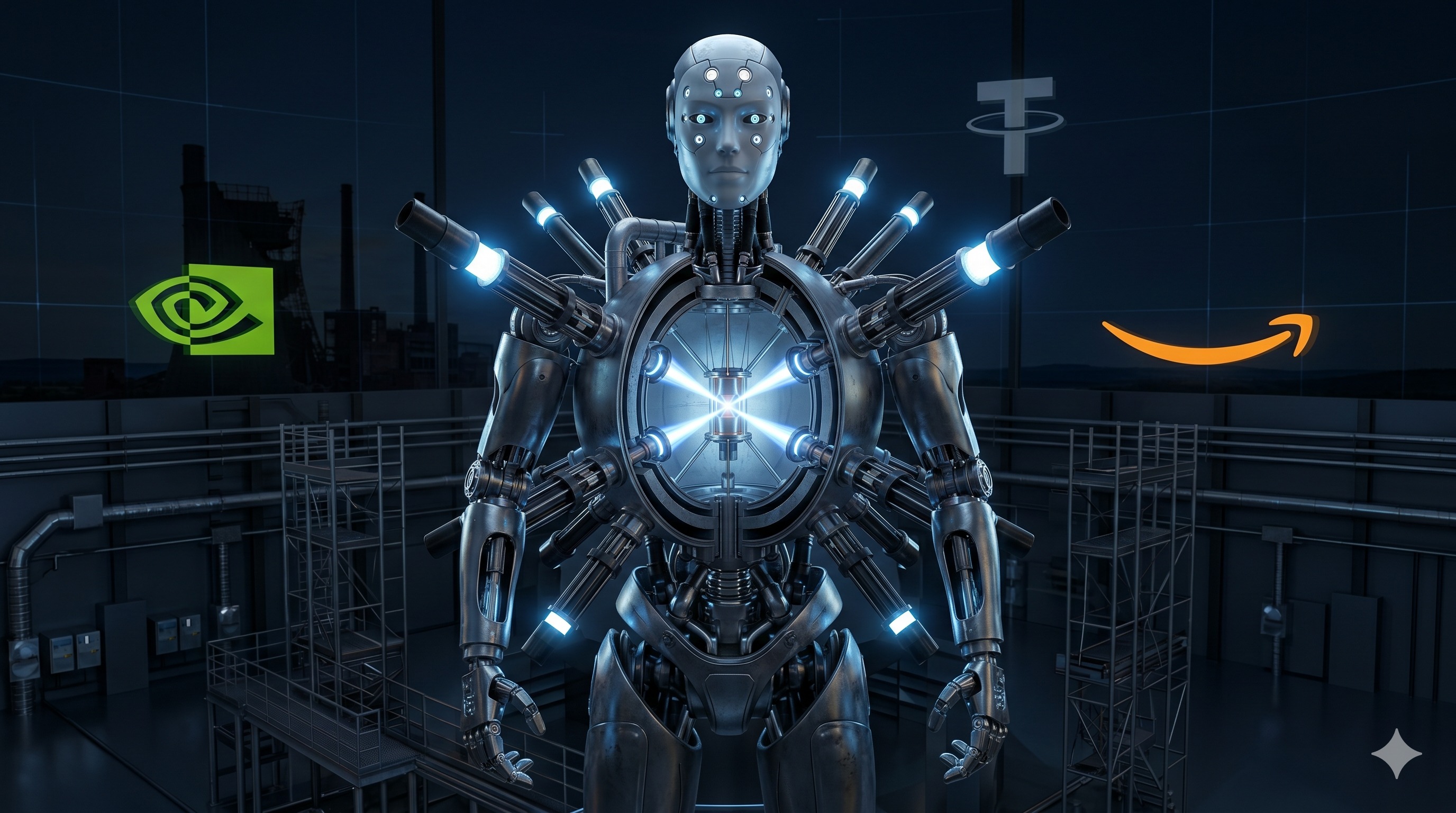
In June 2026, German robotics startup Neura Robotics completed approximately $1.4 billion (€1.3 billion) in Series C funding, led by Tether Investments with participation from Amazon, NVIDIA, Qualcomm, and Bosch. This represents one of the largest single funding rounds in European robotics history, signaling that the humanoid robot sector has entered a capital-intensive phase as it moves from laboratory prototypes toward mass production.
The 4NE-1 Humanoid: Europe's Entry Ticket
Neura Robotics' core product is the 4NE-1 (pronounced "Neuron"), a general-purpose humanoid robot designed for industrial and service applications. The 4NE-1 shares conceptual similarities with Tesla's Optimus and Figure 02 — pursuing the ability to perform physical labor in human environments — but follows a technically distinct approach.
The 4NE-1's specifications include full-body sensor coverage integrating visual, auditory, and tactile inputs; human-like fluid bipedal mobility with articulated arm manipulation; AI-based perception and decision-making systems; and modular, replaceable limb design. Neura Robotics positions the 4NE-1 as a "Cognitive Humanoid," emphasizing that it is not merely a pre-programmed automation machine but a platform capable of learning, adapting, and safely collaborating with humans.
Strategic Implications of the Investment Syndicate
The $1.4 billion round's investor composition warrants detailed analysis. Tether Investments — the stablecoin issuer and one of the largest cryptocurrency companies — led the round, signaling the expansion of digital asset wealth into physical world infrastructure. Amazon and NVIDIA's participation reflects these tech giants' distinct strategic positions in robotics.
Amazon is heavily deploying robotics across its logistics network, from its Kiva acquisition to recent tests of Agility's Digit humanoid. Investing in Neura Robotics suggests Amazon is diversifying its next-generation warehouse automation technology sources.
NVIDIA participates from a different angle. Its Omniverse platform and Jetson edge computing hardware are becoming the infrastructure layer for robot development. Through Neura, NVIDIA secures both financial returns and, critically, adoption of its technology stack — particularly in simulation training and edge inference.
Qualcomm's involvement hints that the 4NE-1 may require high-performance, low-power edge AI chips for real-time perception and decision-making. Bosch, the German industrial conglomerate, represents traditional industrial automation's strategic positioning in the humanoid robot race.
Europe's Humanoid Ecosystem Takes Shape
Neura Robotics' mega-round is not an isolated event. Over the past 12 months, Europe's humanoid ecosystem has been rapidly forming:
Agility Robotics (US/UK-linked) has progressed with Digit commercialization. 1X Technologies (Norway), backed by OpenAI, has developed the Eve and NEO humanoid robots. Fourier Intelligence (China-Europe collaboration) is also pursuing humanoid projects.
However, Neura Robotics occupies a unique position. As a German company, it benefits from Germany's deep expertise in precision manufacturing, industrial automation, and engineering talent. The country's "Industry 4.0" framework provides policy support for smart manufacturing, and Neura's technology sits precisely at the intersection of industrial robotics and AI.
Europe lags behind the U.S. in foundational AI models (no European equivalent of OpenAI or Anthropic), but its traditional advantages in robotics hardware and industrial automation make humanoid robots a domain where Europe can potentially lead. Neura Robotics' funding can be seen as a European "national champion" investment in this space.
The Global Humanoid Capital Landscape
The 2025-2026 period has seen unprecedented capital flowing into the humanoid robot sector. Key players and their positions:
Figure AI completed over $700 million in funding (including Microsoft, OpenAI, NVIDIA, Bezos) and reached a $2.6 billion valuation. Figure 02 is conducting pilot deployments at BMW factories, demonstrating practical automotive manufacturing capability.
1X Technologies, backed by OpenAI, develops the NEO bipedal humanoid focused on home and service environments.
Tesla Optimus, Tesla's in-house humanoid, targets limited production by 2026 with a goal price below $20,000.
Boston Dynamics, owned by Hyundai, has transitioned its Atlas humanoid from hydraulic to electric actuation, demonstrating autonomous warehouse capability in 2025.
Agility Robotics' Digit biped has been tested in Amazon and GXO warehouses, focusing on logistics material handling.
Against this competitive landscape, Neura Robotics' $1.4 billion raise places it among the best-capitalized humanoid companies globally. Tether's lead investment also introduces a new capital source — crypto wealth — flowing into physical infrastructure construction.
Shared Challenges Facing Humanoid Robots
Despite massive capital inflows, the humanoid robot industry faces several unresolved core challenges:
First, the cost magnitude gap. Current humanoid manufacturing costs range from $50,000 to $150,000, while enterprise customer willingness to pay typically falls between $20,000 and $50,000. Reaching consumer-affordable price points ($10,000-$20,000) requires supply chain scaling and design innovation.
Second, the generality-versus-specificity tradeoff. In warehouse logistics, specialized wheeled搬运 robots (like Amazon's Proteus) handle most tasks at one-tenth the cost of humanoids. The "general form factor" advantage of humanoids is often offset by cost and reliability disadvantages in actual deployment.
Third, the missing software ecosystem. Humanoid robot operating systems, app stores, and developer toolchains remain immature. This contrasts sharply with smartphones and electric vehicles, both of which only experienced explosive growth after operating system standardization. NVIDIA's Omniverse and Isaac platforms are attempting to fill this gap, but a true ecosystem remains distant.
Fourth, lagging safety regulations. Humanoid deployment in human workplaces involves complex safety certification and labor law issues. Unified safety standards have yet to be established.
Observatory Analysis
What makes Neura Robotics' $1.4 billion round most notable is not the amount itself but the investor composition. The simultaneous participation of traditional industrial (Bosch), cloud computing (Amazon), AI infrastructure (NVIDIA), mobile chip (Qualcomm), and crypto capital (Tether) suggests that humanoid robots are being viewed by strategic investors across diverse sectors as the physical carrier of the next computing platform.
We believe humanoid robot development will likely not follow the smartphone S-curve (slow start, explosive growth, saturation). Instead, it will more closely resemble electric vehicles, with multiple cycles of "expectation inflation — disappointment — substantive progress." The current capital enthusiasm corresponds to the expectation inflation phase; the true commercialization test will arrive in 2027-2028.
For investors, distinguishing which companies possess genuine hardware-software integration capabilities — rather than those that merely raise capital on concepts — will be the most important judgment over the next two years. Neura Robotics' German engineering heritage is a positive signal, but the ultimate proof will be in the 4NE-1's actual deployment data.
Disclaimer: The information in this article is for reference only and does not constitute investment advice or business decision-making basis. Data and time-sensitive information are accurate as of publication date and may change with subsequent developments. Neither the author nor POC.HK accepts liability for any losses resulting from the use of this information.