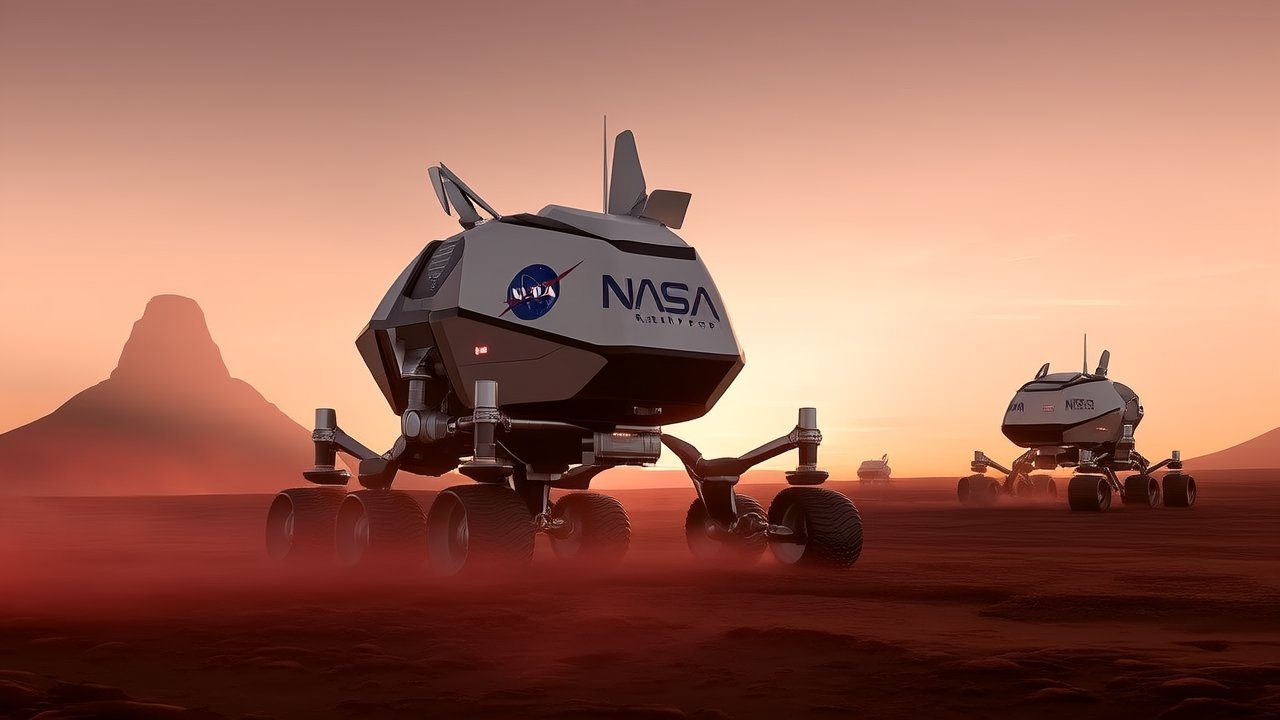
On June 17, 2026, NASA Administrator Jared Isaacman stood at Relativity Space headquarters in Long Beach, California, to announce a structurally significant partnership: NASA will provide the Aeolus atmospheric science instrument suite, while Relativity Space supplies the spacecraft, rocket, and cruise operations to deliver these instruments to Mars. The mission is scheduled for launch in 2028, targeting the first integrated daily global observations of Martian winds, temperatures, dust, and clouds.
On the surface, this appears to be a routine Mars science mission. However, the public-private partnership (PPP) model underlying it may fundamentally change the economic structure of planetary science — just as the Commercial Resupply Services (CRS) program transformed International Space Station operations.
Mission Technical Details
The Aeolus mission core consists of a four-instrument atmospheric science suite designed specifically for the Martian environment. Rather than building the entire spacecraft itself, NASA is outsourcing transportation and operations to the private sector.
Relativity Space will provide the Terran R rocket and spacecraft platform. The Terran R is a fully reusable medium-lift launch vehicle manufactured using the company proprietary Stargate 3D printing technology, which eliminates thousands of parts required in traditional rocket manufacturing. This enables Relativity Space to offer deep-space transportation services at lower cost and shorter lead times.
This division of labor carries profound economic logic: NASA concentrates resources on high-value scientific instruments, while the commercial partner assumes infrastructure and transportation costs. Administrator Isaacman explicitly stated at the announcement: Public-private partnerships are a force multiplier for science. By pairing NASA world-class instruments with commercial innovation and investment, we can deliver more science, more often.
The Strategic Value of Mars Atmospheric Data
The data collected by Aeolus carries not just pure scientific significance but direct operational value. The Martian atmosphere — particularly its dust activity, wind patterns, and density variations — represents one of the greatest uncertainties facing future crewed landing missions.
Mars atmospheric density is only 1% of Earth, yet intense dust storms can last for months, and temperature swings exceed 100 degrees Celsius. The Entry, Descent, and Landing (EDL) phase is the most dangerous moment of any Mars mission — nearly half of all Mars landers have failed at this stage. Accurate atmospheric models are critical for designing safe landing systems.
Aeolus daily global observations will enable scientists to build real-time Martian weather models for the first time. This means future missions can dynamically adjust entry angles, heat shield designs, and parachute deployment strategies based on actual atmospheric conditions.
From CRS to Planetary Science: The Evolution of PPP
NASA public-private partnership model has evolved through three phases:
Phase One: Low-Earth Orbit Commercialization. The Commercial Orbital Transportation Services (COTS) program starting in 2008 and subsequent Commercial Resupply Services proved that private companies could reliably deliver cargo to the ISS. SpaceX Dragon and Orbital ATK Cygnus are products of this phase.
Phase Two: Crew Commercialization. The Commercial Crew Program extended PPP to human spaceflight, with SpaceX Crew Dragon and Boeing Starliner representing this phase. This freed NASA from operating its own crew vehicles.
Phase Three: Deep-Space Science Commercialization. The Aeolus mission represents the beginning of a third phase — applying PPP to planetary science. Unlike the first two phases, which focused primarily on transportation services, Phase Three is characterized by NASA still providing the scientific payload, while the entire mission transport, operations, and data relay are handled by the commercial partner.
The implications are far-reaching. If Aeolus succeeds, it will set a precedent for future Mars orbiters, Venus probes, and even outer-planet missions. NASA can shift more budget from infrastructure to scientific instruments themselves, significantly increasing the return on science investment.
The Emerging Commercial Mars Transportation Market
Relativity Space securing this contract signals that a commercial Mars transportation market is forming. While the company Terran R rocket has yet to make its first orbital flight, it has already earned the trust of multiple customers including NASA.
Unlike the traditional NASA-led model, commercial companies can now offer Mars transportation as a purchasable service. This produces several important structural changes:
First, mission frequency may increase. Under the traditional model, NASA must establish an independent project office, procurement process, and management structure for each Mars mission, typically with 5-7 year cycles. Under the PPP model, commercial companies can offer standardized transportation services, reducing mission planning cycles to 2-3 years.
Second, cost structure becomes transparent. Commercial contracts force suppliers to quote fixed prices, in stark contrast to the cost-plus contracts common in traditional NASA procurement. Fixed-price contracts transfer the risk of cost overruns from taxpayers to contractors.
Third, technological diversity increases. Different commercial companies may pursue different technical paths — from chemical propulsion to nuclear thermal propulsion, from direct entry to aerocapture — creating a technologically diverse ecosystem.
Risks and Challenges
However, this model faces significant challenges.
Relativity Space Terran R has not yet completed its first orbital flight. The company previously focused on the smaller Terran 1 rocket (which flew only once), and Terran R technical maturity remains to be validated. For Mars missions, reliability is the overriding priority — any transportation phase failure would mean the loss of years of scientific work.
Additionally, commercial companies priorities may shift with market conditions. If Relativity Space encounters financial difficulties or strategic adjustments, the Mars mission could be affected. NASA needs to establish appropriate backup plans and risk mitigation strategies.
The PPP model also raises a deeper question: who should determine the priorities of planetary science? Under the traditional model, NASA sets mission priorities through top-down peer review by the scientific community. Under the commercial model, companies may favor missions with greater commercial return potential rather than pure scientific value.
Forward Outlook
The Aeolus mission is scheduled for launch in 2028, with scientific data beginning in the early 2030s. If successful, it will provide NASA with a powerful new tool for planning the Mars exploration roadmap — from scientific research to crewed landing.
Observing the long-term evolution of this partnership model, we can anticipate the following trends:
- Standardized deep-space transportation services will become an emerging market, with multiple commercial companies offering competitive pricing.
- NASA role will shift from mission operator to science investor and customer, similar to how NOAA procures weather satellites.
- Mars mission frequency may increase from once every 26 months to annually or more, dramatically accelerating the pace of scientific discovery.
- International cooperation models may also be affected — other nations space agencies could participate in Mars exploration by purchasing commercial transportation services without developing their own launch vehicles.
- The insurance industry will also face adjustments — as commercial missions replace government-led missions, space insurers will need to develop new risk pricing models for commercial Mars missions.
Aeolus is not just a Mars mission — it is a structural experiment in the economics of planetary science. Its outcome will largely determine how humanity explores the solar system in the decades to come.
Disclaimer: The information provided in this article is for reference only and does not constitute investment advice or business decision-making basis. Data and time information is current as of the publication date and may change with subsequent developments. Neither the author nor POC.HK assumes any responsibility for losses resulting from the use of this information.