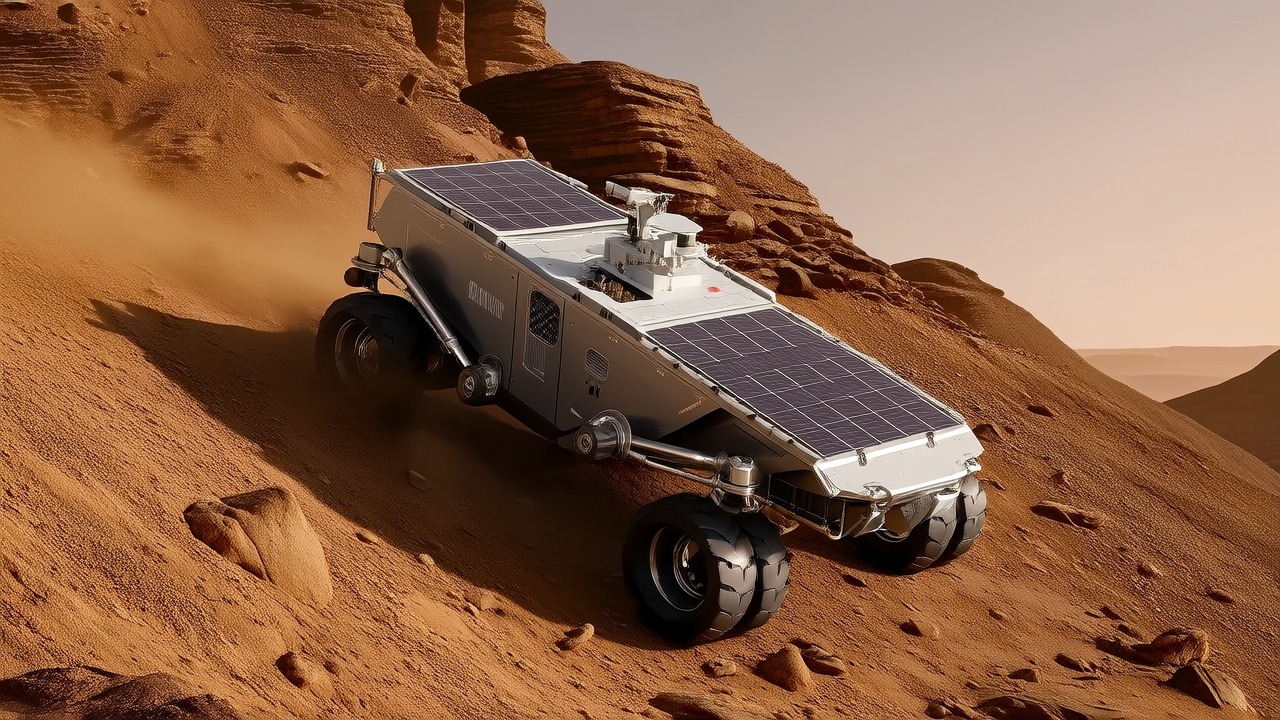
On June 18, 2026, NASA's Jet Propulsion Laboratory released the results of a desert field test for the ERNEST rover prototype (Exploration Rover for Navigating Extreme Sloped Terrain). The four-wheeled, 1.2-meter-long rover autonomously traversed approximately 16 miles (26 kilometers) across California's Colorado Desert over a seven-day campaign, covering the distance in about 37 hours of driving — more than ten times faster than NASA's current Mars rovers.
This is not merely a technology demonstration. ERNEST represents a fundamental paradigm shift in planetary exploration — from "slow, cautious, Earth-command-centered" operations to "fast, autonomous, field-decision-centered" expeditions. This shift is enabled by the simultaneous maturation of three technology curves: mechanical design (active suspension replacing rocker-bogie), artificial intelligence (reinforcement learning-driven autonomous navigation), and space transportation economics (Starship lowering launch costs).
The End of the Rocker-Bogie Era
Since Sojourner landed on Mars in 1997, every NASA Mars rover — Spirit, Opportunity, Curiosity, Perseverance — has used the rocker-bogie suspension system. This is a passive design: no active control elements, relying on mechanical geometry to keep wheels in contact with terrain across different surfaces. Its virtues are simplicity, reliability, and passivity — in an environment where remote repair is impossible, having no moving parts means having no parts that can fail.
But rocker-bogie has a fundamental limitation: it cannot actively adapt to terrain. When a wheel encounters an obstacle, the entire vehicle's posture is passively determined by the terrain, rather than the vehicle actively controlling its posture to overcome obstacles. This limits traversable slope angles and obstacle heights. Curiosity's wheels have been punctured by sharp Martian rocks — not a design failure, but the inherent vulnerability of passive suspension.
ERNEST's active suspension fundamentally changes this design philosophy. Each wheel can be independently lifted — raised over obstacles and then lowered back down. Two powered joints in the front enable multiple gaits: squirming, wheel-walking, and obstacle-climbing. Critically, a clutch mechanism allows switching between active mode (high terrain capability) and passive mode (energy-efficient cruising).
This is not merely a mechanical improvement. Active suspension enables the rover to reach terrain that rocker-bogie cannot access — steep slopes in the Moon's permanently shadowed polar regions, Martian crater walls, lava tube entrances. These are precisely the targets of greatest scientific interest, potentially containing water ice, organic compounds, or critical geological records.
Reinforcement Learning: From Remote Control to Autonomous Expedition
If active suspension is ERNEST's "muscle," reinforcement learning-driven autonomous navigation is its "brain."
Current Mars rover operations follow this pattern: teams on Earth send a set of commands each day, telling the rover where to go, how to get there, and when to stop. With Mars-Earth communication delays of 2.5 seconds to 20 minutes (depending on planetary alignment), real-time remote control is impossible. Perseverance covers approximately 100-200 meters per day — a pace scientists describe as "operating on geological timescales."
ERNEST's approach is fundamentally different. JPL's Dynamics and Real-Time Simulation Laboratory built a high-fidelity virtual testing environment that precisely simulates the rover's physical behavior. Engineers fed the simulator with real rover response data across various terrains (wheel slip rates, motor currents, chassis attitude changes), then ran thousands of simulations simultaneously on a high-performance computing cluster — sometimes completing thousands of hours of virtual tests over a single weekend.
After training, ERNEST could make autonomous navigation decisions without Earth intervention: selecting optimal paths, assessing obstacle traversability, adjusting speed for terrain changes. At JPL's Mars Yard, ERNEST autonomously navigated obstacle courses including sand ripples, rubble piles, steps, and steep slopes.
The combined effect of this autonomy with heavy-lift vehicles like Starship is transformative. If Starship reduces cargo costs to below $100/kg, rovers no longer need extreme mass optimization like Perseverance — they can be built more robustly, with larger batteries and more scientific instruments. More importantly, a single Starship launch could deploy multiple ERNEST-class rovers, rather than the current paradigm of one rover per mission.
The Lunar Catalyst
ERNEST's primary design target is a lunar mission. JPL is developing autonomy technology for a potential long-range lunar rover mission concept that would explore the Moon's south pole permanently shadowed regions.
The lunar polar environment poses unique challenges. The Sun hangs low on the horizon, producing extremely long shadows that make visual navigation difficult — shadow region contrast exceeds the dynamic range of conventional cameras. ERNEST's desert tests were deliberately conducted at dawn, dusk, and night to simulate lunar polar lighting conditions. The rover carries active illumination for operation in total darkness.
Lunar south pole water ice is a core Artemis program target. Deployed on the Moon, ERNEST could enter permanently shadowed craters to directly sample water ice — a task no current orbiter or stationary lander can accomplish. Long-range rovers operating from an Artemis Base Camp would upgrade lunar science from "point sampling" to "regional geological surveys."
Comparison with Current Rovers
Comparing ERNEST with current Mars missions reveals the scale of transformation: Perseverance has traveled approximately 29 kilometers since landing in 2021 — roughly equivalent to one ERNEST multi-day test, but over 4 years rather than 37 hours. If deployed on Mars, ERNEST could traverse the entire floor of Jezero Crater in a single autonomous command cycle.
ERNEST is not without limitations. Having 4 wheels versus Perseverance's 6 means less failure redundancy — if one wheel fails, three-wheel mode severely limits traversability. The active suspension's moving parts increase the number of potential failure points. Higher speed also means more severe potential damage in case of collision — a trade-off requiring careful consideration in an unrepairable environment.
Observatory Analysis: The Scaling Inflection in Planetary Exploration
ERNEST embodies not just a single rover's capability improvement, but a structural transformation in the planetary exploration paradigm. This transformation is driven by the convergence of three independent technology trends.
First, fundamental mechanical platform innovation. Active suspension replacing passive rocker-bogie transforms rovers from "terrain-determined passive devices" into "terrain-conquering active vehicles." This is not an improvement — it is a reinvention of the underlying design philosophy for planetary rovers.
Second, AI-enabled decision-making. Reinforcement learning allows rovers to make real-time decisions despite communication delays, shifting the human role from "driver" to "expedition commander" — setting overall objectives while the vehicle decides how to execute. This represents a qualitative leap in deep space automation from "remote operation" to "goal-oriented autonomy."
Third, heavy-lift logistics support. Starship-class vehicles are fundamentally changing planetary mission mass budgets and cost structures. When launch cost is no longer the primary constraint, rover design no longer requires extreme lightweighting — enabling larger science payloads, more capable computing, and greater design redundancy. Single-launch deployment of multiple rovers would upgrade planetary exploration from "single-point investigation" to "networked exploration."
The convergence of these three trends is transforming planetary science from "detailed observations of a few high-value targets" into "broad-area, high-tempo, systematically diverse terrain exploration." For lunar south pole water ice assessment, Martian astrobiological surveys, and future missions to Europa and Titan, this scaling capability is essential.
For our readers, ERNEST's story is not just about a new NASA rover. It is a case study in how technological paradigms are rewritten — when breakthroughs occur simultaneously in mechanics, computing, and transportation, even a field as mature as planetary exploration can enter a new era of development.
Disclaimer: The information contained in this article is for informational and educational purposes only and does not constitute any investment advice or business decision basis. Data and time-sensitive information are accurate as of the publication date and may change with subsequent developments. Neither the author nor POC.HK assumes any responsibility for any losses arising from the use of this information.