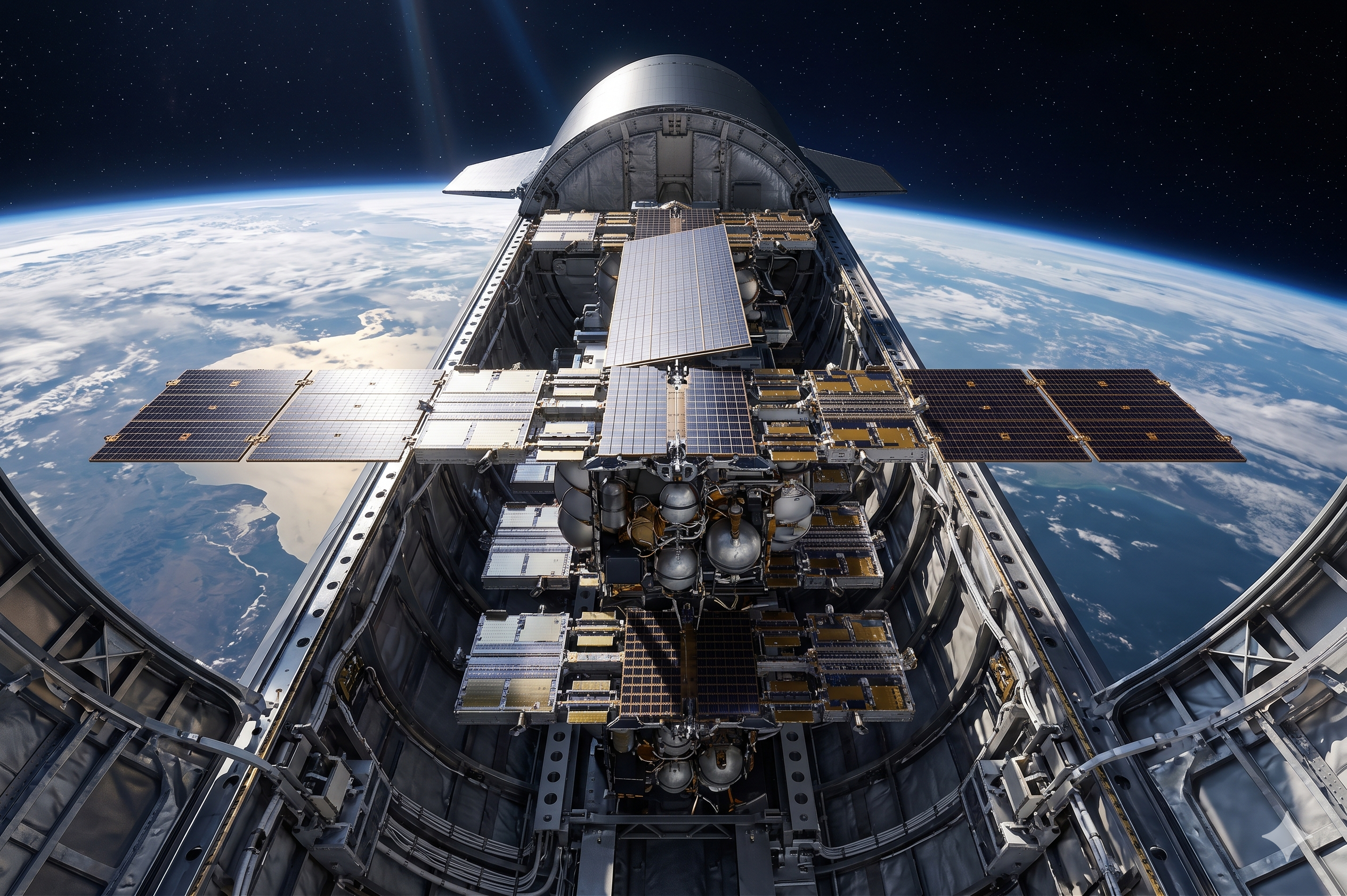
From Ground to Orbit: Muon Space Unveils Starship-Class Satellite Platform for Orbital Data Centers
June 3, 2026, Mountain View, CA — Muon Space has officially unveiled the Condor-Ultra, a next-generation satellite platform purpose-built for Starship and aimed at the emerging "orbital data center" market. This announcement marks not only another milestone in the SpaceX Starship ecosystem but also signals that global cloud computing and AI infrastructure are poised to extend from the ground into low Earth orbit.
I. Condor-Ultra: A Super Platform Engineered for Space Computing
Condor-Ultra is the largest and most powerful satellite platform Muon Space has ever built. According to official specifications, the platform delivers an initial power output of 20 kW, scalable to 100 kW depending on mission requirements. Its nadir payload area exceeds 18 square meters, capable of accommodating large-scale sensors, communications antennas, and computing hardware.
Key technical specifications include:
- Starship Stackable Deployment: Natively designed for bulk release from Starship, enabling constellation-scale deployment of hundreds to thousands of satellites, dramatically reducing per-unit launch costs.
- Starlink 25 Gbps Always-On Connectivity: Integrates SpaceX's Starlink Mini Lasers to provide uninterrupted internet backhaul, ensuring real-time data transmission between ground and orbit.
- 100 Gbps Optical Inter-Satellite Links: Establishes a mesh constellation architecture supporting high-speed communication between distributed computing nodes.
- NVIDIA Space-1 Vera Rubin Module: Purpose-built for on-orbit AI inference, the Rubin GPU delivers 25x the AI compute performance of an H100 under orbital workloads.
- Starlight Propulsion System: After acquiring Starlight Engines last year, Muon internalized the propulsion technology and now controls 95% of its spacecraft manufacturing in-house.
Muon Space President Greg Smirin stated: "The scale of Condor-Ultra is unlike anything before it." Compared to last year's 500 kg-class XL platform, Ultra weighs three times as much and delivers five times the power. The first pathfinder satellite is scheduled to launch in 2028 — and Smirin emphasized that this is no traditional technology demonstrator, but a full production-configuration platform carrying real customer mission requirements.
II. Why Send Data Centers into Space?
The concept of orbital data centers has rapidly evolved from science fiction to engineering feasibility. The driving forces behind it are threefold:
1. Latency Advantage For globally distributed users, LEO orbital data centers can reduce round-trip time (RTT) to 10–20 milliseconds, far superior to the 100–300 ms of intercontinental fiber optic routing. This is decisive for real-time AI inference, financial trading, remote operations, and similar applications.
2. Overcoming Ground Infrastructure Limitations Large data centers on Earth face increasingly severe challenges in power supply, water consumption, land acquisition, and environmental permitting. The orbital environment offers:
- Continuous unhindered solar power (steady generation on the sun-facing side without batteries)
- Natural radiative cooling (the vacuum of space enables efficient heat dissipation)
- Virtually unlimited expansion space (simply add more satellites)
3. The Spacelization of AI Inference The collaboration between NVIDIA and Muon targets a core need: AI inference is shifting from centralized training to distributed edge deployment. Orbital data centers can serve as "space edge nodes," directly processing satellite imagery analysis, real-time weather prediction, global IoT data aggregation, and other workloads, significantly reducing unnecessary data downlinks.
III. Starship-Class Platform: The Key Variable for Economies of Scale
The Condor-Ultra is described as a "Starship-class" platform, and its core significance lies in fully utilizing Starship's payload bay volume and lift capacity. Starship's fairing measures 9 meters in diameter and over 18 meters in height, capable of deploying hundreds of small satellites or tens of tons of large payloads in a single launch.
Muon's design strategy allows Condor-Ultra to be stacked like building blocks for loading, maximizing packing density inside the Starship bay and driving per-satellite launch costs to unprecedented lows. At the same time, the platform also offers configuration options for medium-lift rockets such as Falcon 9 and Rocket Lab's Neutron, enabling customers to deploy before Starship enters commercial service.
This "start with medium-lift rockets, transition to Starship at scale" strategy reflects Muon's pragmatic commercial path. The company is building a new production facility in San Jose that will expand manufacturing capacity 10-fold, with an annual satellite production target of 500 units.
IV. Market Analysis: The Economic Outlook for Orbital Data Centers
Although orbital data centers remain in their infancy, market research institutions and industry analysts have offered optimistic projections:
- The global space data center market is expected to exceed $10 billion by the early 2030s.
- Primary growth drivers include: the explosion of AI inference workloads, data processing demands from LEO communications constellations, and edge computing scenarios in defense and intelligence.
- Wall Street analysts believe that declining launch costs are a prerequisite for the entire business model — if Starship's fully reusable design brings per-kilogram launch costs below $200, the unit operating costs of orbital data centers could become competitive with terrestrial data centers.
Muon claims to have conducted feasibility studies with multiple "hyperscalers." While no specific customer names have been disclosed, Smirin made clear that "the 2028 pathfinder satellite is not a speculative platform — it is being built to the real mission requirements of signed customers."
V. Competitive Landscape: The Race for Space Compute Heats Up
Muon Space is not the only company betting on orbital data centers. The current competitive spectrum can be broadly divided into three categories:
1. Native Startups
- Starcloud (Redmond, WA): Founded by former SpaceX and Microsoft engineers, focused on gigawatt-scale space data centers, proposing an architecture centered on continuous solar power and radiative cooling. Has published a whitepaper and opened collaboration.
- Lumen Orbit: Raised $11 million in seed funding in 2024, targeting the deployment of compute nodes in LEO to offer data processing as a service.
2. Traditional Space Infrastructure Providers
- Axiom Space: Is planning post-ISS commercial modules that include data center module proposals equipped with computing and storage resources.
3. Vertically Integrated Satellite Manufacturers
- Muon Space is the leading representative of this category. Smirin noted that when SpaceX, Starcloud, and others propose building their own large-scale orbital data centers, they often emphasize their vertical integration advantages. But Muon's argument is that as the market matures and performance requirements increase, Muon's vertical integration investments "will be more attractive than having every operator build their own hardware, software, operations, and satellite infrastructure from scratch."
This "Satellite Platform as a Service" model is reminiscent of AWS's role in cloud computing — letting customers focus on the application layer rather than the underlying infrastructure.
VI. Technical Challenges: Space Is Not the Cloud
Sending data centers into orbit presents a series of formidable engineering challenges:
Power Supply The 20–100 kW power requirement is already at the top tier of the satellite industry. Condor-Ultra employs a modular, scalable power architecture, but deploying large solar arrays, maintaining pointing accuracy, and compensating for degradation are all system-level challenges. The 100 kW configuration requires approximately 300–500 square meters of solar panel area, placing enormous demands on deployment mechanisms and attitude control systems.
Thermal Management The vacuum of space renders conventional convective cooling ineffective. High-density computing chips like GPUs can generate thermal densities of tens of watts per square centimeter in orbit. Condor-Ultra's solution relies on radiator panel design, leveraging the large nadir-facing structure as a passive heat dissipation path. Future 100 kW variants may require deployable radiator arrays.
Connectivity and Network Architecture The 25 Gbps Starlink downlink and 100 Gbps optical inter-satellite links form the communications backbone of the orbital data center. Achieving dynamic routing across large constellations, avoiding signal interference, and ensuring link reliability requires integrating software-defined networking (SDN) architecture with automated fault recovery mechanisms.
Automated Operations There are no "data center engineers" in space. Condor-Ultra is equipped with Muon's full-stack automated flight, networking, and ground software systems, operating completely autonomously from orbit planning and data routing to mission scheduling. This system is a core competitive advantage accumulated from Muon's existing constellation operations experience.
Radiation Environment Although LEO is partially shielded by Earth's magnetic field, long-term exposure still causes cumulative damage to semiconductor components. The NVIDIA Space-1 module must pass rigorous radiation hardening certification, and the lifespan and reliability of commercial-grade compute chips (such as conventional GPUs) in orbit remain critical validation items before large-scale deployment.
VII. Outlook: The Next Explosion Point of the Orbital Economy
Muon Space's Condor-Ultra announcement marks a critical inflection point, moving orbital data centers from concept validation toward commercial production. The 2028 pathfinder mission will serve as the industry's litmus test — it needs to prove:
- Whether space-based GPU inference latency and cost can match ground-based solutions
- Whether the operational complexity of large-scale satellite constellations is manageable
- Whether real customer demand exists and is willing to pay a premium
From a broader perspective, orbital data centers represent the next natural extension of the orbital economy — following communications (Starlink) and Earth observation (Planet, Maxar), computing is becoming the third commercially viable layer of space infrastructure. When Starship drives launch costs down by one to two orders of magnitude, deploying compute in space will shift from being merely "possible" to "inevitable."
Muon Space has rapidly iterated through the XL and Ultra platform generations within five years, evolved from a startup satellite manufacturer, secured chip support from NVIDIA, and initiated feasibility collaborations with hyperscalers — all signs that the pace of this domain is accelerating. The Condor-Ultra pathfinder satellite in 2028 may well become the next "space moment" in the history of human computing.