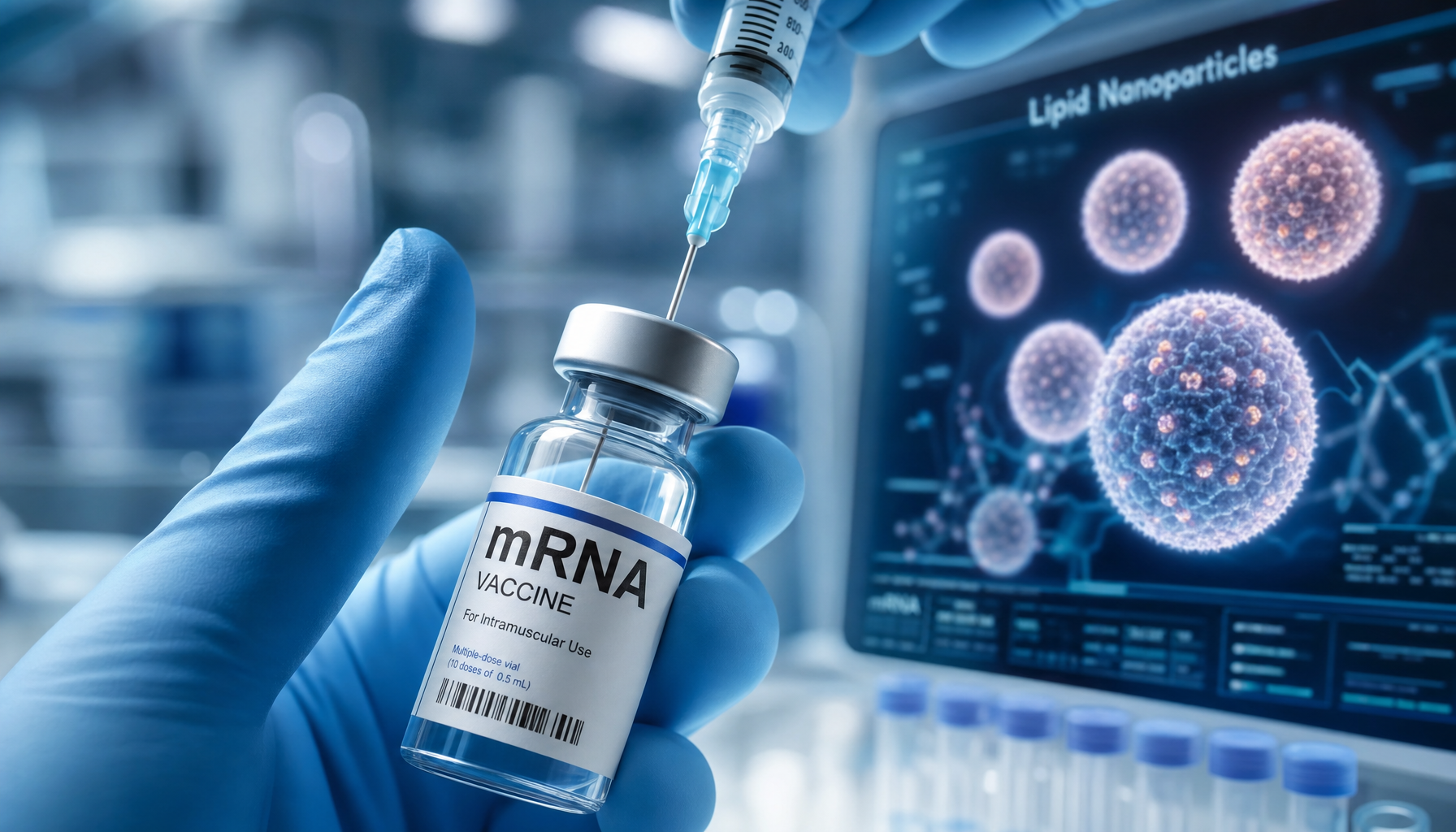
mRNA Cancer Vaccine Clinical Breakthrough: Personalized Therapy Enters Phase 3 Trials
Moderna/Merck's mRNA-4157 (V940) combined with Keytruda reduces relapse risk by 44% in adjuvant melanoma treatment, advancing personalized cancer vaccines toward market approval
I. From COVID to Cancer: The mRNA Platform's Brilliant Pivot
The COVID-19 pandemic catalyzed rapid validation of mRNA vaccine technology, but the true potential of this technology extends far beyond infectious disease prevention. Between 2025 and 2026, personalized mRNA cancer vaccines are transitioning from development to commercialization, becoming one of the most transformative fields in precision oncology.
The core principle of mRNA cancer vaccines follows the same logic as COVID vaccines — delivering mRNA molecules encoding tumor-specific antigens (neoantigens) into the body, where dendritic cells present them to T cells, activating a targeted immune attack against tumor cells. The fundamental difference from traditional cancer vaccines lies in mRNA vaccines' "personalized" nature: each patient's tumor undergoes whole-exome sequencing and bioinformatics algorithm analysis to identify patient-specific mutation sites, followed by customized synthesis of corresponding mRNA sequences. From tissue biopsy to vaccine injection, the entire process can be compressed to 6-8 weeks.
II. Key Clinical Data Analysis
2.1 Moderna/Merck — mRNA-4157 (V940)
This is the closest-to-market personalized mRNA cancer vaccine. The KEYNOTE-942 / mRNA-4157-P201 Phase 2 trial (NCT03897881), published in 2023, enrolled 157 high-risk melanoma patients who received mRNA-4157 plus Keytruda (pembrolizumab) or Keytruda alone after complete resection. Results showed:
- The combination therapy group's 24-month recurrence-free survival (RFS) rate was 78.6%, versus 62.2% in the control group
- Relapse risk reduction of 44% (HR = 0.56, p = 0.0066)
- In subgroup analysis, PD-L1 low-expressing patients also benefited, suggesting the therapy's efficacy is independent of PD-L1 status
The Phase 3 trial INTerpath-001 (NCT06340724), launched in 2025, has enrolled over 1,000 patients with Stage II-IV melanoma, with primary endpoint results expected in the first half of 2027. Moderna has also initiated INTerpath-002 for non-small cell lung cancer (NSCLC) and INTerpath-003 for renal cell carcinoma (RCC), comprehensively expanding its indication portfolio.
2.2 BioNTech — BNT111 and BNT122
BioNTech's strategy is more diversified than Moderna's. BNT111 (FixVac) is a fixed-antigen combination vaccine (non-personalized) targeting four antigens common in melanoma (NY-ESO-1, MAGE-A3, Tyrosinase, TPTE), which can be pre-manufactured without sequencing wait times, significantly reducing costs. In Phase 2 results published in 2025, BNT111 combined with Libtayo (cemiplimab) achieved a 45% objective response rate (ORR) in PD-1 refractory melanoma patients, far exceeding the historical control rate of 12-15%.
BNT122 (autogene cevumeran) follows the personalized route, co-developed with Genentech (Roche), combining chemotherapy and Tecentriq (atezolizumab) for adjuvant treatment of pancreatic cancer. Phase 1 data published in Nature in 2024 showed that BNT122 induced neoantigen-specific T cell responses in 50% of pancreatic cancer patients, with median recurrence-free survival extended by over 18 months. Phase 2 validation is ongoing.
2.3 CureVac / Gritstone / Other Players
CureVac's second-generation mRNA platform (breakthrough modified nucleotide technology) has demonstrated higher antigen expression durability and lower immunogenicity in preclinical stages. Its CVGBM (glioblastoma vaccine), developed with partners, has entered Phase 1 clinical trials.
Gritstone bio (since acquired) pioneered "self-amplifying mRNA (SAM)" technology, with its SLATE platform enabling sustained antigen expression in the tumor microenvironment, mimicking persistent infection to enhance T cell memory. Although Gritstone's clinical trials were temporarily interrupted due to funding issues, its SAM technology has been licensed by multiple major pharmaceutical companies.
III. Technical Route Comparison: Personalized vs. Fixed-Antigen
| Aspect | Personalized Vaccines (mRNA-4157 / BNT122) | Fixed-Antigen Vaccines (BNT111 / Autologous Cell Vaccines) |
|---|---|---|
| Production cycle | 6-8 weeks, requires sequencing and AI prediction | Can be pre-manufactured, available in 1-2 weeks |
| Cost | Estimated $50,000-100,000 per dose | Estimated $5,000-20,000 per dose |
| Applicable patients | Only patients with identifiable neoantigens | Any patient carrying the target antigens |
| Immune diversity | High, targeting individual-specific mutations | Low, limited to pre-set antigen library |
| Patent barriers | Highly dependent on AI platform | Lower production technology barriers |
Each route has its pros and cons. Personalized vaccines win on immunogenicity and precision, but cost and production time are bottlenecks; fixed-antigen vaccines can be mass-produced, suitable for standardized treatment scenarios. The most likely future scenario is complementary coexistence: personalized vaccines for high-risk adjuvant settings, fixed-antigen vaccines for advanced combination therapy.
IV. Industry Dynamics and Market Landscape
Collaboration Agreements
- 2024-2026: Moderna and Merck expand partnership from melanoma to NSCLC, RCC, and initiate pediatric oncology indication exploration
- 2025: BioNTech receives €250 million from EU Horizon Europe funding for European mRNA cancer vaccine production capacity construction
- Early 2026: CureVac signs $1 billion contract with GSK focused on next-generation mRNA platform technology
Market Forecast
According to Frost & Sullivan's 2026 report, the global mRNA cancer therapeutic vaccine market is projected to grow from $1.2 billion in 2025 to $18 billion by 2030, a compound annual growth rate (CAGR) of 72%. If mRNA-4157 achieves approval, the single indication of melanoma could contribute approximately $2.5 billion in peak annual sales.
Regulatory Progress
In 2025, the FDA issued its first draft guidance for personalized cancer vaccine review (Draft Guidance on Individualized Neoantigen Vaccines), clarifying clinical trial design requirements and accelerated approval pathways. The EMA has simultaneously initiated a cancer vaccine evaluation framework under its "PRIME" priority review program. The positive attitudes of both major regulatory agencies have injected regulatory certainty into the field.
V. Challenges and Future Outlook
Despite the bright outlook, mRNA cancer vaccines still face multiple challenges:
-
Tumor immune evasion: Some tumors evade immune recognition through β2-microglobulin mutations or MHC-I downregulation, limiting vaccine effectiveness. Solutions include "multi-epitope design" and combination with IL-2 or tumor-infiltrating lymphocyte (TIL) therapy.
-
Delivery technology: LNPs (lipid nanoparticles) are the current mainstream delivery vehicle, but their liver accumulation tendency limits effectiveness against extrahepatic tumors. Next-generation LNPs, polymeric nanoparticles, and virus-like particles (VLPs) are in preclinical research.
-
Production scalability: The production supply chain for personalized vaccines is not yet mature, requiring distributed GMP production nodes to meet global demand. Moderna plans to complete five regional mRNA production centers by 2027.
-
Insurance coverage and accessibility: High treatment costs will strain healthcare insurance systems. US Medicare has launched an "Outcome-Based Contract" pilot program for personalized cancer therapies.
Looking ahead to 2027-2030, we expect to see:
- mRNA-4157 become the first FDA fully approved personalized mRNA cancer vaccine for adjuvant treatment of high-risk melanoma
- Bispecific mRNA vaccines (encoding both neoantigens and immune co-stimulatory molecules) entering clinical trials
- Combination regimens of mRNA vaccines with CAR-T cell therapy, oncolytic viruses, and other technologies undergoing preclinical validation
- Early commercial validation of the decentralized mRNA "vaccine printer" concept
Conclusion
The transition of mRNA cancer vaccines from concept validation to clinical breakthrough has taken less than five years. The Phase 3 data from the Moderna/Merck alliance will determine whether this technology can truly become part of standard treatment. At the intersection of precision medicine and immunotherapy, personalized mRNA vaccines represent not just the birth of a new drug, but a paradigm shift from "one-size-fits-all" to "bespoke customization" in cancer treatment.
POC.HK Future Technology Observatory — Independent Technology Watch Report