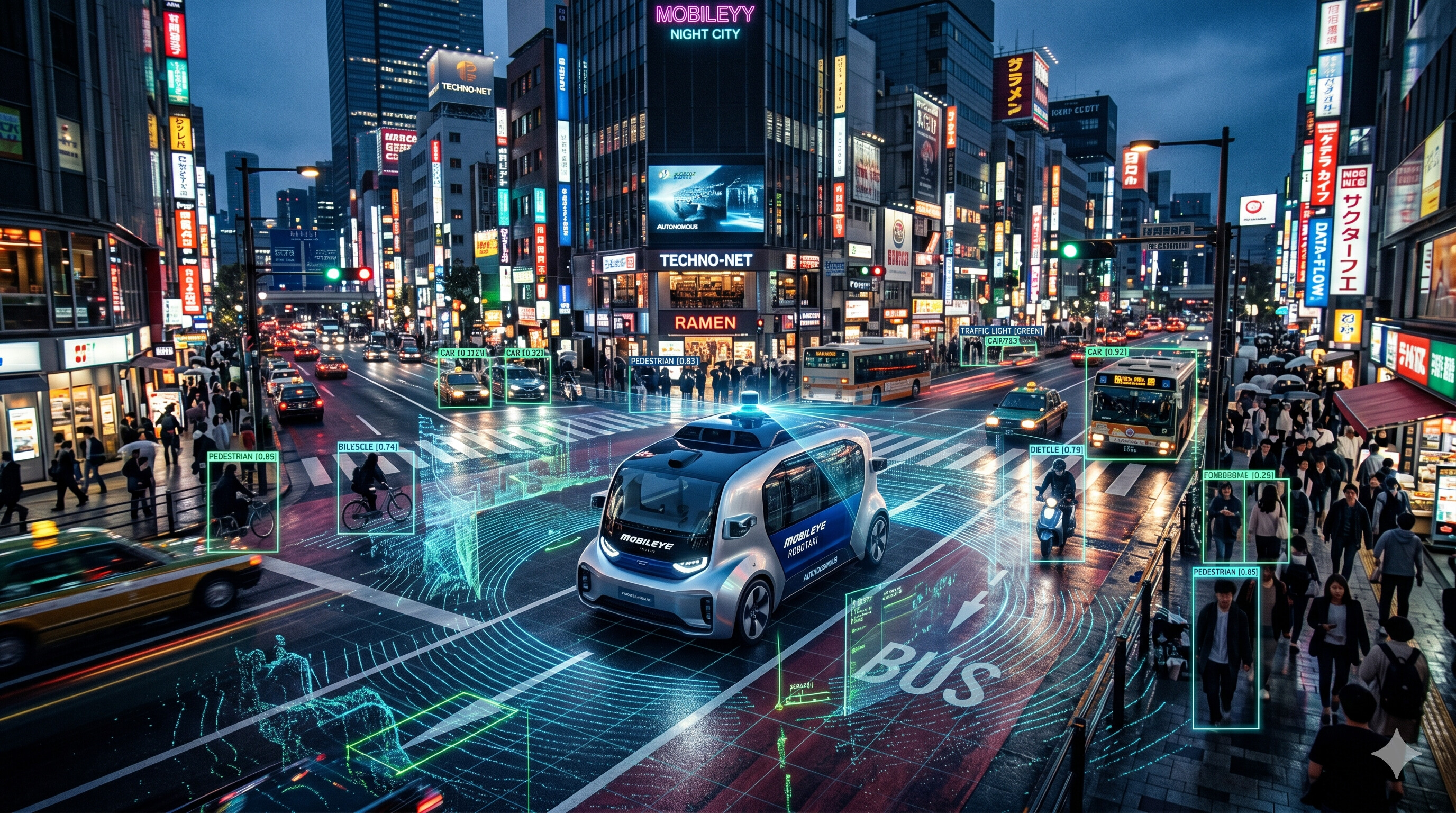
On June 16, 2026, Mobileye Global announced it would launch its own robotaxi service in a major U.S. city in 2027 — shifting from a pure technology supplier to a vertically integrated autonomous ride-hailing operator. The Israel-based company plans to deploy an initial fleet of approximately 100 fully driverless vehicles, scaling to roughly 17,000 vehicles over five years.
This decision matters not because another company is entering the robotaxi race, but because of who is making it. For 25 years, Mobileye has been the neutral "arms dealer" of self-driving — its cameras, chips, and software are embedded in more than 230 million vehicles worldwide. Mobileye's pivot represents a structural judgment about the autonomous vehicle industry: vertical integration is winning, and the pure-supplier model is structurally unsustainable.
Mobileye's Dual Identity Paradox
To understand the strategic significance of Mobileye's decision, one must first understand the fundamental contradiction it faces.
Mobileye's traditional business model is "Intel Inside for autonomy": as a Tier 2 supplier, providing the Mobileye Drive autonomous system to automakers including Volkswagen, Zeekr, and BMW. This model offers light assets, high margins, and no operational risk from fleet management — Mobileye's technology is integrated into multiple OEM autonomy programs.
But this model has an inherent flaw: the more successful the supplier, the harder it becomes to prove its technology's real-world performance in a full-stack operational environment. Because the end-user experience depends on the OEM's integration quality, the fleet operator's execution capability, and the regulatory compliance path — the supplier's technology is just one link in the value chain. In the autonomous vehicle industry, when accidents happen, the public and regulators don't ask "which supplier's software failed" — they ask "which operator's safety culture failed." This means supplier brand value cannot directly translate into market trust.
Mobileye's new strategy attempts to break this impasse: by simultaneously playing the roles of supplier and operator, it can continue licensing technology to OEMs while accumulating real operational data and user experience from its own fleet, feeding back into technology improvement. This is a dual-identity strategy — arms dealer and combat unit simultaneously.
Why Vertical Integration Is Winning
Mobileye's pivot is not an isolated case. The autonomous vehicle industry is undergoing a clear structural convergence: leading players are consolidating around the full-stack vertically integrated model.
Waymo has controlled every aspect — sensors, compute platform, software stack, fleet operations, passenger app, and user experience — from the beginning. Tesla has formed a closed loop from vehicle manufacturing and FSD software to its upcoming Cybercab robotaxi fleet. Zoox (Amazon) designed a custom autonomous vehicle from scratch, controlling every hardware and software component.
By contrast, the horizontal division model — where technology suppliers focus on autonomous driving tech and operators focus on fleet management and user experience — is shrinking. Cruise (GM) is vertically integrated but scaling back operations. Argo AI has shut down. Aurora Innovation is still struggling toward commercial operations.
This structural convergence has deep causes. Autonomous driving's "long tail" problem — edge cases with very low probability but severe consequences — requires end-to-end optimization spanning vehicle design, perception algorithms, and operational strategy. When accidents occur, root causes may involve hardware limitations not fully considered by software, perception model blind spots under specific lighting conditions, or inadequate remote intervention protocols — under horizontal division, these problems are distributed across different responsible parties, making closed-loop improvement difficult.
Moovit: The Hidden Asset
One frequently underestimated element of Mobileye's pivot is Moovit, the public transit app it acquired in 2017. Moovit serves approximately 1.7 billion users across 3,500 cities in 112 countries — an already-established potential ride-hailing demand pool.
The challenge most robotaxi newcomers face is not just technology but user acquisition: spending billions on marketing and user subsidies to build a rider base that supports fleet utilization. Mobileye, through Moovit, already has demand-side infrastructure — not just a user base, but multimodal trip planning, real-time traffic data, and urban mobility pattern analysis capabilities.
By combining Moovit's mobility platform with Mobileye Drive's autonomous driving capability, Mobileye can theoretically reach hundreds of millions of potential passengers through the Moovit app from day one of its robotaxi service — a market position that took Waymo years and billions of dollars to build.
The Profit Math: 17,000 Robotaxis
Mobileye targets an initial 100 vehicles in 2027, scaling to approximately 17,000 over five years. The economics need scrutiny.
Estimated per-vehicle costs including autonomous driving hardware (lidar, cameras, compute), the vehicle itself (likely from OEM partners like Zeekr or Volkswagen), insurance, maintenance, charging, and dispatch center operations: roughly $100,000-150,000 per vehicle. Initial deployment costs for 17,000 vehicles: approximately $1.7-2.5 billion — before operating losses.
At 10 hours per day, $25-30 per hour revenue, annual per-vehicle revenue is approximately $90,000-110,000. After operating costs, per-vehicle annual profit may be $20,000-40,000. Total potential annual profit for 17,000 vehicles: approximately $340-680 million.
These numbers are modest relative to Mobileye's ~$2 billion 2025 revenue. But the strategic value of the robotaxi business lies not in short-term profit but in: accumulating real operational data to improve autonomous technology; building brand trust and market credibility; and providing a "reference implementation" for the technology licensing business, boosting OEM confidence in Mobileye Drive.
The OEM Dilemma
Mobileye's pivot sends an uncomfortable signal to its OEM customers. Volkswagen, Zeekr, BMW, and other automakers integrating Mobileye Drive now face a delicate situation: their technology supplier is becoming a direct competitor.
This echoes Google's acquisition of Motorola Mobility in 2012, when Android ecosystem OEM partners (Samsung, HTC, LG) faced a platform owner that was also a device manufacturer. The resolution came 18 months later when Google sold Motorola to Lenovo to restore ecosystem trust.
Will Mobileye face similar pressure? In theory, if OEMs perceive Mobileye's robotaxi business as competing directly with their own robotaxi plans, they could switch to other autonomous driving technology suppliers — NVIDIA Drive, Qualcomm Snapdragon Ride, or Huawei's ADS system. In reality, the pool of production-grade autonomous driving technology suppliers is extremely limited, limiting OEM bargaining power.
Observatory Analysis: Industry Structural Convergence
Mobileye's pivot provides a critical window into the autonomous vehicle industry's structural evolution. We are witnessing convergence from "multiple business models coexisting" toward "vertical integration dominance."
The driving forces are both technical and market-based. At the technical level, autonomous driving's "long tail" safety problem requires end-to-end system optimization that is difficult to achieve under horizontal division — not a communication problem that contracts and specification documents can solve, but a system-level design trade-off that must occur within a single organization.
At the market level, robotaxi consumers do not care which supplier provided the perception system or which company wrote the planning algorithm — they care about the overall experience: safety, comfort, price, wait time. Vertically integrated companies can take responsibility for the entire user experience; horizontally divided companies can only answer for their middleware.
For the autonomous vehicle industry globally, Mobileye's pivot offers several important lessons. Baidu Apollo operates over 1,000 autonomous vehicles across multiple Chinese cities. Pony.ai and WeRide run commercial services in several Chinese cities. Are they converging on vertical integration too? The answer is yes: Baidu Apollo both operates robotaxis (Luobo Kuaipao) and provides technology licensing; Huawei has deployed a full-stack solution from chips to complete vehicle systems.
Mobileye's decision is not an endpoint but a signpost — telling us which direction the autonomous vehicle industry is heading. For investors and practitioners, the question to consider is: when everyone converges on vertical integration, vertical integration itself may cease to be a competitive advantage and become merely a ticket to entry.
Disclaimer: The information contained in this article is for informational and educational purposes only and does not constitute any investment advice or business decision basis. Data and time-sensitive information are accurate as of the publication date and may change with subsequent developments. Neither the author nor POC.HK assumes any responsibility for any losses arising from the use of this information.