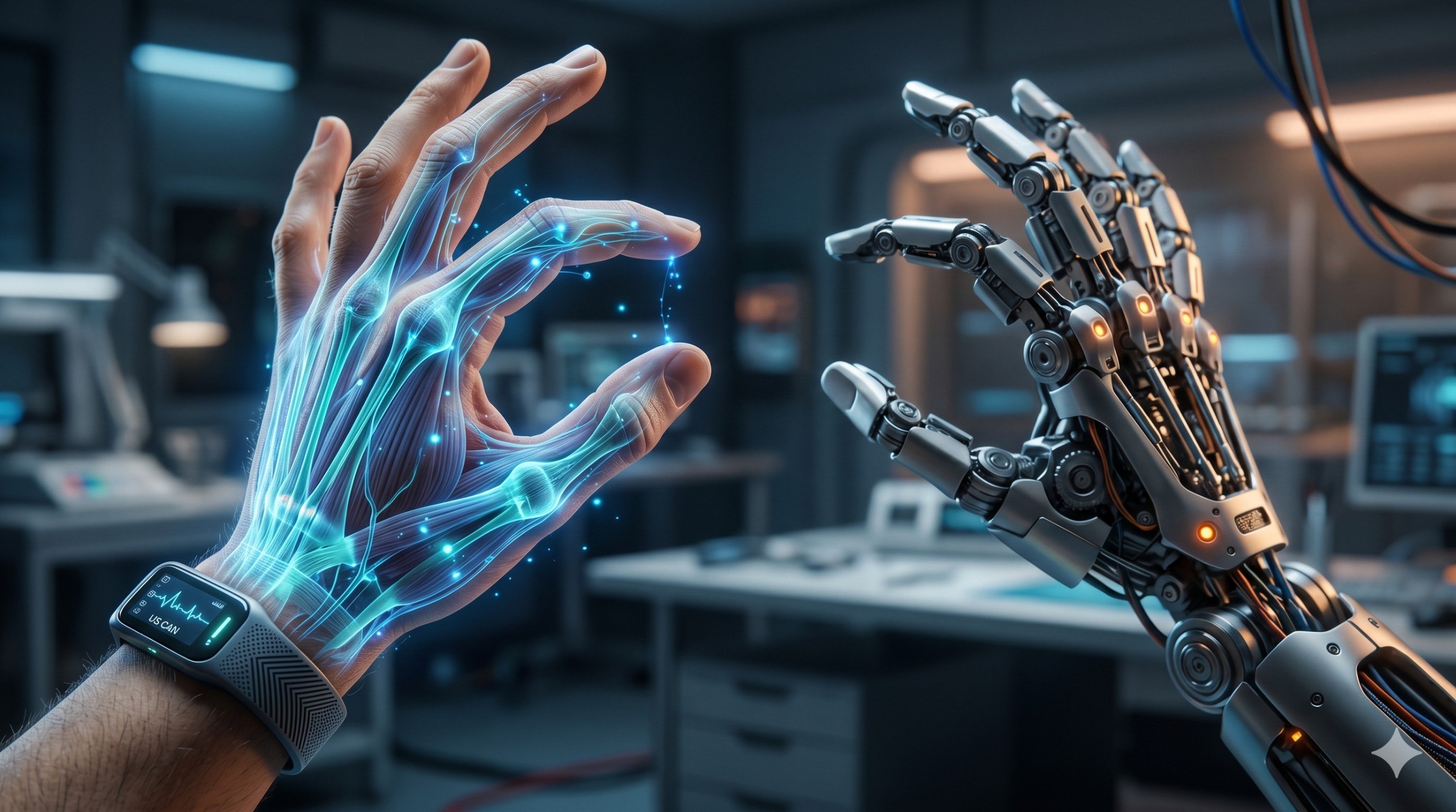
Humanoid robots are learning to walk, carry, and even flip—but picking up a cup without crushing it remains one of their most difficult challenges. In June 2026, a team of researchers at the Massachusetts Institute of Technology unveiled a technology that could fundamentally change this: an ultrasound-based wearable wristband that captures the subtle movements of muscles, tendons, and ligaments beneath the wearer's skin, and converts this data into training signals for robotic hands.
Led by Professor Xuanhe Zhao of MIT's Department of Mechanical Engineering, this development represents a critical inflection point in robot dexterity research. Unlike traditional sim-to-real transfer learning, this approach captures real-world motion data directly from human physiological signals, fundamentally bypassing the inherent physical accuracy limitations of simulated environments.
How Ultrasound Sees Through Skin
The wristband's core technology is based on miniaturized and repurposed medical ultrasound imaging. Traditional ultrasound equipment requires large probes and conductive gel, but the MIT team's version integrates an ultrasound transducer array into a wearable wristband that continuously captures muscle and tendon movements inside the forearm without gel or special preparation.
High-frequency sound waves penetrate the skin and are reflected differently by tissues of varying density and elasticity. The wristband captures hundreds of cross-sectional frames per second, which are then fed into a trained AI algorithm that decodes the images into what engineers call "degrees of freedom"—the specific ways a joint can bend or rotate. The human hand has 22 of these.
In earlier systems, tracking even a fraction of these movements was a significant challenge. The MIT system can simultaneously monitor all 22 degrees of freedom and complete the full loop from ultrasound capture to robot action execution within 120 milliseconds.
Key Performance Metrics
In laboratory demonstrations with eight volunteers, the team validated several key metrics:
| Metric | Value | Significance |
|---|---|---|
| Response latency | 120 ms | Within human natural reaction time |
| Gesture recognition | All 22 DoF | Full human hand range of motion |
| ASL recognition | All 26 letters | Validates fine motor capture |
| Transmission | Wireless | Controller and robot can be in different rooms |
| Sensing technology | High-frequency ultrasound | No gel or skin preparation needed |
Notably, the system successfully recognized all 26 letters of American Sign Language—not merely a showcase but a rigorous validation of fine motor capture capability. Each ASL letter involves different finger configurations and palm orientations, with some letters differing by the subtlest thumb positioning (such as 'M' and 'N').
From Teleoperation to Data Infrastructure
The MIT team envisions two complementary application paths for this technology.
Near-term: Teleoperation. The wristband's wireless capability means a wearer in New York could control a robot in Tokyo with precise hand motion mapping over standard network connections. This has immediate practical value for robot operation in hazardous environments—nuclear facility maintenance, deep-sea exploration. Surgeons could even perform remote procedures, though this would require stricter latency and reliability guarantees.
Long-term: Human Motion Datasets. This is the more transformative direction. The team envisions systematically collecting hand motion data from large numbers of human volunteers performing everyday and specialized tasks—cooking, typing, sewing, surgery, musical instrument performance—and using this data to train robots to autonomously perform these tasks without human guidance.
The scale of this vision is staggering. The hand's 22 degrees of freedom mean that covering the complete motion space for basic actions like "pick up an egg," "unscrew a bottle cap," and "thread a needle" requires millions of training samples. The unique advantage of MIT's approach is that it can acquire this data in natural environments, at very low cost, from ordinary people going about their daily activities—without requiring carefully staged data collection sessions in elaborate laboratory settings.
The Dexterity Gap: Robotics' Hidden Bottleneck
Robot dexterity—especially fine hand manipulation—has long been the most underestimated challenge in robotics. The public and investors focus on whether humanoids can walk, carry, and maintain balance, rarely recognizing that using fingertips to sense material properties, modulate grip force, and execute fine manipulation is orders of magnitude harder than gross motor control.
The current state of humanoid robotics:
-
Gross motor control is approaching practicality: Tesla Optimus walks on factory floors; Boston Dynamics Atlas completes parkour courses; Unitree's robots perform flips. These achievements show that large-muscle skills are advancing rapidly.
-
Hand dexterity remains years behind: A 2025-2026 industry survey showed that even the most advanced humanoids have reached only the level of a human toddler in fine hand manipulation. Most robotic hands still employ a "force solves everything" strategy—either gripping too tightly and crushing objects, or too loosely and dropping them.
-
Training data is the core bottleneck: Unlike large language models that can scrape trillions of tokens from the internet, robot motion data—especially fine hand motion data—is extremely expensive to acquire. Every set of high-quality robot manipulation data requires manual programming by engineers or expensive motion-capture equipment.
The value of MIT's wristband lies precisely in addressing this data bottleneck. If the breakthrough in large language models came from "internet-scale text data," then the breakthrough in robot dexterity may require "human-scale motion data." MIT's ultrasound wristband could be the key tool for achieving this scale leap.
Observatory Analysis: Data Infrastructure Will Determine Long-Term Competitiveness
While every humanoid robot company competes on hardware specifications—torque, degrees of freedom, battery life—POC.HK believes the competition that will truly determine the long-term industry landscape will center on a more fundamental asset: motion data.
This closely parallels the development logic of the AI large language model industry. After GPT-3's release, many companies could obtain similar language capabilities through API calls, but the real differentiator was access to unique training data and user feedback loops. Similarly, as humanoid robot hardware platforms converge (NVIDIA Jetson Thor compute, standardized joint modules, solid-state batteries), data—especially high-quality fine motion data—will become the scarcest strategic resource.
If MIT's technology successfully commercializes, it could give rise to an entirely new data market: platforms for the collection, annotation, and trading of human motion data. This would have profound implications for robotics companies, automation equipment manufacturers, and even the gaming and animation industries.
The question remains whether this technology can transition from lab to product. Comfort for prolonged wear, durability under daily use, and accuracy across different body types and skin tones all need validation at larger scale. But in terms of direction, the MIT team has chosen to address the most overlooked yet potentially most strategically valuable problem in robotics—and that itself is a signal worth noting.
Disclaimer: This article is for informational purposes only and does not constitute investment advice or business decisions. Data and time-sensitive information are current as of the publication date and may change. Neither the author nor POC.HK assumes any liability for losses arising from the use of this information.