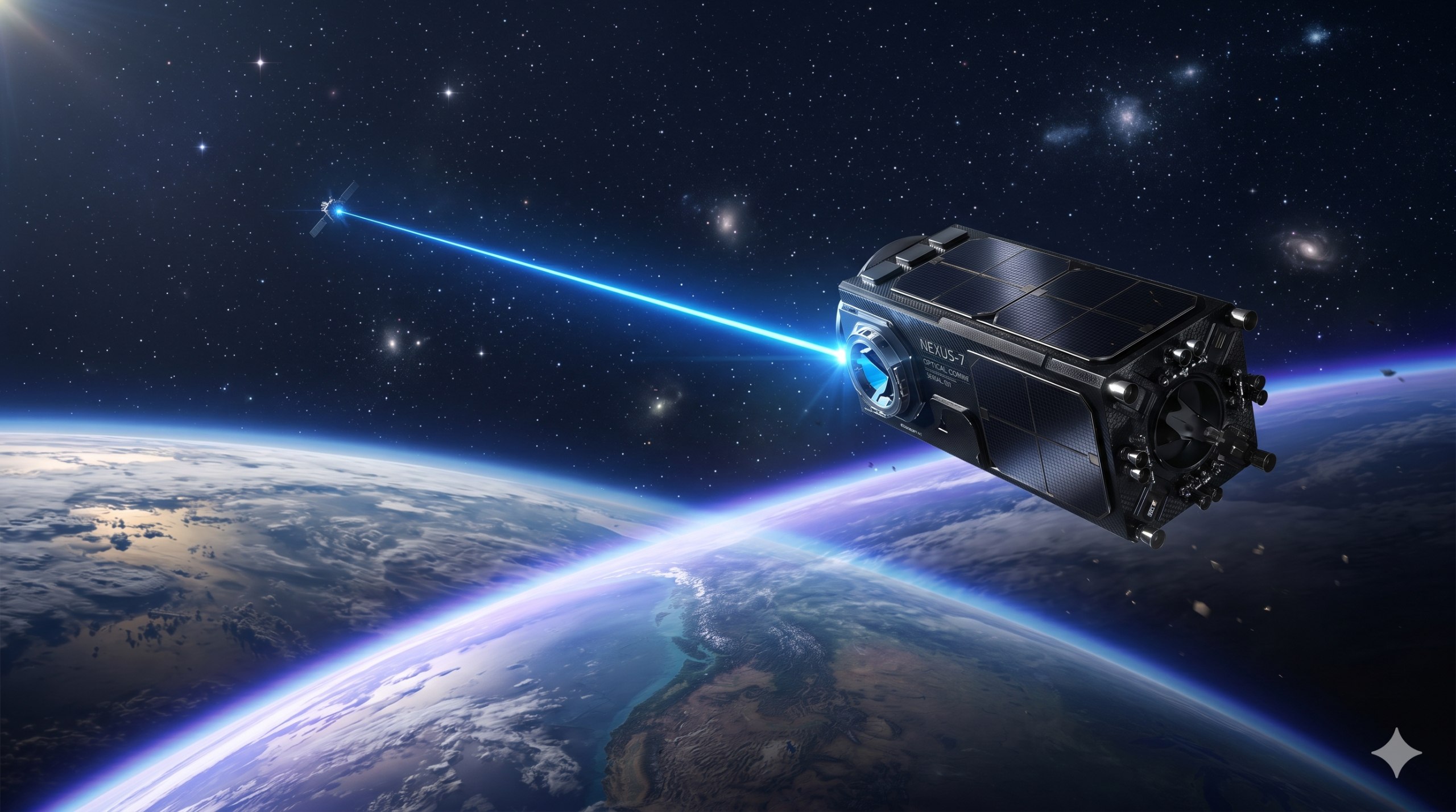
In June 2026, Irish space optical communications technology company MBRYONICS announced a landmark breakthrough: the successful development of the world's first bidirectional coherent optical transceiver supporting 25G to 800G — STARLIGHT. This space-optimised optical transceiver marks a qualitative shift in inter-satellite communications from traditional radio-frequency links to quantum-level optical links, providing unprecedented bandwidth capabilities for low Earth orbit (LEO) satellite constellations, orbital AI data centres, and deep-space exploration missions.
Technical Core: Space-Grade Coherent Optical Communications
The core innovation of STARLIGHT lies in the first complete移植 of coherent optical technology, mature in terrestrial fibre networks, to the space environment. Traditional satellite communications rely on radio frequency (RF) links, whose bandwidth is constrained by spectrum allocation and physical frequency ceilings. The theoretical maximum data rate in the Ka band (26-40 GHz) is on the order of tens of Gbps, but in practice, due to power limitations and interference, routine operation only achieves a few Gbps. STARLIGHT uses coherent optical communications in the 1550 nm band, exploiting the phase, amplitude, and polarisation states of light waves for multi-dimensional modulation, achieving scalable data rates from 25G to 800G on a single wavelength.
The key advantage of coherent detection technology lies in its receiver sensitivity. Compared with traditional intensity modulation direct detection (IM/DD), coherent detection uses a local oscillator to amplify the signal, offering a 10-20 dB improvement in sensitivity. This is especially important in the space environment — laser links between satellites must overcome free-space losses over thousands of kilometres, atmospheric turbulence (in ground-station scenarios), and vibration interference from satellite platforms.
MBRYONICS has achieved the following key technological milestones with STARLIGHT:
Bi-Directional Coherent Architecture: Traditional optical communication terminals require two separate optical paths for transmission and reception. STARLIGHT handles bidirectional signals on a single optical path simultaneously, reducing terminal volume and mass by approximately 40%, which is critical for the limited payload space on satellite platforms.
25-800G Rate-Adaptive Modulation: Supports adaptive rate adjustment from 25 Gbps to 800 Gbps, dynamically switching modulation formats (BPSK, QPSK, 16QAM) according to link conditions — maintaining link stability under adverse conditions and pushing peak bandwidth when conditions are favourable.
Space-Grade Packaging: Fully hardened for the radiation environment of LEO to GEO orbits, extreme temperature cycling (-40 C to +85 C), and vacuum outgassing.
Market Drivers: From Satellite Constellations to Orbital AI Data Centres
The launch timing of STARLIGHT aligns closely with the explosive growth of space infrastructure. The total number of planned LEO satellites worldwide now exceeds 560,000, with communications constellations like Starlink generating petabytes of data daily. Existing RF links struggle to support data backhaul at this scale, particularly for inter-satellite links (ISL) that need to route data within the constellation without passing through ground stations.
An even more forward-looking application scenario is orbital AI data centres. Several companies (including Muon Space and Lumen Orbit) are planning to deploy GPU-equipped satellite platforms in LEO for on-orbit edge inference and data processing. These platforms require massive transfer of training data and inference results between satellites and between satellites and the ground, making 800G-class optical links a critical enabling technology.
As MBRYONICS' CEO noted during the launch: 'When a remote-sensing satellite generates terabytes of image data daily, traditional RF links take hours to complete the downlink. STARLIGHT can accomplish the same task in minutes, with lower power consumption and without regulatory spectrum constraints.'
Competitive Landscape and Industry Impact
Space optical communications is in a period of vigorous growth. Competitors include Tesat-Spacecom (Germany, acquired by Mynaric), SA Photonics (USA, acquired by CACI), BridgeComm (USA), and Sony's laser communications division in Japan. MBRYONICS differentiates itself through its fully proprietary coherent optical technology architecture, as opposed to the IM/DD approach commonly adopted by other vendors.
From a technology roadmap perspective, coherent optics hold fundamental advantages over IM/DD in terms of sensitivity and spectral efficiency, particularly in scenarios requiring long-distance (>1,000 km) inter-satellite links. However, coherent optical technology is more complex, with stricter requirements for laser linewidth, phase noise, and DSP processing capability. Whether MBRYONICS can maintain its performance and cost advantages in volume production will determine its market share.
Notably, STARLIGHT's 25G entry rate already covers the data requirements of the vast majority of currently operational satellites, while its 800G peak rate provides ample headroom for next-generation ultra-high-resolution remote-sensing satellites and orbital AI platforms. This forward-compatible design approach helps reduce upgrade risk for operators.
Observatory Analysis
Space optical communications is undergoing a critical transition from 'experimental technology' to 'commercial infrastructure'. MBRYONICS' STARLIGHT represents the technology maturity inflection point in this transition — when a hardware company can offer a complete product portfolio from 25G to 800G in a single package, it signals that the supply chain and manufacturing processes have reached commercial scale.
From a supply-chain perspective, the core components of space optical communications (narrow-linewidth lasers, high-speed modulators, coherent DSP chips) have long relied on the industrial base of terrestrial fibre networks. MBRYONICS' breakthrough demonstrates that space-grade hardening of telecom-grade optical components is a viable route, and this will attract more telecom optics suppliers into the space market, creating a positive feedback loop.
Within the broader framework of the orbital economy, data bandwidth is the most fundamental infrastructure. Just as the construction of fibre backbone networks in the internet era gave rise to the cloud computing and streaming media industries, the widespread adoption of space optical communications will directly drive the commercialisation of emerging applications such as on-orbit computing, space AI, and real-time remote sensing. Products like STARLIGHT move these applications from theory to engineering feasibility.
Key points to watch over the next 12-18 months include: STARLIGHT's on-orbit validation results, the customer category of the first commercial order (communications constellation operators versus defence customers), and whether the unit cost of coherent solutions can drop to competitive levels with IM/DD as production scales.
Technology Route Comparison: Coherent Optics vs Intensity Modulation Direct Detection
To understand the significance of STARLIGHT, it is necessary to compare the two main technology routes in space optical communications:
IM/DD (Intensity Modulation Direct Detection): This is the approach used by most current space laser communication terminals (including NASA's LCRD and JAXA's LUCAS). IM/DD transmits data by modulating the intensity of the laser, and the receiver uses a photodiode to directly detect the optical power. Advantages include simple structure, low power consumption, and lower cost; disadvantages include limited receiver sensitivity (typically around -30 dBm), low spectral efficiency (1 bit per symbol), and significant performance degradation over long distances.
Coherent Detection: Uses a local oscillator laser to mix with the received signal, amplifying the signal amplitude before digital signal processing. Sensitivity can reach -45 dBm to -50 dBm, 15-20 dB higher than IM/DD. Spectral efficiency can reach 4-8 bit/s/Hz (using QPSK or 16QAM modulation). Disadvantages include high system complexity, requiring narrow-linewidth lasers (<100 KHz), high-speed ADCs/DACs, and powerful DSP engines.
For LEO inter-satellite links (distance 500-5,000 km), IM/DD solutions require excessively large optical apertures (>15 cm) at rates above 100 Gbps, imposing unfeasible demands on satellite platform volume and pointing accuracy. Coherent solutions can achieve equivalent rates with 5-10 cm apertures, which is critical for small satellites (100-500 kg class).
Supply Chain and Cost Analysis
In the cost structure of space optical communication terminals, the optical subsystem (including lasers, modulators, and optical amplifiers) accounts for 40-50% of total cost; the precision pointing, acquisition, and tracking (PAT) subsystem accounts for 25-30%; DSP electronics account for 15-20%; and the remainder goes to packaging and testing.
MBRYONICS has chosen to partner with multiple terrestrial optical communications component suppliers, screening and hardening their COTS (commercial off-the-shelf) components for use in space products. This strategy contrasts with the approach of Tesat/Mynaric, which designs space-specific optical components from scratch. The former benefits from a mature supply chain and steep cost-reduction curves; the latter offers higher reliability (designed for the space environment from the outset).
From an economic scale perspective, once annual production of satellite terminals exceeds 1,000 units, the unit cost of COTS-based solutions is expected to fall to $50,000-$80,000, while bespoke designs may remain at $150,000-$200,000. Given that the total number of LEO satellites could reach tens of thousands over the next decade, cost competitiveness will become a decisive factor in technology route selection.
Standardisation and Interoperability
Another critical challenge facing space optical communications is standardisation. The CCSDS (Consultative Committee for Space Data Systems) is currently developing physical-layer standards for space optical communications (CCSDS 141.0-B), but interoperability requirements for coherent modulation formats are not yet fully covered. Whether optical terminals from different vendors can communicate with each other in orbit will determine constellation operators' supply-chain flexibility and redundancy capabilities.
MBRYONICS has stated that STARLIGHT supports CCSDS and OIF (Optical Internetworking Forum) coherent optical standards, enabling direct interconnection with terrestrial optical network equipment. This allows satellites to connect to the global optical backbone network as nodes in the fibre network, without the need for dedicated gateway conversion equipment.
Disclaimer: This article is for informational purposes only and does not constitute investment advice. Data and timestamps are accurate as of the publication date and may change with subsequent developments. Neither the author nor POC.HK assumes any liability for losses arising from the use of this information.