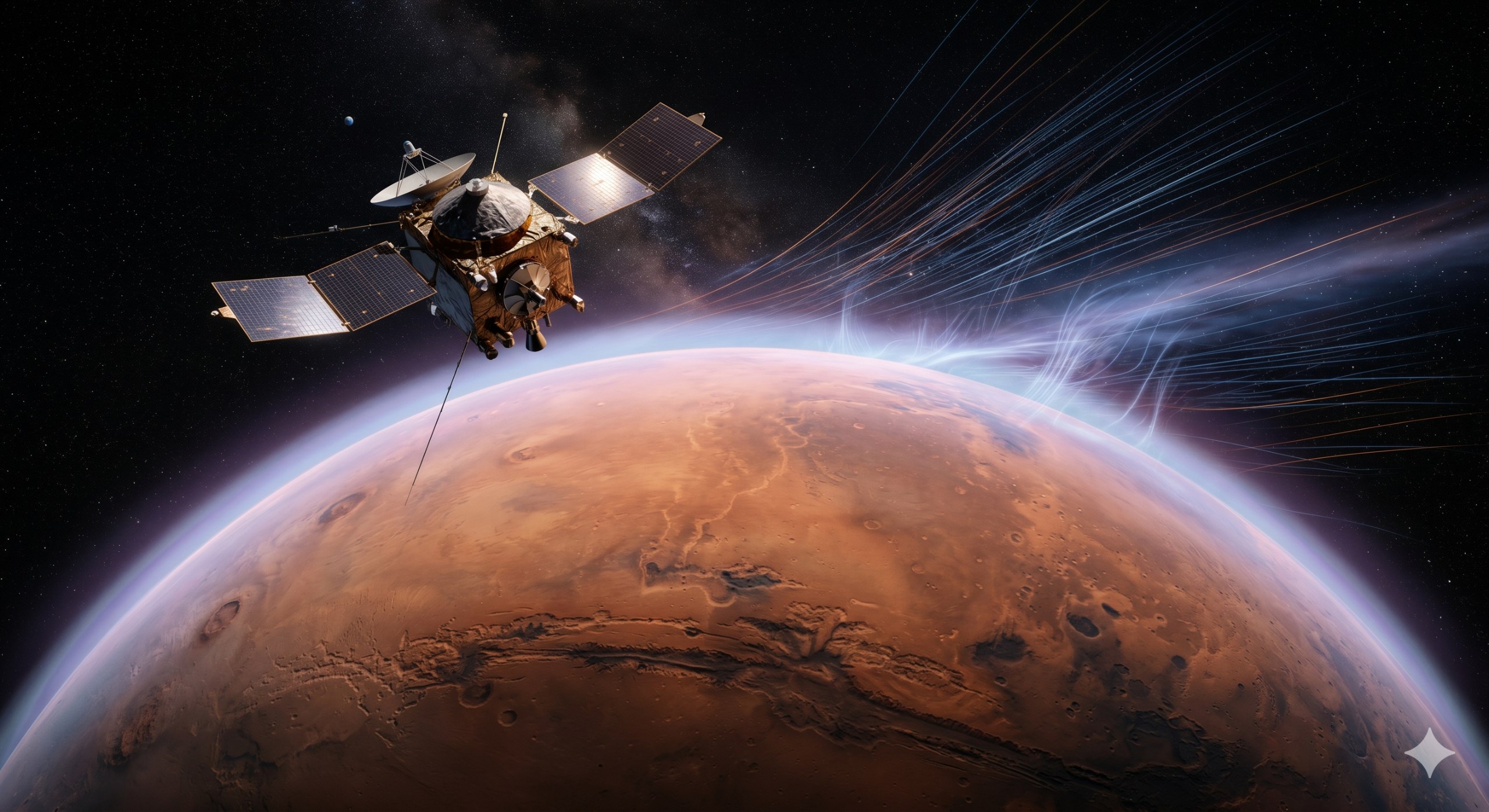
After Six Months of Silence, NASA Declares End to MAVEN Mars Mission: Final Chapter for an Atmospheric Pioneer
2026-06-04 — NASA formally declared the end of the Mars Atmosphere and Volatile EvolutioN (MAVEN) mission this week. The spacecraft, which had operated in Mars orbit for over 11 years, went silent in late 2025. After six months of exhaustive recovery attempts, the agency was unable to re-establish contact. NASA has stated that the investigation into the cause of the spacecraft's communication loss remains ongoing.
MAVEN was not only one of the longest-serving science missions in NASA's Mars exploration history, but it also reshaped humanity's understanding of Mars' climatic evolution through its critical data. Its end marks both a significant loss for planetary science and the close of an era.
MAVEN's Mission: Decoding the Mystery of Mars' Vanished Atmosphere
MAVEN — Mars Atmosphere and Volatile EvolutioN — launched on November 18, 2013, aboard an Atlas V rocket from Cape Canaveral, and successfully entered Mars orbit on September 22, 2014. Its primary scientific goal was tightly focused: to study the Martian upper atmosphere, ionosphere, and their interaction with the solar wind, in order to explain how Mars transformed from an ancient warm, wet planet into the cold, arid desert world it is today.
This question had puzzled planetary scientists for decades. Mars' surface is covered with ancient river channels, deltas, and lakebed sediments, evidence that 4 billion years ago it possessed a thick atmosphere and liquid water oceans. Yet today, Mars' atmospheric pressure is only about 0.6% of Earth's, and liquid water cannot stably exist on the surface. Where did the atmosphere go? This was the core question MAVEN was built to answer.
Key Technology: An Instrument Suite Tailored for Atmospheric Science
MAVEN carried 8 scientific instruments across three core measurement domains:
Particles and Fields Package:
- Solar Wind Electron Analyzer (SWEA): Measures the energy and distribution of electrons in the solar wind
- Solar Wind Ion Analyzer (SWIA): Measures the velocity and temperature of solar wind ions
- Magnetometer (MAG): Precisely measures the magnetic field around Mars
- Suprathermal and Thermal Ion Composition (STATIC): Measures the mass, energy, and velocity of escaping ions
- Solar Energetic Particle instrument (SEP): Monitors the impact of solar flare activity on the Martian atmosphere
- Langmuir Probe and Waves (LPW): Measures ionospheric electron density and temperature
Remote Sensing Package:
- Imaging Ultraviolet Spectrograph (IUVS): Observes the distribution and variation of upper atmosphere constituents
- Neutral Gas and Ion Mass Spectrometer (NGIMS): Precisely measures the chemical composition of atmospheric neutral gases and ions
This combination of instruments allowed MAVEN to establish a complete causal chain of Martian atmospheric loss from three perspectives simultaneously: the "source" (solar wind), the "medium" (magnetic field and particle interactions), and the "result" (atmospheric composition and escape rates).
A Decade of Scientific Legacy: MAVEN's Five Landmark Contributions
1. Confirming Solar Wind Erosion as the Primary Atmospheric Loss Mechanism
MAVEN's most significant discovery came early in its mission. In 2015, the mission team directly measured how the magnetic field carried by the solar wind interacts with the Martian atmosphere, creating an "induced magnetosphere" and accelerating atmospheric ions beyond Mars' escape velocity. Data clearly showed that the interaction between the solar wind and Mars' outer atmosphere strips away approximately 100 to 300 metric tons of atmospheric material every hour.
More importantly, MAVEN observed that Solar Energetic Particle Events (SEPs) could increase escape rates by 10 to 100 times. This finding provided key mechanistic evidence for how a young, active Sun could have rapidly drained Mars' atmosphere — 4 billion years ago, the solar wind was far more intense than today, and Mars' atmosphere was stripped away quickly in its first few hundred million years, triggering a collapse of the greenhouse effect and the freezing or evaporation of its oceans.
2. Mapping Mars' Three-Dimensional Atmospheric Structure and Seasonal Variations
MAVEN's IUVS instrument produced the first three-dimensional distribution maps of oxygen, hydrogen, carbon, and nitrogen in Mars' upper atmosphere, and recorded systematic changes in atmospheric composition with the Martian seasons. Atmospheric escape rates slow significantly at aphelion and increase dramatically at perihelion, a seasonal cycle that repeats every Martian year.
The mission also found that the ratio of hydrogen isotopes (deuterium-to-hydrogen ratio, D/H) in Mars' atmosphere is about 6 times higher than Earth's — a key fossil indicator that large amounts of hydrogen (the lighter isotope) have escaped to space, leaving behind heavier deuterium. Based on this data, Mars has lost at least 80% of its original atmosphere over its history.
3. Capturing the Atmospheric Effects of the 2018 Global Dust Storm
From June to October 2018, Mars experienced its largest global dust storm since 2007 — the same storm that ended the Opportunity rover's mission. MAVEN recorded an unprecedented phenomenon at the top of the atmosphere: The dust storm heated Mars' middle and lower atmosphere, causing it to expand and push more water vapor to higher altitudes, where it was stripped away by the solar wind.
Data showed that during the dust storm, hydrogen abundance in Mars' upper atmosphere surged by 50%, and water escape rates increased more than 10-fold. This discovery revealed the link between short-term extreme atmospheric events and long-term climate evolution — each major dust storm accelerates the loss of Mars' atmosphere to space.
4. Charting the Dynamic Map of Mars' Induced Magnetosphere and Ionosphere
Unlike Earth, which has a global dipole magnetic field, Mars lacks an intrinsic magnetic field and only possesses localized crustal remanent magnetization (primarily in the southern hemisphere). MAVEN's MAG and LPW instruments mapped in detail the structure of the "induced magnetosphere" created by the interaction between the solar wind and the Martian atmosphere, revealing it to be highly dynamic and asymmetric, closely tied to solar wind pressure.
This magnetic field map is crucial for understanding the space physics of Mars' upper atmosphere, and also provides baseline data for assessing the radiation environment for future human Mars missions — because the strength of the induced magnetosphere directly affects the flux of galactic cosmic rays and solar protons reaching the Martian surface.
5. Long-Term Communications Relay Service for Surface Missions
Beyond its scientific observations, MAVEN served a low-profile but vital role: a communications relay station. As one of the few satellites in Mars orbit equipped with UHF relay equipment, MAVEN — alongside the Mars Reconnaissance Orbiter (MRO) and Mars Odyssey — transmitted vast amounts of scientific data from surface missions including Spirit, Opportunity, Curiosity, InSight, and Perseverance.
Curiosity and Perseverance in particular generated hundreds of megabits of scientific data daily; without orbital relay stations, downlink speeds would have been excruciatingly slow. MAVEN's UHF system operated stably, suffering virtually no major interruptions during its 11 years of service — which is precisely why NASA devoted unusually extensive resources to re-establishing contact when it suddenly went silent in late 2025.
The Silence: Six Months of Lost Contact
According to NASA internal sources and SpaceNews reports, MAVEN transmitted normal engineering and science data during its last routine communication in early December 2025. However, during the subsequent scheduled communications window, the Deep Space Network (DSN) was unable to detect its signal.
Initial assessments pointed to two possibilities: (1) an attitude control system failure causing the antenna to misalign with Earth, or (2) a power system anomaly putting the spacecraft into safe mode or a power-off state. NASA initiated standard recovery procedures: sending restart commands through the DSN, switching to backup radio systems, and trying different frequency and power combinations. Each test was spaced days to weeks apart, accounting for the 4 to 24 minutes of signal delay between Mars and Earth.
Over six months, the NASA team executed more than 50 recovery attempts, utilizing the antenna arrays of all three DSN sites worldwide (Goldstone, California; Madrid, Spain; and Canberra, Australia). A weak carrier signal suspected to be from MAVEN was briefly detected at one point, but a stable link could not be established — it was ultimately confirmed to have originated from another Mars spacecraft, a false positive.
In late May 2026, NASA formally convened a mission termination review board. The conclusion: the probability of successfully re-establishing contact had fallen below an acceptable threshold. On June 3, NASA's Science Mission Directorate approved the mission termination resolution.
Notably, NASA emphasized that "the investigation into the specific cause of the spacecraft's communication loss is still ongoing." Since MAVEN's engineering data recorder may have stored the final state before failure, if contact is unexpectedly restored in the future, this data would be extremely valuable. For now, however, the spacecraft has been declared in an unrecoverable silent state.
Mission Timeline
| Date | Event |
|---|---|
| November 18, 2013 | Atlas V 401 rocket launches from Cape Canaveral |
| September 22, 2014 | Successful Mars orbit insertion (orbit capture maneuver) |
| November 2014 | Primary science mission begins (original design life: 1 Earth year) |
| November 2015 | First mission extension (Extended Mission 1) |
| June–October 2018 | Global dust storm observations reveal accelerated atmospheric escape |
| 2019–2021 | Multiple orbit adjustments to optimize science observations and communications relay |
| September 2022 | Celebrates 8 years in Mars orbit, completing over 5,000 orbits |
| Early December 2025 | Final successful communication |
| December 2025 – May 2026 | Loss of signal; over 50 failed recovery attempts |
| June 3–4, 2026 | NASA formally declares mission end |
(Note: The mission received five or more science mission extensions, with cumulative funding of approximately $110 million — far below the original development cost of $670 million, making it one of NASA's most cost-effective planetary missions.)
Impact on the Mars Science Ecosystem
MAVEN's end produces direct consequences on three levels:
Scientific Observation: MAVEN was the only orbital mission dedicated to studying Mars' upper atmosphere dynamics. Its loss means a break in the continuous monitoring of atmospheric escape, induced magnetosphere dynamics, and solar wind interactions. While MRO carries some atmospheric sensing capability, its CRISM spectrometer ceased operations in 2018, and the MCS climate sounder's functionality has degraded over time. In the near term, Mars atmospheric science faces a critical data gap — especially as Mars approaches perihelion in late 2026, which would have been the optimal window for observing peak atmospheric escape.
Communications Relay: MAVEN transmitted approximately tens of gigabits of surface mission data annually. Its departure will increase the communications load on MRO and Odyssey. While NASA's next-generation Mars orbital relay satellites (including ESA's TGO) can partially fill the gap, there remains a shortfall in scheduling flexibility and total data volume. NASA's Mars Exploration Program deputy director has publicly stated that the agency is evaluating whether to adjust MRO's relay slot allocations.
Mission Design: The findings from the investigation into MAVEN's communication failure will directly influence the engineering design of NASA's next-generation Mars missions — including the "Mars Orbiters for Surface-Atmosphere-Space Coupling Study" (MOSAICS), scheduled for launch in 2028. If the cause points to a specific subsystem (such as battery aging, attitude control, or radiation damage), future redundancy designs and component selections will be adjusted accordingly.
Future Mars Atmosphere Exploration Missions
The scientific questions MAVEN leaves behind will not sit idle. Currently known follow-up mission plans include:
- MOSAICS (NASA, target 2028): A next-generation Mars atmospheric science satellite focused on studying the vertical coupling processes of Mars' atmosphere from the surface to space. It will carry higher-sensitivity mass spectrometers and next-generation imaging spectrographs with resolution and coverage surpassing MAVEN.
- Mars Orbiter Mission 2 / MOM-2 (ISRO, target 2027–2028): India's second Mars orbiter, which in addition to testing orbital insertion and communications technology, plans to carry atmospheric observation payloads.
- EscaPADE (NASA / UC Berkeley, target 2028–2029): A twin-satellite Mars atmosphere and magnetosphere mission that will use simultaneous dual-point observations to resolve the three-dimensional dynamics of solar wind-Mars atmosphere coupling. This mission has undergone multiple schedule adjustments and has become an important demonstration of NASA's small planetary missions.
- Tianwen-3 Mars Sample Return (China, target ~2030): While its primary goal is rock and soil sampling, its supplementary atmospheric composition measurements may help fill data gaps in the middle and lower atmosphere.
However, most of these missions are still in development, and the earliest a new dedicated atmospheric science satellite will enter Mars orbit is 2028. This means Mars atmospheric science will face at least two years of "data drought."
Reflection: The Endgame Philosophy of Long-Lived Planetary Missions
MAVEN was originally designed for a single Earth year (about 668 Martian sols). It ultimately operated for more than 11 years — 11 times its expected lifespan. This is not uncommon among planetary probes: Mars Odyssey (arrived 2001) has served over 25 years, and MRO (arrived 2006) is approaching its 20th year. But the longer a mission endures, the more complex its end becomes.
MAVEN's end also raises a question worth considering: Has NASA adequately prepared for "unexpected" mission terminations? The six months between the loss of signal in late 2025 and the formal declaration in June 2026 represent NASA's commitment to "still having a chance," but they also reflect a lack of universal contingency protocols in the planetary communications architecture. If a primary communications relay satellite fails, the data return capability of Mars surface missions faces cascading consequences. This is the engineering management legacy MAVEN leaves to NASA.
Summary: An Era's End
MAVEN's story is, at its core, a brilliant chapter in humanity's quest to unravel the mystery of Mars' climate. From confirming the solar wind erosion mechanism to capturing dust storm effects, from building atmospheric escape models to serving the fleet of surface rovers, it traded an initial investment of $670 million and 11 years of extended service for humanity's deepest understanding of Mars' climatic evolution.
Its end was silent — no impact on the Martian surface, no final images, only the faint radio waves long since dissipated in the Deep Space Network. But its scientific legacy will continue to shape the design of every future Mars probe, every Martian atmosphere model, and every scientist who contemplates why a planet becomes — or ceases to be — habitable.
The Martian wind still blows across dry riverbeds and dusty plains. MAVEN can no longer hear those winds. But humanity's gaze upon the Red Planet is only just beginning to deepen.