Lunar Communications Infrastructure: From Deep Space Network to Lunar Internet
In May 2026, NASA officially announced signing a contract worth approximately $6.4 billion with the "Lunar Communications Alliance" comprised of SpaceX and Blue Origin to deploy and operate a lunar orbital communications constellation called LunarLink. This infrastructure project, dubbed the "Lunar Internet," will fundamentally change how humanity interacts with the Moon — transitioning from the current model of "independent point-to-point communications per mission" to a networked communications model of "continuous coverage, high bandwidth, and multi-user."
Why Does the Moon Need a Dedicated Communications Network?
Current lunar mission communications rely on NASA's Deep Space Network (DSN), a global antenna array comprising three ground stations (Goldstone, California; Madrid, Spain; and Canberra, Australia). DSN is designed for deep space missions, with antennas up to 70 meters in diameter, but bandwidth is extremely limited — at lunar distances, typical data transmission rates are only hundreds of Kbps to a few Mbps, far below Earth internet bandwidth.
As the Artemis program advances, the number of users on the lunar surface will increase from zero (no crewed missions currently) to 4 permanent residents by 2028, and then to 8 to 12 by 2035. Scientific instruments, rovers, drilling equipment, and monitoring cameras will also be deployed in large numbers. A simulation estimate indicates that a fully operational lunar base camp requires daily data transmission of approximately 5 to 10 TB — including high-resolution video, scientific data, and real-time life support system monitoring. DSN's existing capacity is completely inadequate for this demand.
LunarLink Architecture Design
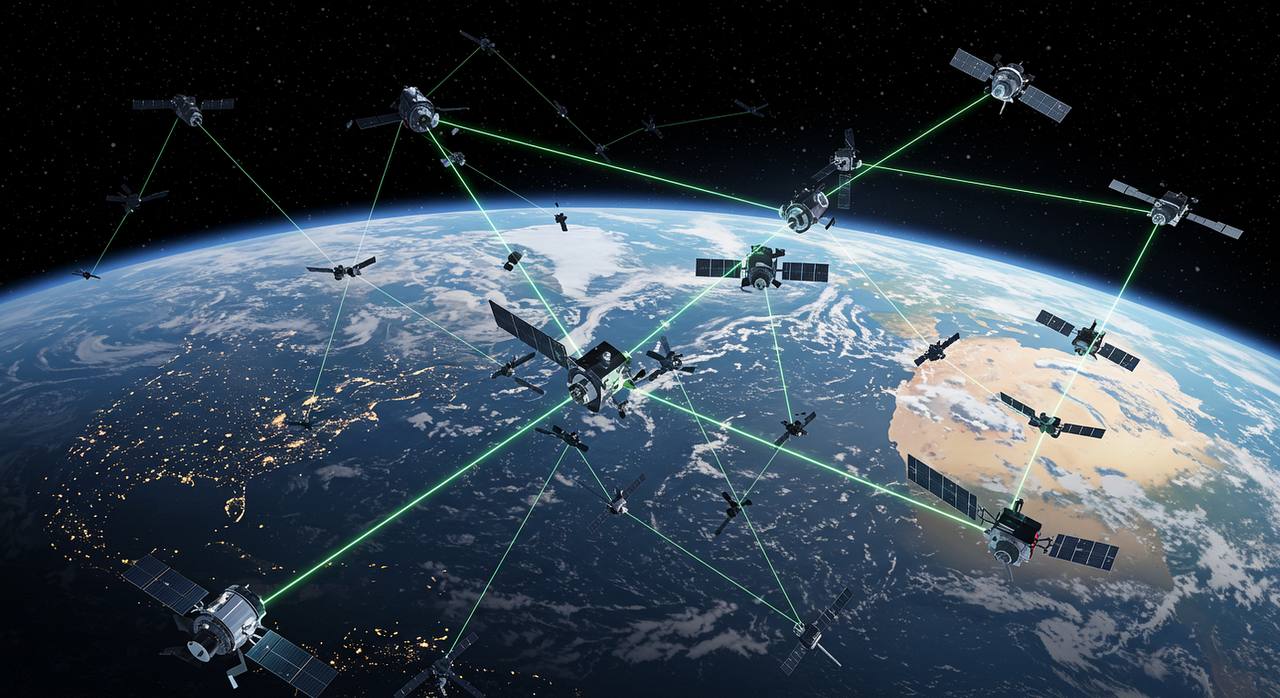
The LunarLink constellation consists of 18 small satellites distributed across two orbital layers. The outer layer comprises 12 satellites operating in Near-Rectilinear Halo Orbit (NRHO) — the same orbit as the Gateway lunar space station — providing continuous coverage of the lunar northern hemisphere and a constant Earth link. The inner layer comprises 6 satellites operating in Low Lunar Orbit (LLO) at approximately 100 km altitude, providing high-bandwidth coverage of the lunar south pole region (where the Artemis base camp is located).
The entire constellation uses laser communications links for inter-satellite connectivity. Inter-satellite laser link rates are designed for 10 Gbps per link, connecting the 18 satellites in a ring-plus-star topology. Earth links use Ka-band (approximately 26 to 40 GHz) radio communications, with a per-satellite downlink bandwidth of 1.5 Gbps. User terminals on the lunar surface connect to LunarLink satellites via S-band or optical terminals.
Key performance metrics of the system include: continuous coverage of 99.5% at any lunar surface location (99.99% in base camp areas), maximum data transfer rate of 1 Gbps, and lunar-to-Earth latency within 100 milliseconds (comparable to Earth satellite internet latency). Compared to current DSN-provided lunar mission communications performance — typical bandwidth of 2 Mbps and latency of about 1.2 seconds — LunarLink will increase bandwidth by 500 times and reduce latency by 12 times.
Technical Challenges and Solutions
Deploying a communications constellation around the Moon faces three unique challenges not encountered by Earth communications systems. The first is thermal management: lunar orbiting satellites experience extreme temperature cycles from 120°C to -170°C approximately every 2 hours. LunarLink satellites' thermal control system employs variable-emissivity radiators and phase-change thermal storage materials to keep electronics operating within a safe range of 5°C to 40°C.
The second challenge is autonomous satellite navigation. In lunar orbit, Earth GPS signals are nearly undetectable (extremely weak due to distance). LunarLink satellites employ a novel space-based autonomous navigation scheme: using inter-satellite laser ranging and lunar gravity models to achieve centimeter-level relative positioning and meter-level absolute positioning without continuous ground control station intervention.
The third challenge is lunar dust's impact on ground terminals. Lunar regolith carries electrostatic charges and adheres to optical surfaces and antennas. Communications terminals at the Artemis base camp are equipped with electrostatic dust-clearing membranes — transparent conductive coatings that apply a slight voltage to repel charged dust particles via electric fields. This technology achieved 99% dust-clearing efficiency in 2025 lunar environment simulation tests.
From Communications to a Complete Ecosystem
LunarLink is not merely a communications system — it will also host lunar navigation and positioning services. The satellite constellation will broadcast GPS-like navigation signals, enabling real-time positioning for rovers and astronauts on the lunar surface. Initial positioning accuracy is approximately 5 to 10 meters, which can be improved to within 1 meter through differential correction techniques.
The U.S. Space Force has also shown keen interest in LunarLink's military applications. Situational awareness of the Moon and cislunar space is considered a critical component of future space operations. In December 2025, USSF released a "Cislunar Space Operations Concept" document, explicitly identifying communications and navigation infrastructure as key elements of "space domain awareness." LunarLink constellation design includes optical sensors for space debris monitoring and catalog management, potentially providing USSF with cislunar space traffic management data.
Observatory Analysis
From an infrastructure economics perspective, the investment return logic for a lunar communications network is similar to satellite internet on Earth: the upfront infrastructure investment is enormous ($6.4 billion), but once built, it dramatically reduces operational costs for all subsequent lunar missions. According to NASA's internal estimates, after LunarLink enters service, communications-related costs for a single Artemis mission would drop from approximately $12 million to about $2 million — a savings of approximately 83%.
Another trend worth monitoring is the emergence of commercial lunar communications services. Beyond LunarLink, at least three private companies — including American Aquarian Space and Japan's ispace — have announced their own lunar communications satellite plans. Aquarian Space's "MoonLink" plans to deploy a small constellation of 4 satellites in 2028, primarily serving commercial lunar missions. If these commercial systems can interconnect with LunarLink, it would form a multi-layered, multi-vendor "lunar network ecosystem" similar to Earth's internet.
Looking Ahead
Over the next five years, lunar communications will transition from "luxury" to "infrastructure." The first 4 LunarLink satellites — two NRHO and two LLO satellites — are scheduled for launch via Falcon Heavy in the third quarter of 2027, reaching Initial Operating Capability (IOC) by the end of 2028. Full constellation deployment is expected between 2029 and 2030, at which point the Moon will have a true broadband internet connection.
This will open a new era of lunar applications: remotely operated lunar rovers can be controlled from Earth with 100 ms latency; scientific data from lunar bases can be transmitted in real time to research teams on Earth; and even — 4K video live streaming from the Moon will become possible. The Moon will no longer be an isolated scientific outpost but a natural extension of Earth's internet. This is not just the construction of communications infrastructure, but humanity's first step toward establishing an information ecosystem on another celestial body.
Disclaimer: This article is written by POC.HK Future Technology Observatory based on publicly available information and independent analysis. The technical parameters, contract amounts, and timelines mentioned are from NASA public disclosures and related contractor announcements; actual deployment may be adjusted due to technical and funding factors.