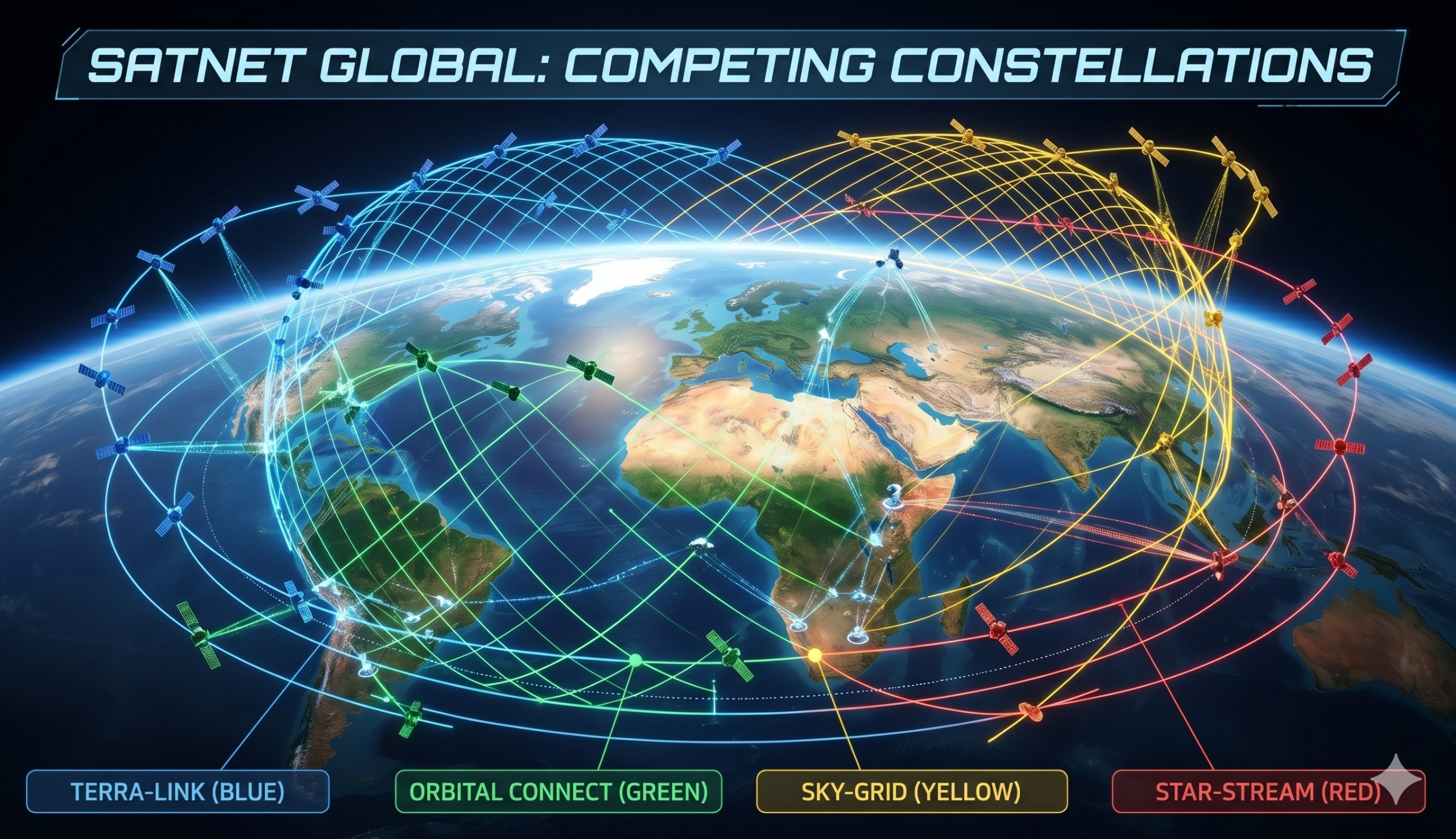
Kuiper vs Starlink: The Full-Frontal Showdown in Satellite Broadband
Amazon's Project Kuiper finally transitioned from the testing phase to large-scale production deployment in the second half of 2025, with the first batch of production satellites launched into their intended orbits via New Glenn and Atlas V. This milestone not only marks a significant step in Amazon's space strategy but also signals that the satellite broadband market has formally moved beyond Starlink's sole dominance into a true two-player competitive era. Yet how significant is the gap between them, and how will this competition reshape the global communications industry?
Deployment Progress and Launch Capability
This is currently the most lopsided dimension between the two. Starlink has launched over 6,500 satellites, with approximately 5,800 operational, forming a stable and redundant mesh network. Leveraging the mature reuse technology of Falcon 9, SpaceX can complete a dedicated launch mission every 3-4 days, deploying 40-60 V2 Mini satellites per mission. With Starship entering production — capable of deploying 100+ V3 satellites per launch — Starlink's deployment ceiling has been pushed even higher.
In contrast, Kuiper has deployed only about 500 satellites as of mid-2026, still a vast distance from its planned 3,236-satellite constellation. More critically, Amazon depends entirely on external launch providers: Blue Origin's New Glenn is still in early commercial operations with unstable launch frequency; ULA's Atlas V is nearing retirement, and the certification and production pace of Vulcan Centaur have fallen short of expectations. This leaves Kuiper's deployment timeline facing considerable uncertainty.
Technical Architecture and Terminal Costs
In satellite design, Kuiper possesses a late-mover advantage. Its satellites' Ka-band communications system and advanced phased-array antenna offer slightly superior spectral efficiency and beam scheduling compared to Starlink's V2 Mini design. Kuiper's terminal antenna cost is controlled within $400, well below Starlink's early terminal cost of $2,500 and even below the current standard terminal price of $599.
But Starlink has not stood still. Its V3 satellites are expected to introduce full-mesh laser link topology, further reducing end-to-end latency and supporting higher per-user bandwidth ratios. At the terminal level, Starlink has launched high-gain flat-panel antennas and large dish antennas targeting fixed broadband and enterprise applications respectively, with product diversity still superior to Kuiper.
Business Model and Ecosystem
Kuiper's core competitiveness lies in the AWS cloud ecosystem. For customers requiring large-scale satellite data processing — such as natural resource monitoring, disaster response, and remote industrial IoT — Kuiper can provide one-stop service from data transmission to cloud computing. This "satellite plus cloud" bundling strategy creates a high switching-cost moat in enterprise and government markets.
Starlink, by contrast, wins through scale effects and brand recognition. The consumer market is Starlink's stronghold, with over 3 million users providing sustained cash flow and the network effects of global coverage. Moreover, Starlink's deployments in aviation (JSX, Hawaiian Airlines, etc.), maritime (Maersk, MSC), and defense (U.S. Department of Defense Starshield contract) demonstrate its evolution from a consumer broadband provider into a comprehensive communications infrastructure company.
Observatory Analysis
At a strategic level, the Starlink-Kuiper competition is fundamentally a contest between "first-mover speed" and "late-mover ecosystem." What Starlink has built over the past five years is not a technology barrier — since Kuiper could theoretically replicate or surpass it — but rather a timing barrier, a compliance barrier, and a brand barrier. Starlink has obtained landing rights in over 100 countries and accumulated extensive regulatory compliance experience that will take latecomers years to match.
Kuiper's financial strength should not be underestimated. Amazon has committed $10 billion in investment and has the capacity to sustain long-term losses. This contrasts with the pressure on Starlink to prove its business model viable through revenue. In other words, Kuiper can fight a protracted war, while Starlink needs to achieve a leap in user scale during its first-mover advantage window to establish sufficient pricing power.
Looking Ahead
The next two years will be decisive for the satellite broadband landscape. Projected trajectory: in 2026-2027, Kuiper will accelerate deployment to over 1,500 satellites, achieving initial commercial service capability and capturing enterprise customers with pricing 20-30% below Starlink. Starlink will expand consumer market coverage density through V3 satellite deployment and full rollout of Direct to Cell services. Monthly subscription fees in the consumer market for both are expected to fall below $50 by 2028, pushing global satellite broadband users past 20 million.
Longer term, the market may not be zero-sum. The demand for satellite broadband is large enough (approximately 3 billion people globally still lack stable broadband connectivity), and after Starlink and Kuiper respectively focus on consumer and enterprise markets, they may actually form a symbiotic relationship. The real threat comes from the flanks: China's GW constellation's low-price strategy in Asian-African-Latin American markets, and traditional telecom carriers' accelerated deployment of 5G Non-Terrestrial Network (NTN) standards — these are the true long-term competitors for both.
Regulatory and Spectrum Battleground
Another front between Starlink and Kuiper is spectrum resources and national landing permits. The FCC has approved Starlink's use of the 2 GHz band for mobile satellite services, while Kuiper is seeking shared authorization for nearby bands. At the international level, the ITU's spectrum coordination mechanism faces unprecedented pressure — two U.S. companies compete globally for orbital slots and frequency priority, while China's GW also files claims in the same bands. This three-way spectrum contest will reach a critical juncture at the 2027 ITU World Radiocommunication Conference, where outcomes may directly determine each constellation's actual usable bandwidth.