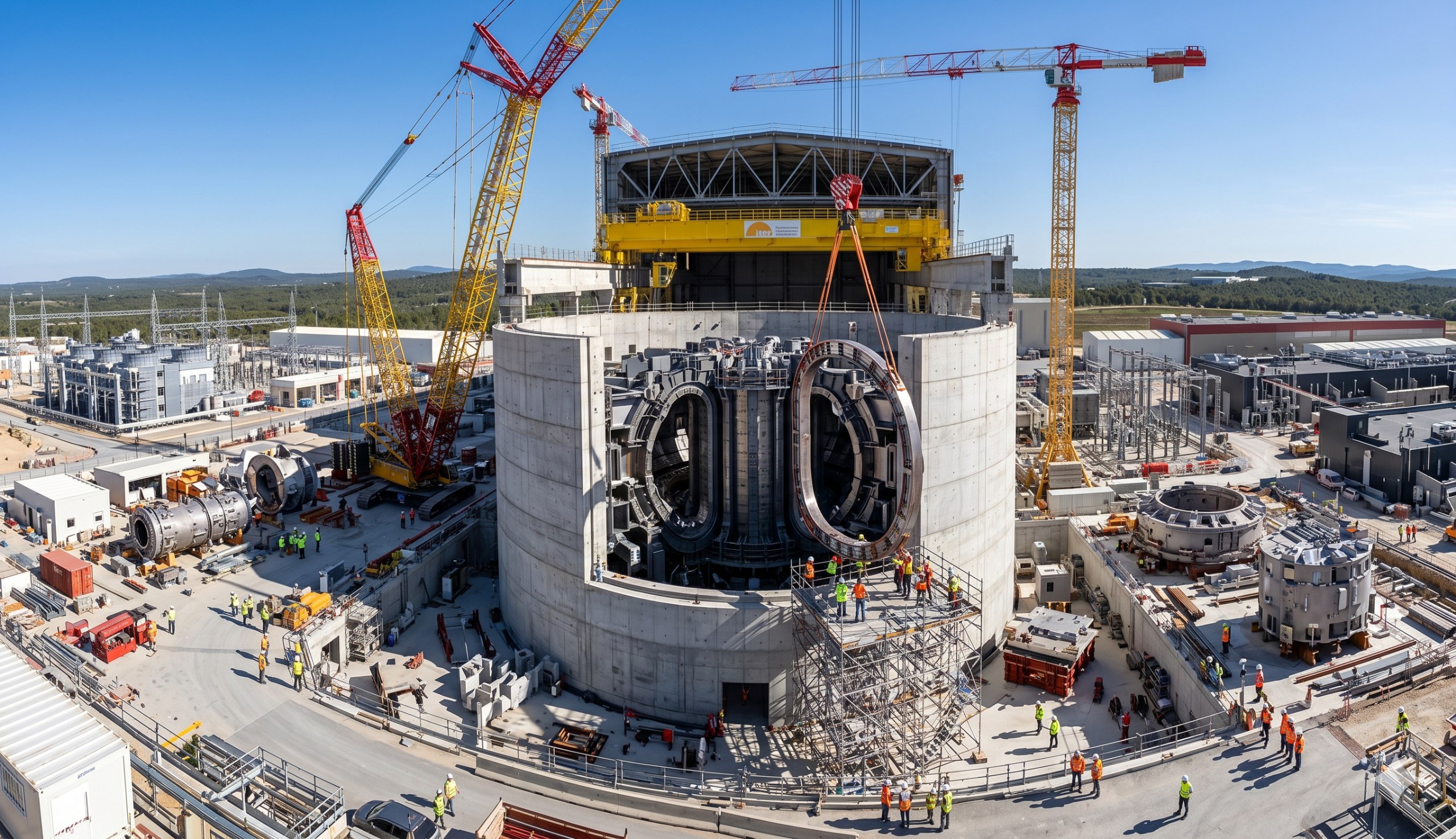
ITER Project Delayed Again
In 2026, the ITER organization officially announced the latest round of project timeline adjustments: the first plasma target has been pushed back to 2033, and full-power operation delayed to after 2040. This marks the sixth major delay in ITER's history, with cumulative construction costs soaring from an initial €5 billion to over €25 billion. The project dubbed "the most complex scientific project in history" faces unprecedented scrutiny.
ITER Project Delayed Again
In 2026, the ITER organization officially announced the latest round of project timeline adjustments: the first plasma target has been pushed back to 2033, and full-power operation delayed to after 2040. This marks the sixth major delay in ITER's history, with cumulative construction costs soaring from an initial €5 billion to over €25 billion. The project dubbed "the most complex scientific project in history" faces unprecedented scrutiny.
Delay Details Breakdown
The specific impacts of this latest delay are as follows:
- First Plasma: Delayed from 2025 to 2033 (8-year delay)
- Deuterium-Tritium Operation: Delayed from 2035 to 2039
- Full-Power Operation: Delayed from 2038 to after 2040
- Total Construction Budget: From initial €5 billion to over €25 billion
The main reasons for the delay include:
1. COVID-19 Pandemic Impact: Lockdowns from 2020-2022 caused severe delays in critical component manufacturing, particularly on-site assembly work in southern France and manufacturing of key components by Russia, South Korea, and the European Union.
2. Supply Chain Disruptions: The Russia-Ukraine war has created uncertainty in the delivery of components committed by Russia. Although ITER officials state that Russia continues to participate, geopolitical risks have clearly increased.
3. Technical Complexity Issues: Core engineering problems such as vacuum vessel module welding quality control, first-wall materials, and the divertor cooling system have repeatedly revealed design flaws requiring rework.
4. Changing Regulatory Requirements: The French Nuclear Safety Authority (ASN) has continuously escalated nuclear safety requirements for ITER, adding substantial compliance costs and workload.
Cost Growth Trajectory
ITER's cost overruns have become the project's greatest risk factor:
| Year | Cumulative Estimated Cost | Major Event |
|---|---|---|
| 2006 (inception) | €5 billion | Initial estimate |
| 2010 | €15 billion | First major revision |
| 2016 | €20 billion | Second major revision |
| 2022 | €22 billion | COVID impact assessment |
| 2026 | €25 billion+ | Latest delay |
| Final (estimated) | €30-40 billion | Industry analyst projection |
It should be noted that ITER's cost-sharing mechanism makes each member country's actual expenditure difficult to calculate precisely — because many components are contributed as "in-kind contributions" rather than direct financial transfers. This means some countries' actual investments may be far higher than nominal budget figures.
Impact on Global Fusion Research
ITER's persistent delays have far-reaching ripple effects across the entire fusion ecosystem:
Impact on Government Routes: ITER delays directly affect subsequent DEMO fusion demonstration reactor plans. The DEMO designs of the EU, Japan, and China all depend on ITER operational data; ITER's delays mean these countries must also correspondingly postpone their commercialization timelines.
Impact on Private Routes: Ironically, ITER's delays objectively benefit private fusion companies. As the government route's progress continues to slip, privately funded compact solutions become relatively more attractive in terms of timing. Multiple industry insiders have stated that if ITER had progressed on schedule in the 2020s, the government route might have created a "ceiling effect" for private startups — but now the situation is reversed.
Impact on Talent Flow: ITER's repeated delays and budget overruns are accelerating the flow of plasma physicists from government projects to private companies. Over the past three years, the number of personnel moving from ITER and related institutions to private fusion companies has increased by approximately 150%.
Observatory Analysis
From the POC.HK observatory perspective, ITER's predicament reveals several deep structural problems:
Governance Structure Failure: ITER operates through 35-country cooperation, requiring consensus-based decision-making, resulting in extremely low management efficiency. From design changes to procurement decisions, every step requires multinational coordination. In contrast, private companies like CFS, facing similar technical complexity, operate with decision-making cycles several times shorter.
The Flaw of In-Kind Contribution Mechanisms: While the in-kind contribution model — where countries provide components rather than cash — alleviates financial pressure, it creates serious interface issues: components manufactured in different countries vary in dimensions and standards, frequently proving incompatible during on-site installation.
Conflict Between Target Scale and Engineering Complexity: ITER's design goal was to maximize scientific output without commercial pressure, leading to continuous design expansion. Every time new physics insights emerged, the design team added new diagnostic systems or safety redundancies. This "feature creep" stands in stark contrast to disciplined commercial project management.
Looking Ahead
ITER's future faces three possible scenarios:
Scenario One — Continued Progress (40% probability): Member countries continue to increase budgets, and the project gradually completes in the 2030s. However, this requires enormous political will — as national fiscal pressures mount, fusion projects may no longer be a priority.
Scenario Two — Substantial Reduction (35% probability): The project scope is significantly reduced, abandoning the full-power operation goal and refocusing on plasma physics research. This would downgrade ITER from an "engineering demonstration project" back to a "scientific experimental device."
Scenario Three — De Facto Termination (25% probability): Core member countries (especially the EU and US) reassess around 2030 and decide to redirect resources toward private fusion companies or new-generation compact government projects. In this scenario, ITER would exist "in name but stagnate in practice."
Whatever scenario unfolds, ITER's fate will be an important bellwether for the global fusion research landscape. But one thing is clear: the future of fusion is no longer determined by a single project. The diversification of fusion investment — from government megaprojects to private startups — has made the path to commercial fusion broader and more resilient than ever before.