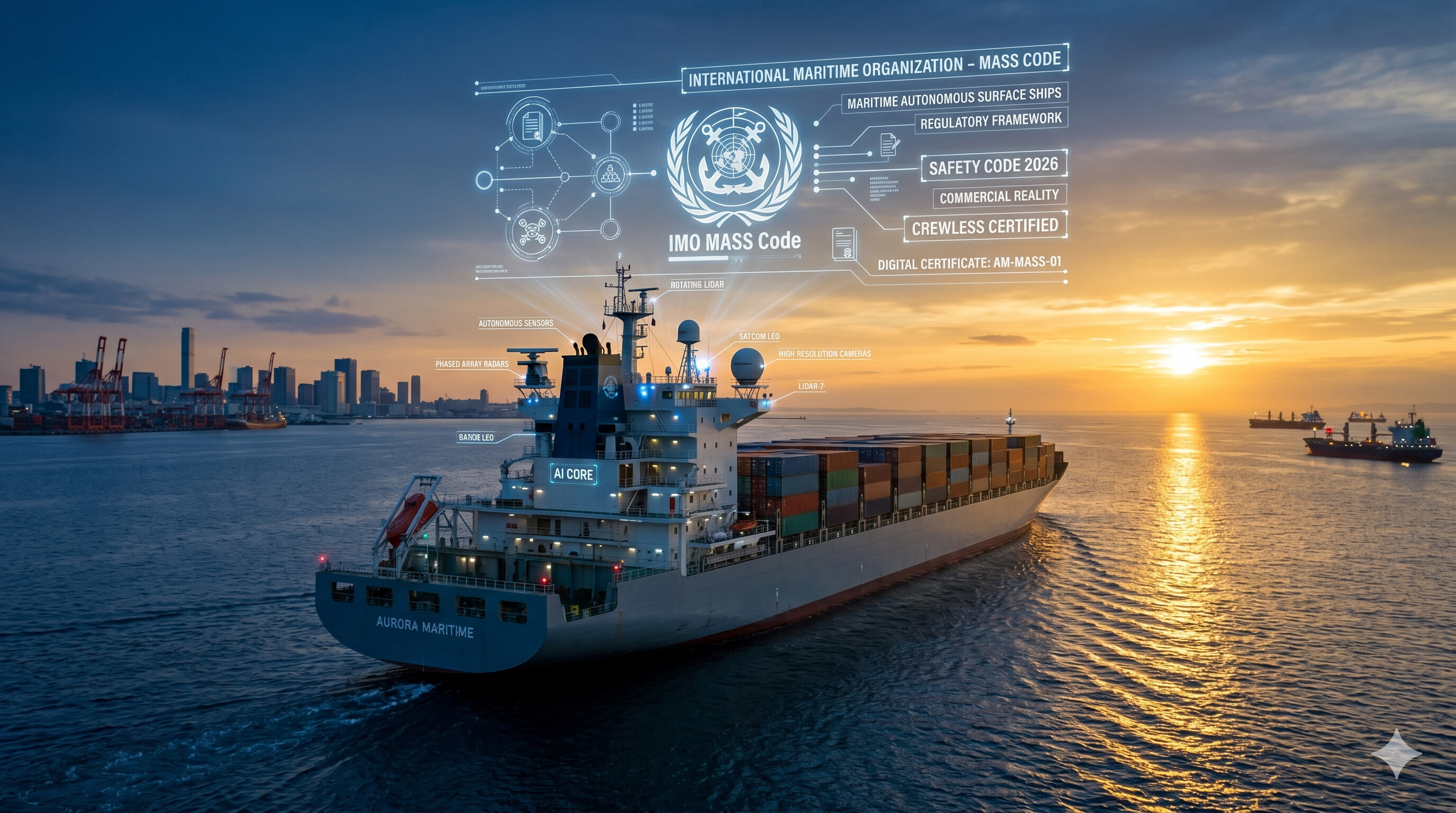
On July 1, 2026, the International Maritime Organization (IMO) first-ever International Code of Safety for Maritime Autonomous Surface Ships (MASS Code) will officially take effect. This non-mandatory regulatory framework, the product of nearly a decade of multilateral negotiations, legal groundwork, and at-sea trials, provides the first international framework for remotely operated and fully autonomous cargo ships.
This is not a routine regulatory update. The MASS Code marks the moment when the global shipping industry — which carries 90% of world trade by volume — formally enters the era of autonomous operations with a regulatory starting point. For an industry historically defined by its conservatism, regulatory clarity often matters more than technical maturity in determining the pace of transformation.
The Core Framework of the MASS Code
The MASS Code adopts a goal-based framework rather than traditional prescriptive standards. This means the code does not mandate specific technical solutions but sets safety, security, and environmental protection targets, leaving industry to determine how to meet them.
Key areas covered include:
Navigation and Operations. Autonomous ships must maintain situational awareness equivalent to that of conventional crews. This requires real-time sensor fusion from radar, optical cameras, AIS, and LIDAR, along with AI-driven collision avoidance decision systems.
Communications and Connectivity. Uninterrupted two-way communication links must be established between the Remote Operations Centre (ROC) and the vessel. The code specifies requirements for bandwidth, latency, redundancy, and cybersecurity — directly driving demand for satellite communications upgrades.
Fire Safety and Search and Rescue. Autonomous vessels must be equipped with automatic fire detection and suppression systems, along with remotely activatable search and rescue procedures. This fundamentally challenges traditional ship design and construction approaches.
Cybersecurity. The code elevates cybersecurity to a status equal to physical safety, requiring autonomous systems to defend against remote intrusion and ensure the vessel cannot be maliciously taken over under any circumstances.
Four Degrees of Autonomy
The IMO framework classifies autonomous ships into four degrees, which serve as a critical framework for understanding industry transformation:
Degree One: Automated processes and decision support. Seafarers remain on board, but some operations can be automated or unsupervised. Most modern commercial vessels already operate at this level.
Degree Two: Remotely controlled with seafarers on board. The ship can be controlled remotely, but crew remain onboard for emergency response. This is the stage of the most advanced current trials.
Degree Three: Remotely controlled without seafarers on board. The vessel is managed entirely from shore-based Remote Operations Centres with no personnel onboard. This is the true regulatory frontier for the MASS Code.
Degree Four: Fully autonomous. The ship can make decisions and take actions independently without any human intervention. This is the industry ultimate vision, though no commercial operations exist at this level yet.
The MASS Code primarily targets Degree Three and Degree Four cargo vessels. Its non-mandatory nature means member states can trial it voluntarily, and these trial experiences will inform the development of future mandatory rules.
Industry Status and Trial Projects
More than 30 autonomous shipping trial projects are currently underway globally. The most representative include:
Norway Yara Birkeland, the world first fully electric autonomous container vessel, has conducted extended autonomous navigation tests in the Oslo Fjord. Operational data suggests autonomous system performance in open water already rivals that of experienced crews.
Japan Meguri autonomous cargo vessel completed a long-distance autonomous voyage from Tokyo Port to Tsu City, covering approximately 800 km, demonstrating the ability to navigate safely through busy shipping lanes.
China Zhi Fei conducted autonomous berthing and unberthing tests at Qingdao Port, validating AI-driven precision maneuvering reliability in harbor environments.
However, these trials have also exposed the industry core obstacle: regulatory uncertainty. Before the MASS Code, autonomous vessel international operations existed in a legal gray area — they might comply with one country trial requirements but lacked commercial operating permits in others. The MASS Code eliminates this uncertainty.
Economic Analysis: Crew Cost vs Infrastructure Investment
Proponents of autonomous shipping typically emphasize crew cost savings — crew typically accounts for 30-40% of a cargo ship operating costs. A large container ship with 20-25 crew members costs approximately -3 million annually in crew expenses. Eliminating the crew entirely would save this cost.
However, this simplified calculation overlooks several critical factors.
First, Remote Operations Centres require new infrastructure investment. Each ROC needs advanced communications equipment, redundant connectivity links, and 24/7 professional operations teams. Broadband satellite communications costs — especially for remote routes — can be substantial.
Second, autonomous systems initial capital expenditure is significantly higher than conventional vessels. Autonomous ships require redundant sensor suites, high-performance onboard computers, AI decision systems, and multiple communication links. The development, certification, and maintenance costs of these systems must be amortized over years of operation.
Third, insurance cost structures change. Autonomous vessel risk profiles differ fundamentally from conventional ships — accident causes shift from human error to system failures and cyberattacks. Insurers need new actuarial models to price these risks, and transition period premiums may exceed those of conventional vessels.
Overall, the near-to-medium-term economic advantages of autonomous shipping may concentrate on specific route types: fixed routes, long distances, open waters, and low port complexity. For complex port operations and variable weather conditions, remote or autonomous operation advantages are less pronounced.
MASS Code Impact on Related Industries
The MASS Code generates a series of second-order effects:
Satellite communications is the most direct beneficiary. Autonomous ships require uninterrupted broadband connectivity, dramatically increasing per-vessel data consumption. Conventional vessels use 10-50 GB monthly, while autonomous vessel data requirements could reach terabyte levels. Starlink, OneWeb, and future LEO satellite communication networks become critical infrastructure.
Port infrastructure must be upgraded to accommodate autonomous vessels. Investment in automated terminals, intelligent berthing systems, and autonomous cargo handling equipment will accelerate. Major ports including Singapore, Rotterdam, and Shanghai have already begun planning autonomous-compatible facilities.
Cybersecurity faces new demand. An autonomous cargo vessel is essentially a 100-meter-long floating IoT device with a far larger attack surface than conventional ships. Cybersecurity solutions for vessel navigation systems, communication links, and ROCs will become standard requirements.
Marine insurance must fundamentally rethink risk models. Major insurers including Lloyd and Gard have begun developing autonomous vessel-specific policies, but data scarcity makes pricing challenging.
Forward Outlook
The MASS Code taking effect is a starting point rather than an终点. The IMO plans to re-establish a working group at MSC 112 in December 2026 to develop an Experience-Building Phase framework, paving the way for eventual mandatory MASS Code.
Based on current technical trajectories and regulatory trends, we can anticipate the following timeline:
2026-2028: Trial implementation period. A few pioneering nations (Norway, Japan, UK, China) conduct commercial trial operations under the MASS Code framework, primarily on short-sea and fixed routes.
2028-2032: Scale validation period. First-generation autonomous cargo vessels begin regular commercial service on major trade routes. Satellite communications and ROC infrastructure begin forming network effects.
2032 and beyond: Mandatory code takes effect. Based on trial experience, a mandatory MASS Code may take effect, driving widespread industry adoption.
Shipping autonomous transformation will not be as rapid as the automotive industry, given vessel service lives of 20-25 years and longer regulatory cycles. However, the MASS Code has established an irreversible direction — just as containerization transformed global trade in the 1960s, autonomy will fundamentally reshape 21st-century maritime transport economics.
Disclaimer: The information provided in this article is for reference only and does not constitute investment advice or business decision-making basis. Data and time information is current as of the publication date and may change with subsequent developments. Neither the author nor POC.HK assumes any responsibility for losses resulting from the use of this information.