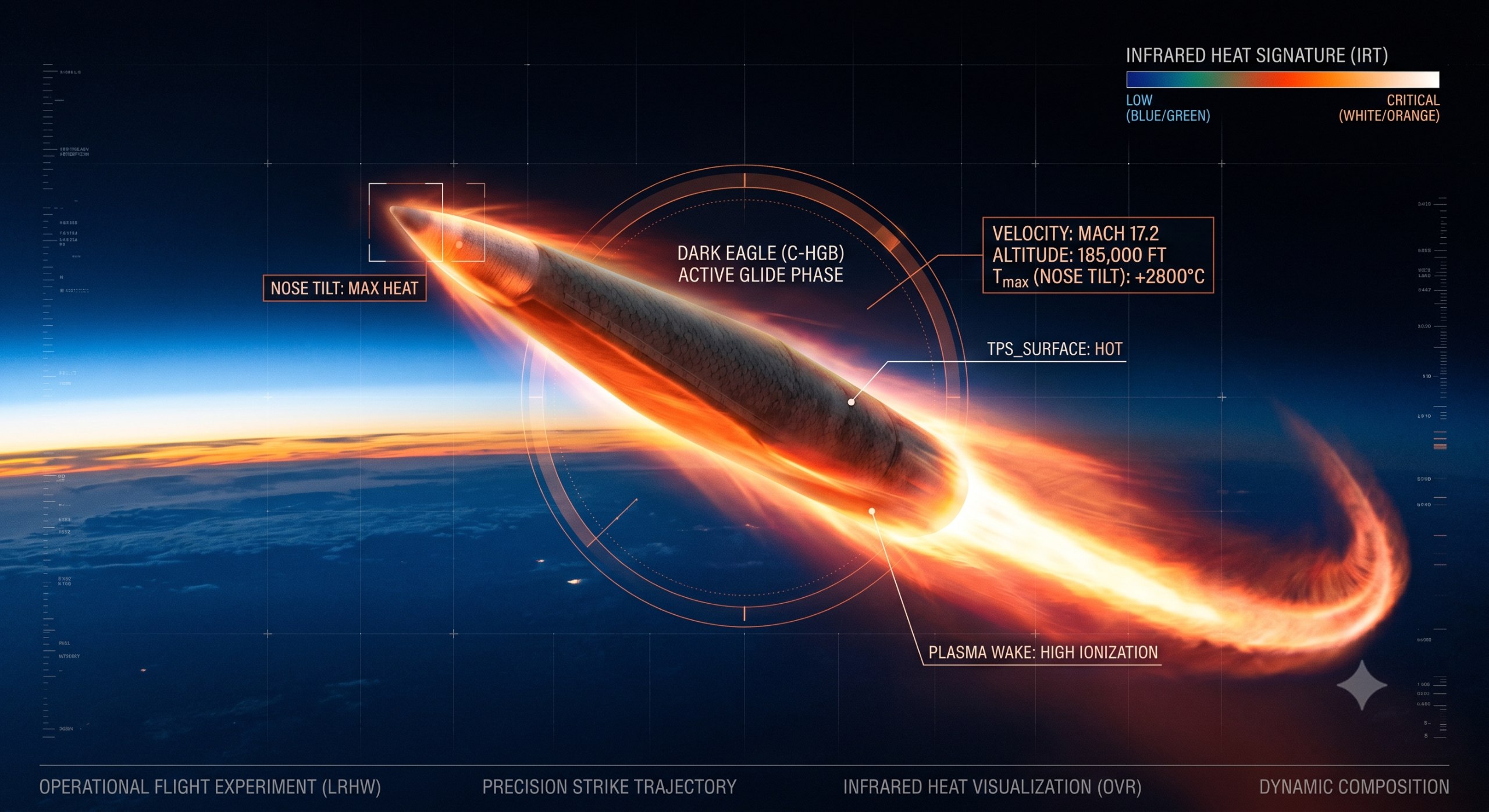
Hypersonic Weapons Go Operational: US Dark Eagle Successful Test, China's DF-17 Already Deployed
On June 1, 2026, the US Army successfully conducted the first operational test of the Long-Range Hypersonic Weapon (LRHW) "Dark Eagle" from Cape Canaveral, Florida. The missile flew over 2,800 km, reached a top speed of Mach 17, and impacted within 3 meters of its target. This test marks the transition of hypersonic weapons from technology validation to operational deployment -- a global hypersonic arms race is accelerating.
Dark Eagle: America's Ground-Based Hypersonic Strike Capability
Dark Eagle is a ground-based long-range hypersonic weapon system developed jointly by the US Army and Lockheed Martin. Unlike traditional ballistic missiles, Dark Eagle does not follow a predictable parabolic trajectory. Its key differentiator is the Hypersonic Glide Vehicle (HGV) -- accelerated to hypersonic speed by a rocket booster, it separates and glides at high speed in the upper atmosphere, using extreme maneuverability to evade existing missile defense systems.
Dark Eagle's key data:
- Range: Over 2,800 km (maximum range undisclosed, external estimates exceed 3,500 km)
- Speed: Mach 17 (approximately 21,000 km/h)
- Accuracy: CEP (Circular Error Probable) less than 3 meters (this test result)
- Altitude: Upper atmosphere (approximately 40-100 km)
- Vehicle Type: Common-Hypersonic Glide Body (C-HGB)
- Maneuverability: Capable of significant lateral maneuvers in flight, extremely difficult to intercept
The C-HGB is a joint Army, Navy, and Air Force glide vehicle design -- all future US hypersonic weapons will share the same HGV design, differing only in boosters. This commonality strategy aims to reduce development costs and accelerate deployment timelines. The Navy's Conventional Prompt Strike (CPS) is expected to complete shipboard testing by 2027, while the Air Force's AGM-183A ARRW, despite multiple test failures, has achieved success in its last three test flights.
Hypersonic Weapons Classification
Current global hypersonic weapons fall into two main categories:
Hypersonic Glide Vehicles (HGV): Such as Dark Eagle and China's DF-17. Boosted to high speed by a rocket, the glide vehicle is released for unpowered gliding in the upper atmosphere. Advantages include extreme maneuverability and unpredictable trajectories, making them almost impossible for current defense systems to intercept. The disadvantage is that speed gradually decays during the glide phase.
Hypersonic Cruise Missiles (HCM): Such as Russia's Zircon (3M22 Tsirkon). Using scramjet engines for powered flight throughout the trajectory, maintaining sustained speed and maneuverability. Advantages include full-flight maneuverability, but technical difficulty is higher (stable scramjet operation remains an engineering challenge).
| Weapon | Country | Type | Speed | Range | Status |
|---|---|---|---|---|---|
| Dark Eagle LRHW | US | HGV (Ground) | Mach 17 | >2,800 km | Operational test success |
| DF-17 | China | HGV (Ground) | Mach 5-10 | 1,800-2,500 km | Deployed (2019 parade) |
| DF-41 + HGV | China | HGV (Ground) | Mach 10+ | 12,000-15,000 km | Testing |
| Zircon | Russia | HCM (Naval) | Mach 5-8 | 1,000 km | Deployed |
| Kinzhal | Russia | Air-launched ballistic | Mach 10 | 2,000 km | Combat-tested |
| CPS / C-HGB | US | HGV (Naval) | Mach 17+ | >3,000 km | Shipboard testing |
China's Hypersonic Arsenal
China's hypersonic weapons development speed and deployment scale lead globally. The DF-17 was the world's first formally deployed hypersonic glide vehicle, publicly displayed at the 2019 National Day parade and now deployed in multiple PLA Rocket Force brigades.
China's hypersonic weapon sequence includes:
- DF-17: Medium-range hypersonic ballistic missile with waverider-designed HGV
- DF-41 + HGV: Intercontinental hypersonic glide vehicle -- mounting an HGV on the DF-41 ICBM for global reach
- YJ-21: Shipboard hypersonic anti-ship missile
- Xingkong-2 / DF-ZF: Experimental hypersonic vehicles in testing
Notably, China has invested heavily in hypersonic wind tunnel facilities. The JF-22 wind tunnel in Beijing can simulate flight conditions from Mach 10-25, making it one of the world's most advanced hypersonic test facilities. This infrastructure advantage provides China with sustained R&D superiority.
The Defense Dilemma: Challenges of Intercepting Hypersonic Weapons
Hypersonic weapons pose a fundamental challenge to existing missile defense systems. Traditional ballistic missiles follow predictable parabolic trajectories, allowing defense systems to calculate intercept points during midcourse and terminal phases. But HGVs' arbitrary maneuvering in the upper atmosphere means their flight path cannot be predicted -- intercept systems cannot calculate intercept points in advance.
Current hypersonic defense programs under development include:
-
US Glide Phase Interceptor (GPI): Developed by Raytheon, targeting interception during the HGV's glide phase (rather than terminal phase). This requires locking onto and tracking a maneuvering target within an extremely short decision window. Testing expected by 2030.
-
Space-Based Sensor Layer: SpaceX and L3Harris are building a low-Earth orbit satellite tracking constellation for the Space Development Agency (SDA), planning hundreds of satellites equipped with infrared sensors for global hypersonic target tracking.
-
Directed Energy Weapons: High-energy lasers and microwaves could theoretically intercept hypersonic targets at light speed. But current laser systems lack the power and range for reliable high-speed maneuvering target interception. The UK's DragonFire laser successfully downed a drone at 3.5 km range in late May testing -- but hypersonic interception remains distant.
-
Electronic Warfare Countermeasures: Disrupting HGV navigation and communication systems to cause target deviation. This non-kinetic approach, while not destroying the weapon, can prevent precision strikes.
Strategic Stability Erosion
Hypersonic weapons' impact on strategic stability may be more profound than their direct military capabilities. Because HGV flight behavior near the edge of the atmosphere makes early warning systems unable to distinguish ICBMs from HGVs -- this increases the risk of miscalculation. In a crisis, a detected HGV launch could be misinterpreted as the start of a nuclear strike, triggering a catastrophic chain reaction.
China's and Russia's hypersonic weapons development, to some extent, represents a response to US missile defense systems. When US missile defense deployments in Europe and Asia (such as THAAD and Aegis Ashore) undermine traditional ballistic missile deterrence, hypersonic weapons emerge as the technical solution to restore strategic penetration capability.
But this "response" is creating new instability. The US Dark Eagle and China's DF-17 increase the attractiveness of first strikes -- if you can destroy an opponent's key command and control nodes with un-interceptable weapons before they can react, the incentive for preemptive action grows significantly.
Outlook: International Order in the Hypersonic Age
The June 2026 Dark Eagle test confirms a reality: hypersonic weapons are no longer a future concept but current operational capability. The deployment of systems like Dark Eagle and DF-17 will profoundly shape future conflict dynamics.
Arms control circles are discussing bringing hypersonic weapons into new START-type or INF-type treaty frameworks -- but since these weapons' technical parameters are difficult to verify (small, mobile, no fixed silos), traditional satellite monitoring can barely track them. Technical unverifiability makes arms control negotiations nearly impossible.
In the foreseeable future, the hypersonic arms race will continue accelerating -- the US, China, Russia, Japan, France, India, and Australia are all developing their own hypersonic programs. The outcome of this race will not only determine the shape of future warfare but fundamentally redefine the logic of great power deterrence.